
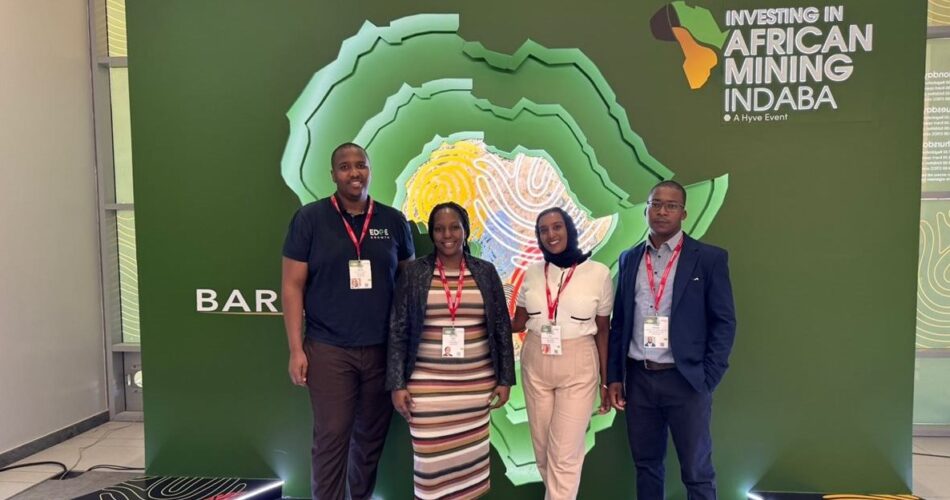
In his address at the 2026 Investing in African Mining Indaba in Cape Town recently, Mineral Resources Minister, Gwede Mantashe said the government is committed to creating a regulatory framework that attracts investment and ensures that the benefits of the country's mineral wealth are shared equitably with all South Africans.
However, clauses related to implementing Black Economic Empowerment (BEE) requirements in mining exploration were removed from the draft Mineral Resources Development Bill (MRDP).
Mantashe assured that this is not a “backing away from change” or an endorsement of the view that “black participation is a hindrance to economic development”.
Nabila Wally, Head of Business Development at Edge Growth, spoke business community About the role of black-owned SMEs in transforming South African mining.
Left to right: Fana Mnguni, Noluwo Nla, Nabila Valley and Tiani Masingo from Edge Growth at this year's Investing in Africa Mining Indaba. Image supplied.
Is it possible to reach BEE targets and promote investment opportunities within mining?
Yes, it is possible, but only if the change is considered strategic rather than accidental.
This year’s Investing in Africa Mining Indaba highlighted that partnerships between government, industry, communities and financing partners are vital to unlocking inclusive economic outcomes.
The theme of the event, “Stronger Together: Progress Through Partnerships”, reflects this reality: a complex agenda like transformation requires alignment among stakeholders, not isolated compliance.
From an investment perspective, transformative pipelines incorporating ESG principles, local partnerships and supplier development strengthen investor confidence, expanding capital flows into mining enterprises that demonstrate real socio-economic impact.
This means that BEE targets should be incorporated into investment readiness criteria, deal structures and project feasibility assessments.
Why is there so much opposition to the issue of change?
Pushback arises because change is often viewed as a cost or regulatory burden rather than a strategic growth driver.
Historical stressors include:
- Fear of increased costs and reduced competitiveness in a global market where margins are thin.
- Concern over capacity gaps, where locally empowered partners are not always operationally or financially prepared.
- Simplistic implementation models that focus on ownership percentage rather than actual economic participation.
- Misconceptions that change and competitiveness are mutually exclusive.
Indeed, this year’s Indaba messaging and industry discussions show that transformation and competitiveness must co-exist if mining is to sustainably support growth, jobs and investment, but this requires deliberate design, capacity-building and genuine partnerships rather than box-ticking.

#JoburgIndaba: Can mining development and transformation co-exist in South Africa?
Can mining development and transformation co-exist in South Africa?
Absolutely! The overarching theme of the Mining Indaba is that inclusive growth and transformation are mutually reinforcing, not contradictory.
Development creates opportunities for dynamic, scalable SME partnerships; Transformation ensures that the benefits of that growth reach historically disadvantaged groups.
However, co-existence depends on an integrated approach that aligns with business strategy, capital flows and operational realities rather than treating transformation programs as isolated policy add-ons.
When change is integrated into value chain expansion, procurement strategy, local manufacturing and investment models, both goals flourish together.
Should the draft Mineral Resources Development Bill (MRDP) contain BEE-related clauses specifically for mining exploration?
Yes, but with nuances. Exploration is not just an entry point; It is a pipeline to real industrial participation by black-owned companies.
Having BEE-related provisions in the MRDP can provide clarity and incentives early in the mining lifecycle, indicating that transformation begins at the early stages of value creation.
But mandates alone are insufficient; What's important is how those sections are designed:
- Must be practical (reflecting exploratory risk and capital cycles).
- Not just ownership percentage, but also capacity support should be included.
- Value creation, not just title transfer, should be encouraged.
Effective regulation must align transformation requirements with investment certainty so that the bill supports competitiveness as well as inclusion.

#MiningIndaba: Is South African mining ready for the skills of tomorrow?
Exploration is an entry point for Black-owned businesses; Enterprise and supplier development (ESD) is another. How can ESD serve as a growth engine for black-owned businesses in the mining supply chain?
ESD must be strategically structured, relevant and partnership-driven to function as a development engine.
Some key principles from current industry insights:
- A). Align ESD with actual operational demand. ESD should link SMEs to real procurement needs, not imaginary quotas. When SMMEs understand exactly what mines require – quality, time, standards – they can scale.
- Market engagement and procurement access,
- Business Coaching and Operational Upskilling,
- Quality assurance and standard readiness,
- Capital access in line with actual cash-flow demands.
- mining weekly Analysis shows that most ESD programs fail because they do not replicate actual operational readiness and they lack sequencing. Instead of increasing spending, design programs that reflect the practical realities of mining supply chains.
- The Mining Indaba emphasized organizational and value chain partnerships involving OEMs, local manufacturers, miners and financiers to bridge capacity gaps and unlock industrial co-development.
- Where mines share forward-order books with ESD recipients, SMEs can plan capacity expansion, capacity investment and workforce development more efficiently.
B). Get ahead with financial aid.
The most effective ESD programs combine:
C). Use partnerships and clusters
D). Take advantage of demand predictability

Teboho Makhabane of Sanlam Investments: African youth are the key to unlocking just energy transition
What is the key to strengthening ESD programs to help black-owned SMEs become scalable suppliers to mining houses?
There are some key elements that distinguish strong ESD programs from weak programs:
- A). Demand-led design Instead of supplier development driven by expenditure quotas, programs should be demand-led and co-designed with procurement teams in mining operations. When SMEs learn exactly what buyers want, they can optimize quality, delivery and compliance.
- Technical skills.
- quality standard.
- compliance.
- Business Management.
- financial literacy. Without capacity upgrading, even funded SMEs fail to maintain supply contracts.
- Supplier Retention.
- Repeat the command.
- SME revenue growth.
- Employment creation.
- Quality performance. These results matter more than percentage spending figures.
B). Not just capital assistance, but capacity upgradation should also include:
C). Integrated performance measurement. Instead of counting expenses, measure:
D). Structured pathways to scale up strong programs create tiered development paths ranging from micro-enterprise support to readiness for major contracts with milestones, accountability and regular evaluation.
E). Institutional Partnerships: Effective ESD programs connect industry players with development finance, accelerators and universities to strengthen the ecosystem that supports SME scaling.
Change and growth align when they are strategic, not regulatory considerations.