
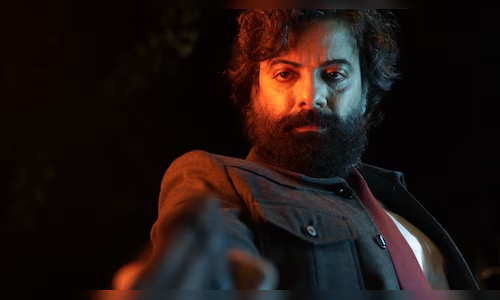
The film, which had its global premiere at the Cannes Film Festival in 2023, took Anurag Kashyap's moody, pulpy noir three years to reach home.
Named after a US President who was famously assassinated, the 146-minute film follows the story of a supposedly dead policeman turned assassin Uday Shetty (Rahul Bhatt), who roams the darkness of Mumbai like a dystopian ghost with Kennedy as his alias.
If Kashyap's recent work has oscillated between self-mythology and self-doubt, with Kennedy he returns to the grammar of passion that first defined him. As hyper-stylish and over-produced as it is, an unnerving, nihilistic, almost funeral rites underpin the film and follow Uday Shetty as he cuts and spreads chaos and despair in each frame.
Bhatt plays the titular role with depressing indifference – his eyes are bloodshot and hooded, his body language coiled, his voice extremely gravelly. He allows Pyotr Ilyich Tchaikovsky's background score to add emotional resonance. The Russian musician's growing sadness is a stark contrast to the gloom and filth of Mumbai's underbelly. The effect is mostly jarring, sometimes hypnotic.
Also read: O'Romeo movie review: A heady cocktail of love, violence and vengeance
Kashyap tried to weaponize Tchaikovsky's romanticism to underline the absurdity of violence glamorized on screen. The lush orchestration elevates street-level brutality into operatic farce, making the bloodshed seem both grandiose and meaningless.
Set in the midst of the coronavirus pandemic, Kennedy uses the respiratory mask not only as a precautionary cover, but also as a device that conceals and aids underworld activities.
Cinematographer Sylvester Fonseca has captured an atmospheric Mumbai that is sparse, wet, bathed in neon, a metropolis on the brink of decay where shadows loom large. The city serves as more than a backdrop; It is the engine of corruption where politicians, policemen, fixers and gangsters exist in a seamless continuum.
Chiaroscuro lighting and long takes create fear rather than patient suspense. Although deliberate, the pace is effortless, enough to test you. This is a film that wants to make you feel trapped – by the city, by fate, by complicity.
The murders here – and there are plenty – are sudden, brutal, unnecessary, banal. Kashyap seems intent on emphasizing their futility. No one is spared – not the good-looking, not the non-involved, or the fallen. Amidst the carnage and devastation, an order emerges.
Also read: Shahid Kapoor, Vishal Bhardwaj and the art of reinvention
In the act of killing an honest veteran worker, Kennedy murdered his entire family, including a group of people eating on the side of the road some distance away, who had absolutely nothing to do with him. His thirst for blood is so infectious that it even infects the worker's son. Undoubtedly one of the best scenes of his oeuvre, this is Anurag Kashyap at his most brilliant, terrifying form.
No murder solves anything; Cruelty merely rearranges the hierarchy of predators. Kennedy's physical reckoning gets him no closer to liberation or clarity. Instead, it deepens his alienation, increases his hallucinations, and increases his guilt.
Like Travis Bickle, Kennedy is an oblivious driver pursuing a city he believes is diseased. Both this film and Taxi Driver take us inside the minds of the protagonists and immerse us in the chaos that drives these psychopaths to unleash.
Yet where Martin Scorsese's classic 1976 film flirts with the twisted heroism projected on Bikal, Kashyap rejects that temptation. He does not mythologize Kennedy as merely an official in a broken system, not its avenger.
Closer to home, Kennedy also echoes Sriram Raghavan's Badlapur in finding revenge as a hollow pursuit. In that 2015 film, vengeance mutilates the Avenger; Here, violence is presented so frequently on a daily basis that it barely registers as a moral choice. Both films question the assumption that cruelty can restore balance. But in Kennedy, it just perpetuates the rot.
To compensate for the lack of content, Kashyap uses excess of style. Kennedy is too opaque to be accessible. Kashyap's elliptical storytelling often feels stilted, as if he's deliberately blurred important emotional beats. But beyond the grainy textures and existential dread, it's nothing you haven't seen before.
Nearly all of the film's major players and high-points — including its anti-hero, a strangely cheerful, beautifully dressed, completely unexplainable Sunny Leone character, and Amir Aziz and Boyblanc's opera club songs — feel like imaginary concepts and sketches waiting to be fully realized. But they never do that.