
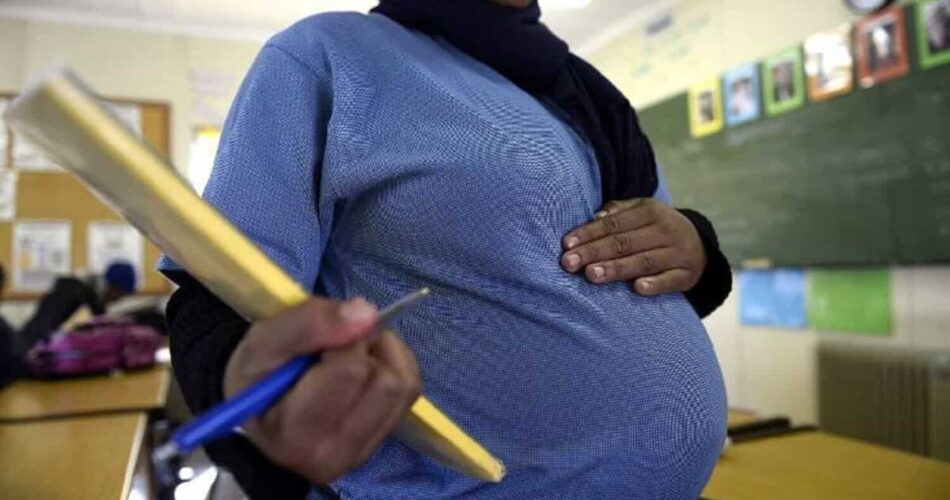
More than 60% of pregnant teenage girls do not return to school after the two-year 'grace' period.
In the corridors of schools in South Africa, the rustling of notebooks can be accompanied by the weight of a child on a student's back.
A study conducted by the Human Sciences Research Council revealed that more than 60% of pregnant adolescent girls do not return to school after the two-year period first implemented by the Department of Basic Education (DBE).
This policy allows schools to discourage or temporarily prevent mothers from returning, increasing dropout rates.
In a move to combat the ostracism and shaming pregnant schoolgirls face, Basic Education Minister Siviwe Gwarube has unveiled draft regulations on the management of learner pregnancy.
Framing the rules as an important step in protecting constitutional rights, Gwarrube said in a statement this week that the country was finally moving away from a period where “young girls were expelled or dropped out of school because of pregnancy,” adding that the practices “contributed to alarmingly high school dropout rates.”
care of principal
Under the new framework, the school principal is positioned as the primary guardian of the student's educational continuity.
The draft directs that headmasters should ensure that every pregnant student remains in school and, importantly, returns to her respective grade without fear of exclusion after the birth of the child.
The principal must negotiate a formal leave of absence with parents or guardians and ensure that the student's right to privacy is protected under the Personal Information Protection Act (POPIA).
“These rules build on that progress and reaffirm our commitment to dignity, inclusion and equal opportunity,” Minister Gwarube stressed.
Also read: More than half of SA's children still face multiple deprivations – Statistics SA
continued schooling
To prevent pregnancy from becoming a fixed academic deadlock, the rules detail a rigorous process for “reasonable accommodation.”
Schools are now tasked with ensuring that all formative assessments, including classwork and assignments, are packed and delivered to students during their absence.
This ensures that a student's academic progress is not limited to his physical presence in the classroom alone.
In addition, for those in Grades 4 to 11 who may miss the year-end examinations for medically justified reasons related to pregnancy or childbirth, the rules allow promotion based on their school-based and practical assessment scores.
Also read: These 34 Gauteng schools failed their safety assessment
pregnancy announcement
The draft also reflects a strict mandatory reporting requirement.
If a student under the age of 16 becomes pregnant, the school is legally obliged to report the matter to both the Department of Social Development and the South African Police Service.
“The aim is to protect young children and ensure that potential abuse is investigated,” the draft rules said.
report to father
The rules leave no room for ambiguity with regard to the biological father.
If he or she is a teacher or member of school staff, the incident should be reported to the South African Council for Educators and the employee relations branch of the department.
Even when the father is a fellow student, school-based support teams should intervene, the draft notes.
Parents, teachers and members of the public now have until 25 April 2026 to submit their comments (email protected).
Read now: Shockingly few Gauteng teachers have been checked against the sex offenders registry
Support local journalism
Add The Citizen as a preferred source on Google and follow us on Google News to see more of our trusted reporting in Google News and top stories.