
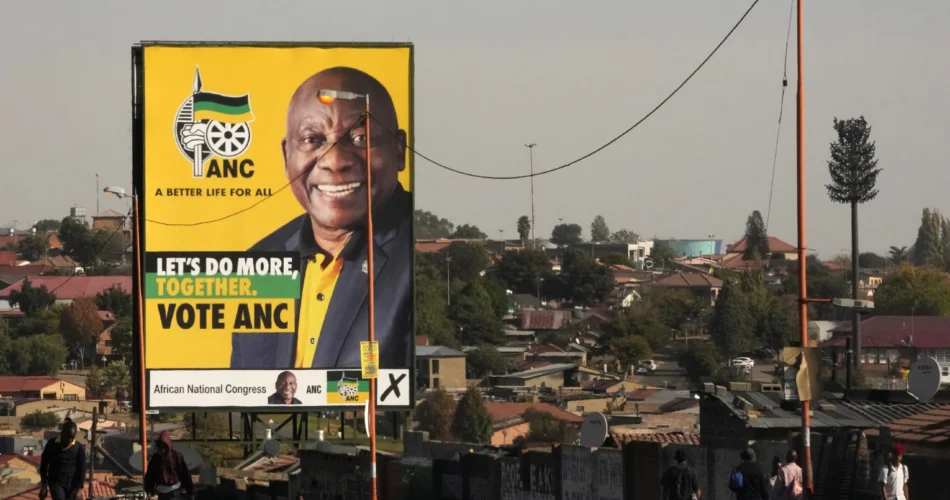
South Africa celebrated Independence Day on 27 April to commemorate three decades of the historic transition from apartheid to democracy. The celebration has provided an opportunity for Catholic clerics to share their perspectives on their visit to the nation. They are calling for solidarity with the oppressed and internal transformation of citizens.
Yet, as formal structures of segregation have been dismantled, the daily reality for many remains complicated by economic inequality and corruption. in an interview with Crux NowFather Stan Muyebe, director of the Southern African Catholic Bishops' Conference (SACBC) Justice and Peace Commission, suggests that the definition of freedom should evolve further. He argues that the concept should extend beyond political rights to include moral responsibility and personal transformation.
Muyebe explained, “Many of the moral and political challenges that South Africa faces today stem from a failure to understand that independence is not just freedom from structural injustice, but also an effort to free ourselves from greed, corruption, violence and abuse of power.” Crux Now.
From evaluating the health of the nation's democracy and the growing influence of money in politics to addressing the controversial “white genocide” narrative and the Catholic Church's role as a “field hospital”, Father Muybe takes a comprehensive look at the obstacles and hopes facing the Rainbow Nation.
Following are the excerpts from that interview…
Crux Now: As South Africa celebrates another Independence Day to remember the transition from apartheid to democracy in 1994, how has the definition of 'freedom' evolved for the average South African over the past three decades?”
Muyebe: During the struggle against apartheid, independence was understood as freedom from an unjust and oppressive system. In post-apartheid South Africa, it needed to be complemented with an alternative idea of freedom – freedom as individual liberation or internal transformation. A lot of work still remains to be done in this regard.
Many of the moral and political challenges facing South Africa today can be attributed to a failure to understand that independence is not only freedom from structural injustice, but also an effort to free oneself from greed, corruption, violence and abuse of power.
Central to this development is the decision that was rightly taken during the CodeSA negotiations to base the new South Africa on constitutionalism, centered on a Bill of Rights. Freedom is largely understood in terms of these rights, sometimes with little regard to the common good as a moral framework within which these rights should be exercised.
As a corrective measure, some have proposed bringing about a national dialogue with a social compact in the form of a charter of civic responsibilities, including a code of ethical conduct for those exercising legislative, judicial and executive power. Although it cannot resolve all challenges, it can serve as an important basis for situating freedom within a strong moral framework, a framework of the common good.
How do you assess the state of democracy in South Africa today?
We have to give the state of democracy in South Africa some credit. Across the continent, it is common for liberation movements that become ruling parties to lose their electoral dominance after about 25–30 years, especially in major urban centres.
In many African countries, a familiar pattern emerges when such movements begin to lose their legitimacy: resorting to electoral manipulation, questionable constitutional amendments, and sometimes even violent repression of opposition parties and citizens. This has not happened in South Africa. In the 2024 South African general election, we saw a clear decline in the ANC's electoral dominance and a shift away from a one-party dominance system – without the systemic repression seen elsewhere on the continent.
As a result, unlike many other contexts, South Africa is benefiting from relatively strong democratic institutions: an independent judiciary, a professional and credible electoral commission, a free and vibrant media, and an active civil society. Members of parliament are able to openly criticize the president without fear of reprisal – something that is still lacking in some parts of the continent. Elections are generally free and fair, and the results are accepted by the ruling party.
However, South Africa also faces significant risk factors that could jeopardize the future of its democracy. There are particular concerns about the widening gap between rich and poor, the growing influence of money in politics, instability within emerging coalition systems, and systemic weaknesses in holding public officials accountable for corruption. The ongoing commission of inquiry has also raised concerns about state capture by organized crime and how it destroys the country's democracy. Together, these dynamics have contributed to a sense of voter apathy and growing disillusionment with democratic institutions.
There are also broader geopolitical concerns, particularly the growing rapprochement between white supremacist regimes in the United States and white supremacist groups within South Africa. It is not yet clear how these will unfold in the coming years.
During the struggle against apartheid, the Catholic Church was a vocal voice for justice. Do you believe the church is still speaking with the same prophetic voice today, or has the landscape changed?
In post-apartheid South Africa, the Church in general – not just the Catholic Church – has issued several statements condemning the greed of the political elite and their disregard for the poor. Despite these efforts, there remains a strong perception that the Church has lost its prophetic witness. Perhaps the current conditions of South Africa call for a prophetic witness that is broader and deeper than simply issuing statements or pastoral letters condemning corruption and structural injustice.
Of course, there are differing views on what the church must do to reclaim its prophetic voice. In my humble view, to renew this witness, the Church needs to adopt a synodal church approach. This requires a synodal transformation adapted to the African context. In the African context, being a synodal church also means becoming what Pope Francis calls “a church as a field hospital during and after war”.
To be a church that is a field hospital is to be a church that is a close friend of those who live on the margins – the modern “lepers” of society, the so-called untouchables: those living in informal settlements and slums, the homeless, unemployed youth in taverns, ragpickers, sick miners, exploited workers in farms and factories, and victims of floods and other forms of social and spiritual vulnerability. In practice, this means parishes, religious, Caritas Apostolate and justice and peace groups directed at establishing a ministry of presence among the untouchables. This means holding networking sessions and discernment sessions as church agents who are living out the ministry of the church as a field hospital.
A church that establishes such spiritual and pastoral closeness will inevitably become wounded because of its proximity to the wounded. However, by walking with those on the ground in a spirit of prayerful discernment, and learning from their faith in God amidst inhumane conditions, the Holy Spirit will teach the Church what it must say about “Pharaohs” and the structures of greed and indifference. The ministry of presence at Ground Zero, the ministry of the Church as field hospital, is therefore a school where the Holy Spirit is teaching the Church about the suffering face of Christ in the poor and what the Church must say to Pharaoh about the injustice and suffering to which the most vulnerable in society are subjected. Currently, the Church tells the truth about power to the Pharaoh after consulting and listening to the views of large NGOs, policy experts and mainstream media on national issues. Being a Synod church brings a new perspective: listening to the Holy Spirit while walking with the poor at Ground Zero.
There is much debate going on about Black Economic Empowerment (BEE). Some see this as necessary prevention; Others see it as enriching a small political elite. How does the Church approach the pursuit of economic justice in a way that truly uplifts the dignity of the poor?
From the Church's perspective, the question is not simply whether black economic empowerment is necessary, but whether it is achieving its moral purpose. The Church affirms that redress is necessary: the injustices of apartheid were not only political, but also profoundly economic, and they continue to shape the lives of millions of people.
We must acknowledge that much of BEE has focused on ownership transfers and equity deals at the top level of the economy, often benefiting a relatively small and politically connected group. This has not translated into broad-based economic inclusion. Furthermore, governance challenges including fronting and rent-seeking have weakened the policy's credibility and intended impact.
The measure of empowerment is not the wealth of the few, but the restoration of dignity to the many. Any system that enriches only a few while leaving the many out falls short of the demands of the common good. The test of any policy is not its intentions, but its impact on the poorest and most vulnerable. Economic transformation must be broad-based, transparent and accountable, otherwise it risks losing moral legitimacy.
There are stories both locally and internationally claiming that 'white genocide' is taking place in South Africa, particularly in relation to farm attacks. How do you respond to these allegations, and how do we address the real fears of some communities without fueling racial division?
Many people know that the story of “white genocide” is false. This claim should be understood as a disinformation campaign intended either to intimidate South Africa into withdrawing its case against Israel at the International Court of Justice, or to justify possible future interference in South Africa's sovereignty.
As the global order moves away from the rules-based international system, the world's weaker countries, most of which are in Africa, now find themselves at the mercy of the superpowers and their coercive diplomacy. Disinformation campaigns will increasingly become a prominent feature of coercive diplomacy. As the Church, our call is to preach the gospel of truth, brotherhood and the common good in a world that is gradually normalizing the use of coercive diplomacy and disinformation.
Many believe that the Truth and Reconciliation Commission has prioritized forgiveness at the expense of justice. Is it possible to achieve true social unity in South Africa without addressing the economic and land inequalities created by apartheid?
The South African Truth and Reconciliation Commission made an indispensable contribution to national healing, but it was never designed to fulfill the function of healing and justice.
The Commission's mandate included redressing violations of political and civil rights. It did not extend to apartheid and its violation of social and economic rights. That is why a separate process was established to facilitate land reform and redress the land inequalities created by apartheid.
Programs like land reforms or BEE, which were created to address the injustices of the past, have generally failed, and there are many factors behind the failure. These factors are well documented in the reports of various commissions. One of the factors is the capture of programs by elite interests, both political and corporate. Systems originally designed for justice and redress have, in some instances, been transformed into means of accumulation and protection. In the process the original good intentions have been compromised by systemic corruption and elite appropriation. The greed of the elite and in some cases the greed of the intended beneficiaries themselves have contributed to the collapse of the land reform program and BEE. A national dialogue to discuss the three decades following apartheid in South Africa and to develop a shared vision for the common good economy. Hopefully, this process will provide space for a courageous conversation about the future of apartheid, particularly how to balance the tension between the imperatives of a growing South African economy and the imperatives of restructuring the economy so that it is more inclusive.