
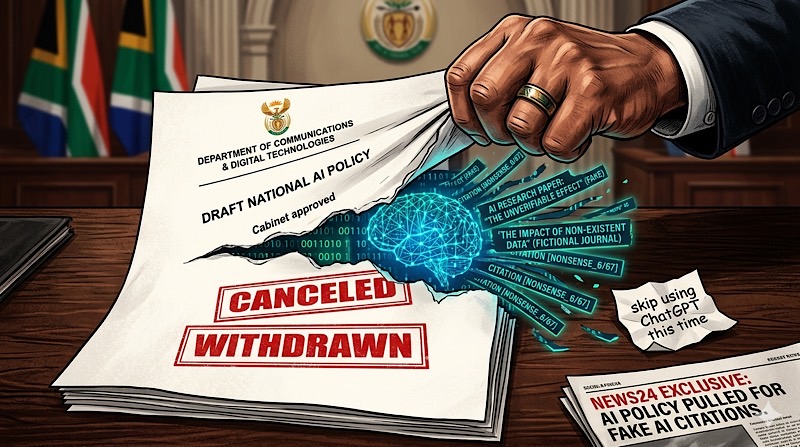
The South African government produced AI policy documents in April, which were themselves the product of unverified AI. The irony is almost too neat.
Here is what happened. Communications Minister Solly Malatsi, a DA figure, published an 86-page draft national AI policy earlier this month. It was cabinet-approved, ambitious and full of academic citations. News 24 studied the bibliography. Of the 67 academic papers cited, at least 6 did not exist. The magazines were real. The articles were fabricated. Malatsi withdrew the policy on 27 April, calling it an “unacceptable omission” and promising “consequence management” for those responsible.
Before the dust settled on that, Home Affairs Minister Leon Schreiber, who is also the DA, explored the same problem in his department's newly revised white paper on citizenship, immigration and refugee protection. Except worse. News24 found that out of 148 references in the document, 102 were not verifiable or traceable. An initial internal review shows that the fake citations were not woven into the main text, but were added to the bibliography after the document was drafted, which raises a different and more troubling set of questions about who actually did it and when.
Schreiber suspended two senior officials: a chief director in the unit responsible for the white paper, and a director involved in the drafting process. He also appointed two independent law firms to manage the disciplinary process and, in a move that suggests someone has suddenly developed a zeal for thoroughness, ordered a review of every policy document produced by the department from November 30, 2022. That date is not random. This is the day OpenAI released ChatGPT.
The DA's response to both incidents has been to mandate AI verification in all its ministerial portfolios, with Schreiber promising to raise the issue at the next cabinet meeting. The chair of the parliamentary portfolio committee made a more pointed suggestion to Malatsi's team: “skip using ChatGPT this time” when doing the rewrite.
This is particularly inconvenient for the DA given that the party has been one of the most vocal proponents of using technology to fix South Africa's flailing public service. Schreiber built his Home Office reputation as a corruption-fighter on digitalization and AI. Malatsi's entire portfolio is digital transformation. The argument was always that technology-forward governance was better governance. The countermeasures are now in two separate Cabinet-approved documents.
Technology itself is not the villain here. AI tools generating fake quotes that appear credible is a known and documented problem, with almost every technology publication covering this sort of thing since 2023. The officials involved either did not know this, or knew and did not investigate. Both explanations are bad.
South Africa is not alone. Similar incidents have happened with governments from Brazil to Australia. But the timing here is brilliant: the country's draft framework to regulate AI had to be scrapped because it contained irresponsible use of AI. You couldn't really script it.
Sensing the opportunity, the ANC has summoned Malatsi to appear before Parliament. Malatsi has said that he will cooperate.
Meanwhile, in some government office, someone is probably redrafting AI policy. Hopefully by hand.
(Sources: News24; MyBroadband; TechCentral; The Register; Daily Maverick; GroundUp)