
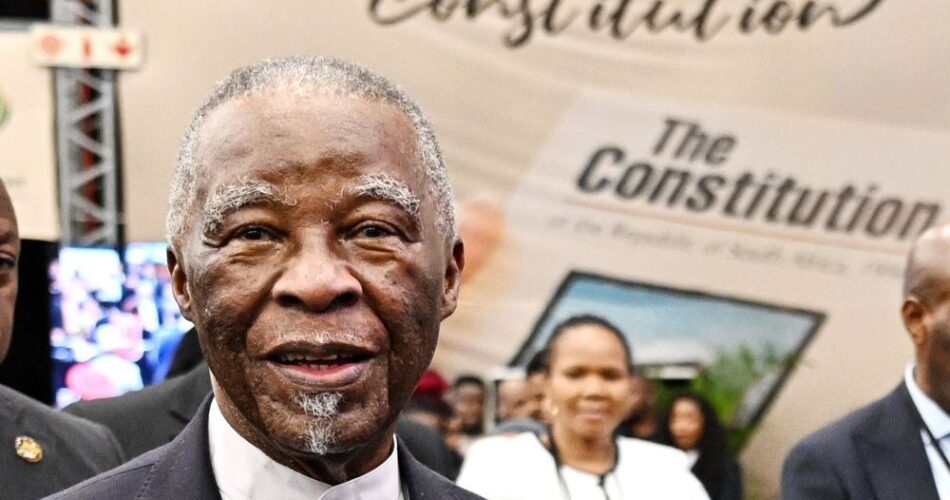
Ahead of the 16th annual Thabo Mbeki Africa Day Lecture in Cape Town this weekend, Parliament and the University of South Africa (UNISA) hosted a joint symposium on “Celebrating 30 years of the South African Constitution in a rapidly changing world”.
The symposium, held at the National Assembly, forms part of the national commemorative program to commemorate 30 years of the Constitution of the Democratic Republic of South Africa.
The event was attended by over 250 participants from various sectors of society, including former President Thabo Mbeki, Patron of the Thabo Mbeki Foundation.
16th Annual Thabo Mbeki Africa Day Lecture by Dr Kayode Fayemi, former governor of Ekiti State of Nigeria, at the Century City Conference Center on Saturday.
Designed under the theme, “Rebuilding African Unity in an Age of Fragmentation: Sovereignty, Solidarity, and the Renewal of Institutions”, the program positions Africa Day as a strategic platform for reflection, dialogue, and agenda-setting, bringing together diverse stakeholders to reflect on African unity and renewal, with engagement spanning the economic, constitutional, cultural, academic, diplomatic, and public spheres.
Activities hosting the main event include a Friday seminar and a post-lecture session with young people on Monday, 25 May, at the Unisa Paro campus.
National Assembly Speaker Thoko Didiza, who delivered keynote speeches, said that as a Member of Parliament and the Pan-African Parliament, Africa Day is not just a day to remember and celebrate, but also a day to take stock of how much remains to be done to realize Africa's vision for the future.
“Agenda 2063, a broad participatory approach, enabled us to re-imagine the Africa we want and put forward how these can be achieved across different sectors. The Pan-African Parliament, which brings together public representatives from member parliaments, has developed model laws that have brought harmony to certain legislative frameworks across the continent.
“All of this reflects the journey we have undertaken in laying the foundation from which we can build the Africa we want,” Didiza said.
“Here in South Africa, as we reflect on Africa Day, in a context where we are celebrating 30 years since the country came into force of the Constitution, the supreme law that laid the foundation for the South African constitutional democracy that we seek.
“In recognition of this special occasion, the National Assembly convened A webinar on May 10, 2026 in which weReflecting on our own journey, its successes and challenges. Today, we are partnering with UNISA to host this symposium as part of preparations for the main Africa Day event taking place here in Cape Town on 23 May 2026.
“This symposium will focus on contemporary issues facing Africa and the role Africa can play in shaping Africa’s future and functioning democracies,” Didiza said.
Didiza said that in 30 years of democratic rule, the foundation of strong institutions has been laid, which forms the architecture of the country we want.
“We have a legislative sector that has played a vital role in developing transformative laws. Today, we have a strong judiciary that delivers justice and instills confidence in the society that all are equal before the law.
“We have progressively ensured and are still ensuring that the human rights of all citizens are respected through our various constitutional bodies and our civil society. Our government has been able to develop policies and implement programs that meet the needs of our society. We can look back with admiration at the steps taken to build a functional state,” Didiza said.
“While appreciating the foundations and building blocks that underpin our democracy, I have no doubt that this symposium will reflect on the progress and challenges we still face from the perspectives of the diverse members of society present here today.”
UNISA Vice-Chancellor, Professor Puleng Lenkabula spoke Mbeki's historical poem 'I am an African'He said that this is not just a demonstrative declaration, but a moral declaration. Weave together the threads of our identity and our past.
“President Mbeki declared, ‘I am made up of immigrants who left Europe to find a new home… I am the grandson of men and women who came from the continent of Africa… I am made up of those who were brought from India and China’, and we all understand and know that speech.
“In that single sweeping affirmation, President Mbeki refused the logic of apartheid fragmentation. He insisted that the 'I' of the new South Africa was multiple, wounded, yet indivisible,” Lenkabula said.
He also said that when the Constitution was first adopted, it gave legal form to what was envisioned.
“Yet, three decades later, we must still ask whether the constitutional promise of a united democratic, non-racial, non-sexist and prosperous South Africa has been fulfilled, for all those who said ‘I’, or whether a gap has remained between the constitutional text and lived concrete realities that many struggle to cross,” Lenkabula said.
“When we remember the foundation of our Constitution and the promise of a new and better South Africa, what do we see? Do we see the South African promise fulfilled? Or do we see a dream deferred?
“These are some of the questions that we are going to talk about today that the intellectuals and communities of our society should consider,” Lenkabula said.
(email protected)