
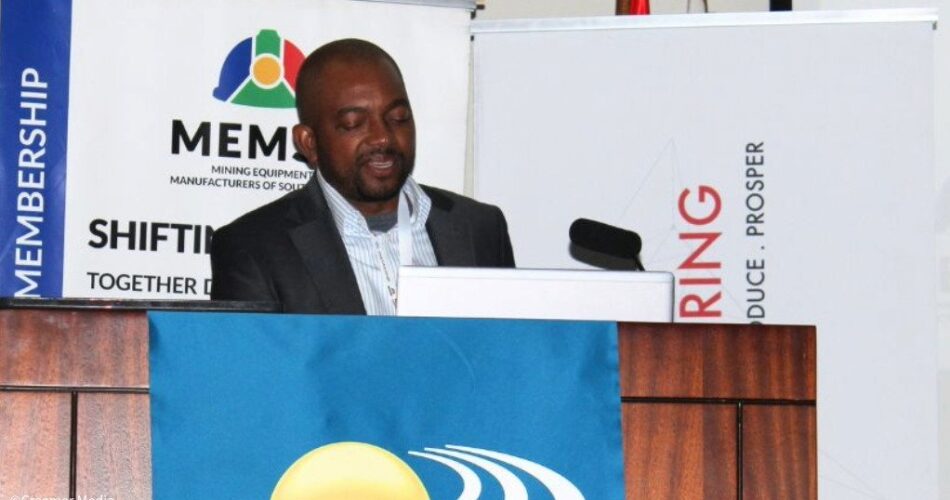
South Africa needs stronger collaboration, localization and technology adoption to help build a more competitive mining equipment manufacturing sector, mining equipment manufacturers group South African Mining Equipment Manufacturers (MEMSA) highlighted at the Mind Shift Conference 2026, held at the IDC Conference Center in Sandton on 21 May.
The conference brings together role players from the mining and manufacturing industries, academia, youth and worker organisations, government and skills sector to build a shared understanding of the future of mining.
MEMSA President giving welcome address matimba expensive noted that the tenth anniversary of the cluster came at a time when South Africa needed to move beyond consuming technology and instead developing, owning and exporting it.
“MEMSA was established to strengthen South Africa’s mining equipment manufacturing industry through collaboration, localisation, innovation and industrial development,” he said.
Mahnge said South Africa has already demonstrated strong mining and engineering capability through deep-level mining, but needs to take a more thoughtful approach to industrial readiness.
He stressed that companies, institutions and sectors can no longer innovate in isolation, as the future of mining will be built through connected ecosystems, shared knowledge and collective leadership.
That message shaped much of the first day's discussions, as speakers linked South Africa's mining competitiveness to its ability to embrace AI and other technologies to improve safety, support local manufacturing, strengthen value chains and prepare workers for changing roles.
During the first panel discussion, titled 'Mining the Future: Is Africa Ready for an AI Revolution Underground?', CEO of digital transformation and technology company Smartops Solutions mahen patrice benzen AI adoption was framed as a broader mining challenge rather than just a technology issue.
He pointed out that AI raises questions about safety, jobs, policy and competitiveness, especially as mines become more automated, data-driven and reliant on real-time decision-making.
The panel also warned that the adoption of AI cannot be separated from the sector's readiness to use it responsibly.
Executive Director of the Mandela Mining Precinct, a mining research organization Julie Courtnage Cautioned that South African mining is still not ready for full-scale AI. However he acknowledged that no mining jurisdiction can be described as fully AI-native yet.
“Globally, mining is still in the midst of advanced experimentation, selective piloting and scaling, while South Africa remains first on the AI maturity curve and continues to face gaps in infrastructure, skills and governance.
“AI governance is therefore important,” he stressed.
That governance challenge was closely linked to safety, with speakers arguing that the value of AI would depend on whether it could help mines operate earlier and more effectively.
Mine Health and Safety Council Research and Excellence Center Manager Flexon Magweregwede pointed out that AI can help the mining sector move from reactive health and safety management to predictive and proactive risk management.
He said AI could help mines identify high-risk areas before incidents occur, but he cautioned that the technology should not be adopted casually.
Instead, each technology should be supported by a clear value proposition and a practical understanding of the problem it seeks to solve, he stressed.
While security was one of the most obvious areas for the use of AI, speakers also pointed to the role of the technology in resource discovery and improving operational competitiveness.
CEO of coal research consortium Coaltech Avhurengwi Nenegovela It was said that AI can significantly reduce the time required for geological modeling and resource estimation work.
He argued, “Leadership needs to understand AI as a competitive tool, especially where it can help the industry ask new questions of existing geological information and improve the speed of decision making.”
The focus on competitiveness continued during the second panel discussion titled 'Smart Mines, Strong Value Chains', where speakers moved from AI readiness to considering the broader systems needed to support smart mining and localization.
CEO of mining enterprise development organization Lefaro Zenzo Nkomo It was observed that smart technology is no longer a concept for the future, but has already become the norm in modern industrial environments.
Speakers said this change will impact not only mine operations, but also manufacturers and small and medium-sized enterprises (SMEs) hoping to supply equipment, components and services across increasingly digitalized mining value chains.
CEO of diversified mining company Seriti Resources and Chairman of Futurecoal take the mic Explained that legislation can support innovation when consultation is properly conducted and when technologies align with business strategy and employee needs.
The panel also considered how technology convergence could improve mining performance.
Scientific Research Organization Council of Scientific and Industrial Research (CSIR) Mining Cluster Executive Manager Bongi Ntsoelengo The role of automation, sensors, digital twins and decision-support tools in improving productivity and safety was highlighted.
However, the Director of the African Research Center for Ore System Science, Professor glen navala Cautioned that technology and AI alone will not solve the challenges of mining without capacity development.
This need for capacity extended beyond mining companies, as speakers also linked future competitiveness to communities and SMEs.
CEO of consulting company Siyakha Consulting dion kerr malherbe It was emphasized that mining communities need to be integrated into future value chains rather than being dependent on mining operations.
For SMEs looking to participate in those value chains, intellectual property law firm Spoor & Fisher Patent Lawyers & Partners lou stan It was pointed out that proper IP protection and enforcement strategies were needed from the beginning, especially when companies demonstrated technologies locally or internationally.
The question of how to pay for innovation, and whether this can support profitability, was explored during the third panel discussion, titled 'Innovation or Margin? 'Making sustainability pay in mining'.
Head of Business Development, Development Finance Institute ECIC Portia Dubey The discussion focused on whether innovation can strengthen the bottom line in a capital-intensive industry facing continued cost pressures.
Technology company CrystalForge MD Ahmed Kader Argued that innovation and margin need not work against each other, provided technologies are implemented in ways that respect the first principles of engineering.
He said the business case is central to proving whether a technology will create value in a specific operation.
President of the professional association Southern African Institute of Mining and Metallurgy gary lane It similarly cautioned that mining companies need to continue investing in innovation for long-term sustainability and margin protection, even during short-term budget pressures.
He warned that poor business cases and a weak understanding of value streams could result in companies spending heavily on AI or other technologies without generating the expected returns.
The final session of the day, the CSIR Fireside Chat titled 'Innovation is not a game for anyone', returned to the collaboration theme raised in Mahenge's opening speech, with speakers focusing on skills, commercialization and the relationship between research and industry adoption.
Senior Policy Analyst at industry body Minerals Council South Africa brian ncube Commented that innovation requires stakeholders in the mining ecosystem to work together to drive value.