
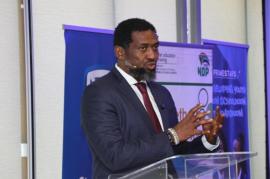
Minister of Higher Education and Training, Buti Manamela, has secured a commitment from private sector leaders to partner with the government in advancing South Africa's skills development agenda and strengthening the country's education-to-employment pipeline.
The commitments came from a high-level business breakfast convened by Manamela on Monday, ahead of the higher education and training budget vote speech given in Parliament on Tuesday.
The engagement brought together government representatives, skill development institutions, intermediaries and start-ups as well as officials and leaders from agriculture, mining, engineering, ICT, financial services and other strategic sectors.
The discussion focused on tackling South Africa's deepening youth unemployment crisis and improving the alignment between the country's education and training systems and labor market needs.
There are currently over three million young people in South Africa who are not in education, employment or training, while despite frequent complaints from businesses about skills shortages, many graduated and qualified young people remain unemployed.
Manmela said the partnership aims to create a practical platform through which government and business can work together to ensure that skills development responds meaningfully to labor market demands and economic growth.
He said the initiative will evolve into a sustainable partnership platform, supported by regular engagement and a clear implementation plan to ensure accountability and measurable results.
The discussions were based on five strategic themes, including:
• Reimagining public-private partnerships in the post-school education and training (PSET) sector, moving toward strategic, long-term collaboration that builds sustainable systems.
• Bridging the skills-industry gap through direct business involvement in curriculum alignment, workplace exposure and training design.
• Expanding apprenticeships, learners and work-integrated learning opportunities by exploring incentives, removing barriers and improving implementation at scale.
• Identifying what businesses need from government, including policy certainty, efficient processes, accessible funding mechanisms and improved accountability.
• Establishing a shared accountability framework that clearly defines roles, responsibilities and measurable outcomes for both government and business.
The session concluded with the participating business leaders making a formal pledge to support the implementation of the skill development agenda of the government.
One of the key outcomes of the engagement was strong support for the revitalization and repositioning of technical and vocational education and training (TVET) colleges.
Business leaders said TVET colleges are central to South Africa's economic future and should be established as institutions preparing young people for practical, future-focused professions that will remain relevant despite advances in artificial intelligence and automation.
The participants also called for stronger coordination within the government and closer synergy between the public and private sectors to make skill development interventions more responsive and effective.
Entrepreneurship development also featured prominently at the discussion, with business leaders emphasizing that youth should be empowered not only to find jobs but also to create businesses and employment opportunities.
The engagement was co-hosted by Standard Bank and PrimeStars.
Dr Kirsten Greenhope, Head of Corporate Citizenship at Standard Bank, stressed the importance of prioritizing business education and practical skills development as key pillars of inclusive economic participation.
PrimeStar CEO, Nkosinathi Moshoana, highlighted the importance of linking learning opportunities directly to employment through initiatives such as the organisation’s “Learn to Earn” campaign.
Manamela said the discussions need to be translated into practical implementation and measurable impact.
“The report that comes from this process should lay out directly how we partner and collaborate in a meaningful and measurable way. Important work is already happening across sectors and institutions.
The minister said, “Our responsibility now is to identify what is working, understand how to scale it up, and take all these commitments forward into concrete programs that benefit youth and the economy.”
He reiterated the Government's commitment to ensure that the post-school education and training system becomes a driver of economic inclusion and opportunity.
He said, “We cannot allow our education and training system to become a waiting room for unemployment for our youth. It must become a platform for empowerment, productivity, innovation and national development.” – sanews.gov.za