
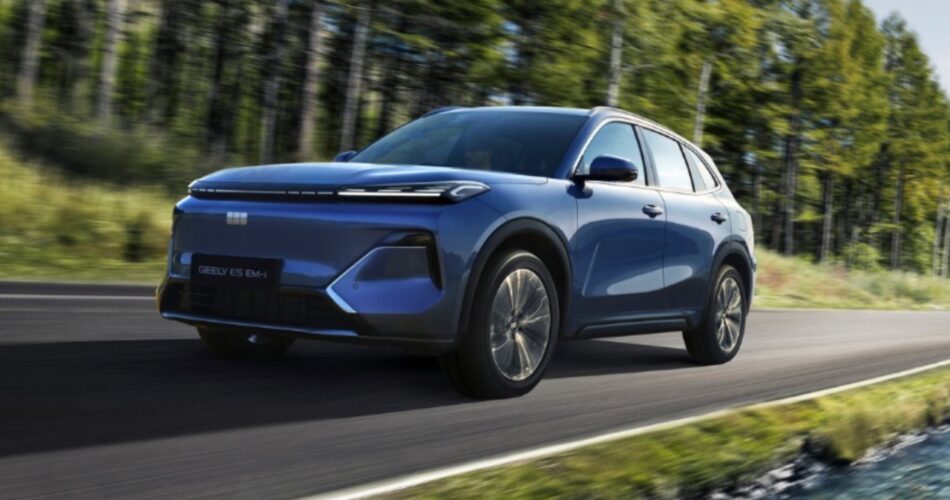
A video posted on Instagram last weekend shows a Geely vehicle driving down a Durban road, with the driver's hands behind his head and the steering wheel turning on its own. The caption read, “My jelly is driving me around Durban, it's crazy.”
The clip, shared by Matthew Ravel with his 1,653 followers, has already received more than 1,600 likes and a stream of comments ranging from surprise to complete disbelief (an appropriate reaction in a country where most drivers regard the rules of the road as mere suggestions).
Ravel, a property businessman based in Umhlanga Rocks, tagged the Geely Pinetown dealership in his post, captioning it: “Self-driving cars are here in South Africa.”
In the footage, the Geely logo is clearly visible on the steering wheel, the cabin's panoramic roof and the fading green road edge in front of the passenger window. What it doesn't show is anything illegal, at least not yet, because the car isn't actually driving in the way the law understands the term.
Billed as the most affordable 100% electric car in South Africa, Geely equips its local E5 and E2 models with Level 2+ advanced driver assistance systems. This means that adaptive cruise control, lane keeping assist, automatic emergency braking, blind spot detection and rear cross traffic alert are all working together to keep the car in its lane and at a safe distance from the vehicle in front.
This does not mean that the driver can check out. Level 2 systems still require full human attention, hands on or near the wheel, and eyes on the road. The moment the driver stops monitoring, the assistance becomes a threat, not a convenience.
This is where it gets weird. South African law currently only recognizes vehicle automation up to Level 1, where the driver maintains full control and the car only assists with acceleration or braking. The National Transportation Department has said it is developing regulations for autonomous vehicles, with approval targeted for 2027. Until then, there is no legal framework for a Level 2 system, let alone manual highway driving, which Geely and other brands are already selling in showrooms from Sandton to Pinetown.
The brand's flagship electric SUV here, the Geely E5, starts at R599,999 for the EM-i hybrid and goes up to R788,888 for the fully electric Apex Plus. The smaller E2 hatch starts at R339,900. Both come with the same set of ADAS features, a home wallbox charger and a warranty for the battery lasting up to eight years or 200,000 km.
Geely has been open about its global autonomous ambitions. At Auto China 2026 in April, the company unveiled the EVA Cab, a purpose-built L4 robotaxi prototype designed for driverless commercial operations. It has five LiDAR units, dual NVIDIA Thor chips and enough computing power to process the road in real time without a human behind the wheel. A fleet of 100 robotaxis is planned for Shanghai this year, with Geely's ride-hailing arm Cao Cao Mobility aiming for 100,000 units by 2030.
The global autonomous vehicle market is projected to exceed $280 billion (about R5.1 trillion) by 2026, but South Africa is still drafting regulations for the technology that is already in local driveways.
This means that Ravel's video is less a glimpse of tomorrow, but rather a public reminder that cars have arrived and laws have not. Whether South Africa's regulators will be able to catch on before the next viral clip arrives is another question entirely.
(Source: GeelySA & businesstech & TopGearSA)