
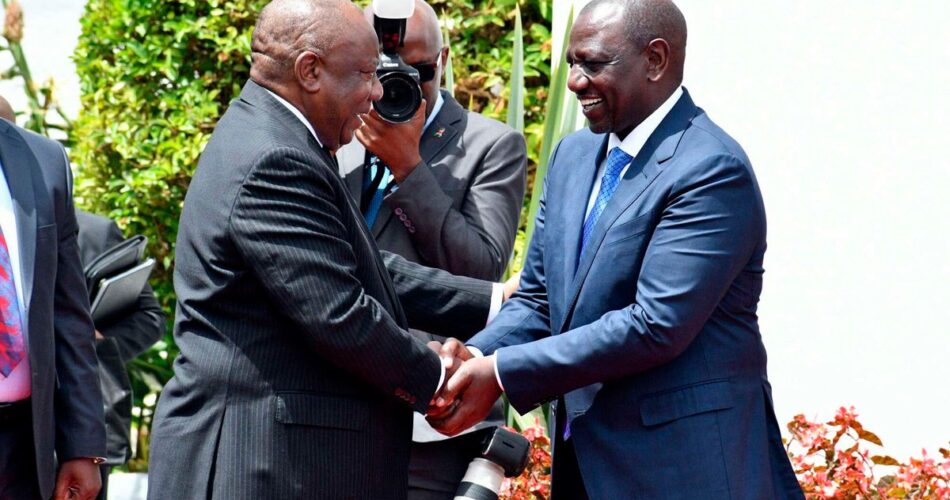
Kenyan President William Ruto has made three state visits this year, visiting Tanzania, Azerbaijan and Kazakhstan, where he signed deals ranging from trade and energy to intelligence sharing.
But his most important trip so far may be a trip to Pretoria this week from June 3 to 5.
On June 3, Ruto began his first state visit to South Africa, continuing the pattern in which Kenya's previous three presidents – Mwai Kibaki, Uhuru Kenyatta and now Ruto – have made high-profile visits to Africa's most industrialized economy.
On paper, relations between the two countries remain strong. A statement from the South African Presidency described bilateral relations as “strategic” and “cordial”, while Kenya's High Commission in Pretoria said the visit “reflects the shared commitment” to deepening prosperity and pursuing development.
President Cyril Ramaphosa made a similar visit to Nairobi in November 2022, when he announced conditional visa-free entry for Kenyans traveling to South Africa for short stays.
migrant concerns
Yet those visa conditions remain a source of frustration, especially among Kenyans living in South Africa.
In an open memorandum to President Ruto ahead of the visit, the Kenyan expatriate in South Africa called on the two leaders to discuss free trade agreements, reform work permit rules and strengthen cooperation in health and education.
“The challenges of migration, health, trade and education facing Kenyans in South Africa are interconnected and actionable,” he said, calling for stronger consular support and structured engagement with Pretoria through the existing Joint Cooperation Commission.
He also urged both governments to mutually recognize educational and professional qualifications and to review work permit processes, which he described as lengthy and costly.
“Overall, these measures will improve the living experience of Kenyans in South Africa while strengthening broader bilateral relations.”
However, bilateral issues are only one dimension of the visit.
strategic differences
Kenya and South Africa have often taken different approaches to global and continental politics.
Ruto skipped the G20 meeting in South Africa last year and sent a representative in his place.
Meanwhile, Ramaphosa did not attend the inaugural Africa Climate Summit in Nairobi in 2024 and also the recent Africa Forward summit co-hosted by Kenya and France. Some observers linked these absences to France's decision to invite Kenya instead of South Africa to the G7 summit later this month.
Bob Wekesa, director of the African Center for Americas Studies at the University of the Witwatersrand, said the two countries should pursue their national interests while finding common ground on continental priorities.
“These countries are prioritizing different political issues in the emerging alliances; South Africa is more prominent among the BRICS while Kenya is more inclined towards the West,” Dr Wekesa said. East African.
“It is vital that these two countries use their anchor-state status in Africa to reorient the continent to the changing global order. The evidence shows that when Africa speaks as one, it makes more sense.”
While bilateral engagement remains important, he argued that the two countries should also bring their respective regional blocs – the East African Community and the Southern African Development Community – into broader discussions on trade and development.
continental fault lines
Ruto has supported African Union reforms, an area in which South Africa remains influential but often finds itself on opposite sides of major debates.
When Israel sought observer status in the African Union, South Africa and Algeria opposed the move, and no consensus was reached. Pretoria is also a vocal supporter of Palestine, which has observer status in the AU.
When South Africa took Israel to the International Court of Justice over the Gaza conflict in 2024, Kenya was among the countries that argued the dispute needed a political rather than legal solution.
South Africa has maintained close ties with Moscow and the broader BRICS bloc amid growing differences with US President Donald Trump. In contrast, Kenya is more closely aligned with Washington.
“They should come up with a common position, at least a framework for engagement with global powers, especially because a new world order is emerging, and that requires a collective African position,” Dr Wekesa said.
“It is fine for each country to pursue its own policies, but they must speak as one on broader questions of global governance. They must find a common position on African priorities.”
There are differences between the two countries on Western Sahara also. Kenya supports Morocco's autonomy plan, while South Africa supports the right to self-determination of the Sahrawi Arab Democratic Republic, whose government operates in exile from Algeria. Kenya nevertheless continues to host the Sahrawi embassy in Nairobi.
migration debate
The visit comes at a time when South Africa is facing criticism over repeated xenophobic violence against other African citizens.
Kenyans in South Africa said both governments should address what they described as “xenophobia and securitized policing”.
“Groups such as Operation Dudula and the recent anti-migrant mobilizations from March through March have affected Kenyans at clinics, schools and informal business sites, particularly in Gauteng,” he said in a Monday memo.
He also objected to this Visa-free travel conditions. Kenyans are currently allowed to stay for a maximum of 90 days per calendar year, while the limit on individual visits is 30 days. Nairobi bears the cost of deporting Kenyan citizens who overstay.
Ramaphosa has repeatedly rejected allegations that his government is indifferent to xenophobia. During his visit to Nairobi, he argued that immigration controls should not be used to restrict the ability of Africans to travel and live across the continent.
“South Africa and Kenya must work together to ease the movement of people, as our citizens should not be strangers on this continent.
“Immigration should never be a source of division. Africans should embrace each other, not drive each other away.”