
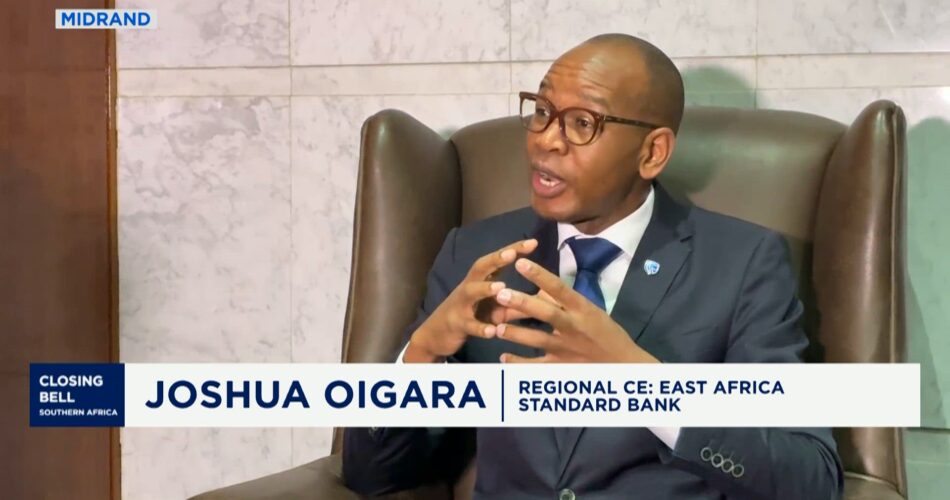
South Africa and Kenya have a huge opportunity to deepen trade and investment ties, but turning that promise into measurable economic benefits will depend on reducing cross-border friction, improving policy implementation and expanding trade-based cooperation, according to Joshua Oigara, regional chief executive of Standard Bank East Africa.
Speaking to CNBC Africa on the sidelines of the South Africa-Kenya Business Forum in Midrand, Oigara said relations between the two countries are underdeveloped relative to the size, sophistication and strategic importance of their economies. He described the forum as a potentially historic moment, especially because it preceded direct talks between the heads of the two countries, which he said sends a strong signal of confidence to investors and the private sector.
“These are two of the most dynamic economies on the continent,” Oigara said, pointing to Kenya’s strengths in digital innovation, mobile money and regional connectivity in East Africa, as well as South Africa’s deep capital markets, manufacturing capacity and financial sophistication.
In his view, the corridor linking Southern and Eastern Africa should be much more active than it is today. Bilateral trade between South Africa and Kenya currently stands at about 11.5 billion rand, with Oigara suggesting that this figure should be possible in sectors including logistics, education, infrastructure, mining, agriculture, trade and manufacturing.
For Oigara, the main issue is not the lack of opportunity, but the persistence of operational and institutional barriers. They identified payment barriers, integration gaps and inefficient transaction processes as key obstacles preventing strong commercial flows.
“What you have seen is digitalized inefficiencies,” he said, arguing that digitalization alone is not enough if the underlying systems remain fragmented. Instead, he said, businesses and policymakers need to focus on deeper integration that allows payments, goods, services and skills to move more seamlessly across borders.
The comments come as South Africa and Kenya seek to build stronger commercial ties under the broader framework of the African Continental Free Trade Area, or AfCFTA. Oigara highlighted that the first shipment of goods under the AfCFTA was between South Africa and Kenya, calling the milestone proof that the model can work and that the corridor can serve as a catalyst for broader continental trade integration.
He also underlined the imbalance in existing trade relations. South Africa is Kenya's most important trading partner on the African continent and its seventh-largest trading partner globally, but the flow of goods is heavily tilted in Pretoria's favor. According to Oigara, for every one rand Kenya effectively exports or spends in the relationship, it receives approximately 11 rands from South Africa, creating an 11 to 1 imbalance.
Still, he said the difference also highlights where Kenya's upside lies. He pointed to agriculture as an obvious area for expansion, particularly in tea, coffee and floriculture, where Kenya already has global strength. He also said industrial manufacturing and pharmaceuticals could provide further opportunities if Kenyan companies increase capacity and competitiveness.
Oigara suggested that one reason why more Kenyan companies have not entered the South African market more aggressively is that East African businesses have found it easier to expand into their immediate neighbourhood, historically one of the continent's most integrated regional blocs. He said East Africa has enjoyed strong growth of around 6% to 8% and has benefited from deeper adoption of mobile payments, savings and digital financial services.
But South Africa presents a different challenge. Its economy is home to larger and more established industrial players, particularly in mining, services and trade. For Kenyan companies to compete effectively, Oigara said they will need to scale up, strengthen capabilities and develop the confidence to “go south and scale up.”
He positioned Kenya not only as a market in its own right, but as a gateway to the broader East African corridor of some 450 million people with a median age of about 20 years. The demographic profile, coupled with rising education levels and widespread digital adoption, is making the region one of the most attractive growth stories on the continent.
Oigara also pointed to Ethiopia as another market with long-term potential. He said that although some observers have focused on headwinds, the pace of reforms in the country over the past year has been significant, particularly in finance and foreign exchange. Standard Bank was the first bank on the continent to set up a representative office in Ethiopia more than a decade ago and recently renewed its license there, a sign of its confidence in the market, he said.
On the broader AfCFTA agenda, Oigara said he is encouraged by the growing transaction volumes in African markets, including payment flows managed by Standard Bank. He said the bank is seeing double-digit annual growth of 20% to 30% in merchant-related payments activity across its network. He also highlighted progress on the Pan-African Payments and Settlement System, saying that 160 banks from 19 countries are now connected and Standard Bank was the first bank to enable that process through its local system.
Nevertheless, he argued that the biggest challenge is logistics and implementation rather than policy ambition. Although digital payments can now be made relatively easily, physical goods still face long delays at ports and borders. Oigara said it could still take 14 to 21 days to move products through African trade channels, making intra-African commerce less efficient than importing goods from outside the continent.
That's why, he said, the establishment of a new business-to-business council announced at the summit could prove crucial. The Council is expected to help create a more practical, private sector-driven mechanism to address investment barriers, registration processes, policy coordination and market-entry challenges.
Oigara said the private sector should play a leading role in translating summit declarations into concrete outcomes. He described Standard Bank not only as a participant in the Forum, but as the “architect and co-creator” of the summit, reflecting the lender's strategy to position itself at the center of trade, investment and payments integration across Africa.
Ultimately, Oigara said the success of the South Africa-Kenya trade agenda should not be measured by the number of agreements signed, but by what is implemented over the next 12 months.
The real test, he said, will be whether more businesses are operating in the corridor, whether livelihoods are improving and whether the policy commitments made at the summit are translating into tangible economic activity.
For the two major economies of the south and east of the African continent, the opportunity is clear. The challenge now is to make the corridor work at the speed and scale that business demands.