
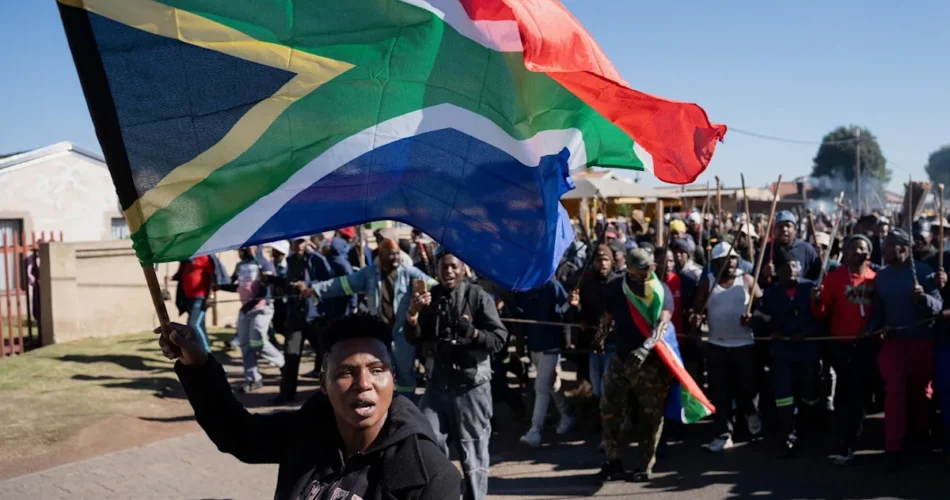
“I moved to Southern Africa because of the infrastructure there,” Fifi, a 21-year-old Ghanaian footballer who plays for the Bucks Buccaneers in the Namibian Premier League, told DW. After the football season ended, he was in South Africa on holidays when he was caught up in anti-immigrant protests. Fifi was one of a group Ghanaians who were recently repatriated From South Africa to Ghana.
South Africa has been around for a long time A destination for migrants across Africa. It offers many economic opportunities and relative political stability. It's no surprise that South Africa hosts one of the Largest migrant population on the African continent.
According to Stats SA, South Africa's national statistics agency, there are an estimated 3.3 million immigrants living in the country. This is about 5.1% of the population of 65 million. Other estimates, including undocumented immigrants, put the figure much higher.
Data shows that the majority of migrants to South Africa come from the Southern African Development Community (SADC). Under SADC rules, citizens of member states can stay visa-free in South Africa for a maximum of 90 days. But ensuring that visitors leave after 90 days is one of the major causes of recent anti-immigrant protests.
Migration trends in South Africa
“In the early '90s, you would have people coming to South Africa fleeing wars, civil wars in Mozambique,” Fredson Guillengue, project manager for the leftist Rosa Luxembourg Foundation in Johannesburg, told DW. “But later, because of the situation in Zimbabwe, large numbers of people were coming from Zimbabwe to South Africa. And in the last decade, People fleeing conflict in DRCBut also economic immigrants.”
South Africa's mining sector and industrial economy has been dependent on migrant workers for decades, leading to well-established migration routes across the region.
According to Ongama Mtimaka, acting director of the Raymond Mhlaba Center for Governance and Leadership at Nelson Mandela University, migration patterns have evolved. “The trend over the last 15 years has been migration to settle in South Africa.” Many immigrants are now settling down, forming families and becoming a more permanent feature in the country.
Recent data from Stats SA shows that most migrants settle in Gauteng, followed by the Western Cape. These migrants settle only where economic opportunities exist. But rising anti-immigrant sentiment has brought the issue to the fore.
President Ramaphosa's plan to tackle illegal migration
South African President Cyril RamaphosaAnnounced several new measures to crack down on illegal and irregular migration. He vowed that his government will not tolerate those who violate immigration laws, strengthen border security, eliminate corruption within the immigration system, close loopholes in immigration law and work with other African countries to tackle the migration challenge.
He also warned against vigilantism: “No other person is allowed, for example,Confronting someone on the street to ask for proof of nationality“
South African authorities say they have deported more than 100,000 undocumented migrants over the past two years and stopped about 450,000 illegal border crossing attempts last year.
Fifi said, “South Africa needs to create jobs, fight corruption and tackle maladministration. These are the main issues.”
Anti-immigrant groups doubt Ramaphosa's plan
Ramaphosa's assurances have done little to convince anti-migrant protesters such as the All-Truck Drivers Forum and Allied South Africa (ARDF-SA), a group critical of foreign nationals in the transport sector. “Unfortunately, South Africans feel that the government does not listen to them,” ARDF-SA interim organizer Freeman Bhengu told DW. Another anti-immigrant group, March and March, rejected Ramaphosa's proposal as impractical.
President Ramaphosa appears to have called on citizens not to take the law into their own hands, but it appears to have fallen on deaf earsRajesh Jantilal/AFP
South Africa has a total land border with six neighboring countries of approximately 4,471 km (2,779 mi). Officially, there are 53 designated land border crossings, but many footpaths, gaps in the border fence and makeshift paths exist. Experts say that it will be difficult to impose police on them.
Additionally, analysts agree that Ramaphosa's address did not outline a comprehensive plan to address the myriad issues driving migration to South Africa. Factors such as the economic and political situation of neighboring countries.
Matimka, who works at Nelson Mandela University, urged the government to avoid populist reactions and emotions and instead adopt a strategic, evidence-based approach. “It is important that South Africa does not take an anti-African stance, given that our companies are profiting from the rest of the continent,” he said.
African countries threaten lawsuits and tit-for-tat
While Ramaphosa tries to reassure South Africans and the rest of the continent, a June 30 deadline set by anti-migrant groups to expel all undocumented migrants is under threat. Malawi plans to repatriate more than 3,000 of its citizens before the deadline.Ghana has started airlifting its citizens out of the country, and Nigeria is about to follow suit.
Ghana was one of the first African countries to evacuate its citizens from South AfricaSiphiwe Sibeko/Reuters
Ghana is currently considering taking legal action against South Africa in international courts to demand compensation for its citizens following recent anti-immigrant and xenophobic attacks. The Ghanaian government has also petitioned the African Union to deal with the growing situation.
Nigeria's Foreign Minister Bianca Odumegwu-Ojukwu has categorically warned that the federal government is considering retaliation against South Africa.
Edited by: Crispin Mavakideau