
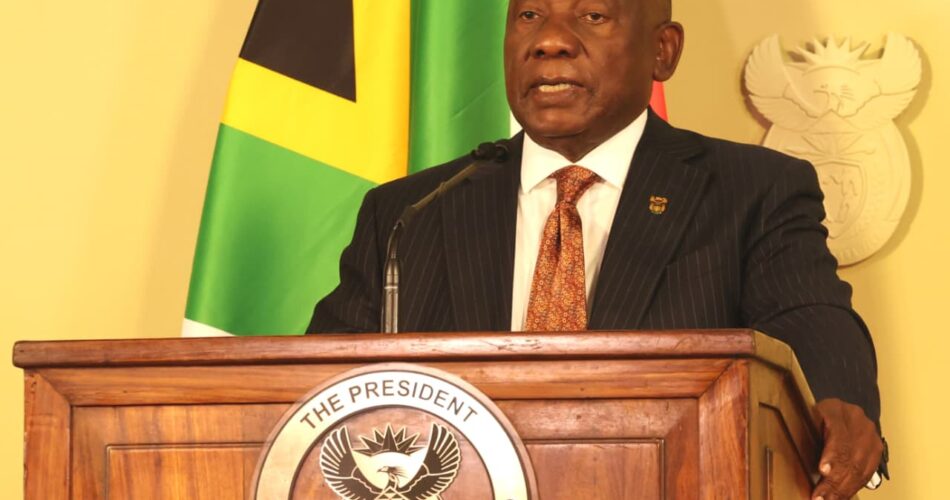
President Cyril Ramaphosa addressed the nation on the government's management approach to the recent surge in protests against illegal migration and foreign nationals. South Africa. (GCIS)
President Cyril Ramaphosa's national address on migration may be remembered as one of the most consequential interventions on the issue since the advent of democracy.
Not because it offered any fundamentally new policy position. Not because it settled the highly emotional public debate over immigration.
But because it acknowledged what many South Africans have been saying for years: migration is no longer just an issue of border management. It has become a labor market issue, a service delivery issue, a governance issue, a security issue and ultimately a development issue.
The President's speech attempted to occupy a difficult middle path between two increasingly polarized positions.
On the one hand, he acknowledged the legitimate concerns of citizens regarding illegal immigration, pressure on public services, labor market distortions, organized crime and weaknesses in immigration enforcement. On the other hand, he rejected xenophobia, vigilantism and attempts to scapegoat foreign nationals for South Africa's broader socio-economic challenges.
From a political point of view, this balancing act was necessary.
However, strategically, the more important question is whether the government has correctly formulated the nature of the problem it is attempting to solve.
From an implementation perspective, the answer is partly yes.
The President correctly recognized that migration cannot be addressed through enforcement alone. He explicitly linked migration pressures to unemployment, poverty, weak economic growth and limited economic opportunities. He further acknowledged that migration is a regional and continental phenomenon that requires cooperation with neighboring States and African partners.
This is a significant departure from simplistic narratives that portray migration as the sole cause of South Africa's economic difficulties.
Yet the speech also reveals a darker reality. Migration is not a problem. Migration is its symptom.
The underlying challenge is the interplay between migration flows and weak institutional systems.
When public services are functioning effectively, migration pressure becomes manageable. When labor markets are properly regulated, exploitation becomes difficult. When economic growth is creating opportunities on a large scale, competition for scarce resources becomes less intense. When border management systems are efficient and corruption is under control, public confidence increases.
In other words, migration outcomes are largely determined by the quality of the systems into which migrants enter.
This is where the Integrated Development Systems lens becomes useful.
Migration should not be analyzed from a single perspective. It sits at the intersection of six interdependent systems:
- The governance system is responsible for policy, regulation and enforcement.
- The economic system responsible for investment, growth and job creation.
- The labor market system is responsible for workforce regulation and fair competition.
- The social services system is responsible for health, education and municipal services.
- Security system responsible for border control and criminal enforcement.
- The Regional Development System is responsible for cooperation across Southern Africa and the continent.
When any system performs poorly, migration pressure increases. When many fail together, migration becomes politically explosive.
South Africa is experiencing exactly this convergence.
The President's speech identifies several challenges. However, implementation remains the critical missing link.
South Africa does not suffer from a lack of migration policies. Nor does it suffer from lack of law. What it suffers from is fragmented execution.
The speech outlined a series of interventions: stronger border management, faster deportations, special immigration courts, labor inspections, anti-corruption measures within Home Affairs, biometric identification systems, labor migration quotas and regional diplomatic engagement.
Individually, the interventions seem sensible. However, collectively, they raise a fundamental implementation question: who will integrate them?
Government experience shows again and again that success rarely depends on the quality of individual interventions. It depends on the quality of coordination between them.
A border management authority could strengthen border controls. The Home Ministry may modernize documentation systems. The Department of Employment and Labor can recruit inspectors. Police may increase enforcement activities. Municipalities can strengthen informal business regulation.
Yet without a common operational framework, shared data systems, integrated accountability mechanisms and coordinated execution structures, the overall impact remains limited.
The migration challenge therefore becomes less about policy design and more about implementation architecture. In fact, one of the most important sections of the President's speech may be the least discussed.
The address repeatedly stressed coordination between departments, provinces, municipalities, security agencies and regional partners. The creation of an inter-ministerial approach and strong coordination mechanisms show that the government itself recognizes that migration is a systems challenge rather than a departmental challenge.
Identity is important. But recognition alone is insufficient.
The real test will be whether the government develops the institutional capacity to manage migration as an integrated system.
The township economy provides a useful example.
The President acknowledged growing public concern about the dominance of foreign-owned spa shops and informal businesses in many communities. He also acknowledged the perception among many South Africans that they were being excluded from economic opportunities in their own neighbourhoods.
Concerns should neither be dismissed nor inflated.
The success of many Somali, Pakistani and other migrant-owned businesses cannot be understood through a migration lens alone.
It is also a story of entrepreneurial organisation, collective purchasing systems, informal distribution networks, extended operating hours, access to pooled capital and a strong business ecosystem.
So the policy question should not simply be how to restrict participation. The more strategic question is how to build an entrepreneurial infrastructure capable of enabling South African-owned enterprises to compete effectively.
Without addressing this dimension, enforcement alone is unlikely to resolve underlying economic frustrations.
The same principle applies more broadly. No amount of immigration enforcement can replace economic growth. No amount of deportations can replace job creation. No border technology can eliminate the development factors that encourage migration across regions.
The President himself clearly acknowledged this reality when he said that the long-term answer lies in investment, industrial expansion, infrastructure development and the creation of millions of jobs.
That observation may end up being the most important sentence in the entire speech.
Migration management and economic development cannot be separated. They are two sides of the same policy equation. A country that creates macroeconomic opportunities manages migration more effectively because institutions have greater capacity and citizens have more confidence in the future. A country experiencing persistent unemployment, inequality and weak development inevitably finds migration becoming a focal point of broader social frustrations.
The significance of Ramaphosa's address therefore lies not in the specific measures announced, but in the fact that the government has finally elevated migration to the level of a national system challenge.
The next phase should focus on implementation. South Africans will not judge a speech by its tone. They will evaluate it based on the results. Are borders more secure? Has corruption reduced?
Are labor laws enforced? Have local enterprises strengthened? Are public services safe? Are migration processes more efficient and more humane? Most importantly, does public confidence improve?
These are ultimately implementation questions.
Speech provides diagnosis. The country is now waiting for evidence that the system can provide a cure.
Dr. Lehlohonolo Gabriel Mambona Is an implementation systems architect specializing in institutional delivery systems, governance integration and development execution frameworks.