
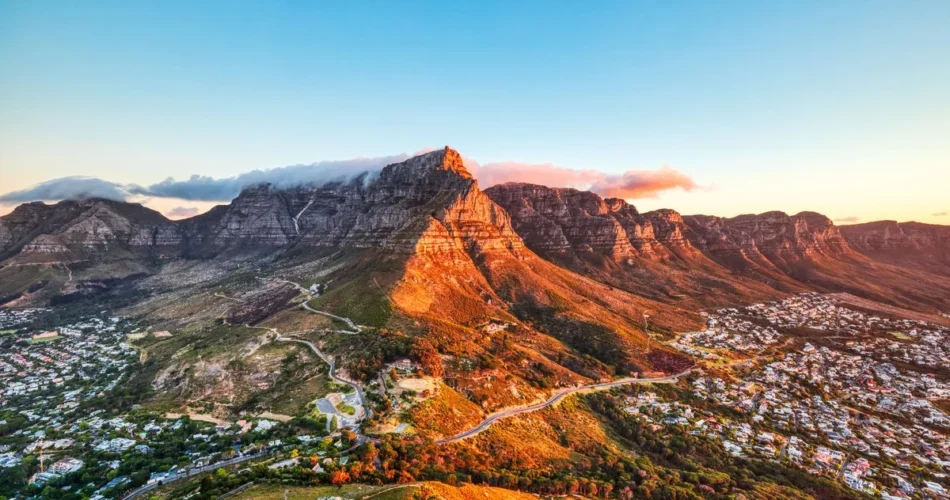
“Be aware, but don't be afraid.” This is the main advice JD van Zyl, founder of tour operator The Travel Café, would tell any tourist who is nervous about coming here. South Africa.
based in cape townjedi, who founded travel cafe With her husband, François Lebrun, she runs a boutique travel company specializing in curated small-group tours in South Africa and Southern Africa.
Wine lovers head to the winelands in Stellenbosch and Franschhoek for cellar tours and tipple tasting. Nature lovers will seek out the penguin colony at Boulders Beach or tackle the sandstone hiking trails on Table Mountain. And shopaholics will spend time browsing the outlets on Cape Town's V&A Waterfront.
This is only a small fraction of the magnetic forces that draw visitors and allow Tourism To thrive in South Africa. In fact, the country's international tourism sector fully recovered from its pandemic decline in 2025, with total arrivals reaching 10.5 million, 17 percent more than the previous year and nearly three percent more than 2019.
However, this is the same country that is very popular abroad touristsis also one of highest crime rate In this world.
Founders of The Travel Café Cape Town, François Lebrun (left) and JD van Zyl (The Travel Café)
South Africa has recently made headlines when tourists have gone missing or been found dead while travelling.
Last month, it was reported that the bodies of a South African couple, Ernst and Dina Marais, were found floating in crocodile-infested waters near Crooks Corner in the Kruger National Park, having been stabbed multiple times.
The murders repeated another incident just months earlier, which devastated a Devon family. Late last year, British tourist Lorna McSorley Tui, 71, disappeared while walking from the lodge where she was staying in the KwaZulu-Natal province during a package holiday. Locals and authorities believe that it is possible that she was murdered and her body parts were used for “muti” – witchcraft.
These incidents have been described as isolated or rare events, yet the general crime rate statistics in South Africa are high enough to worry tourists considering visiting the country.
Don't base decisions solely on statistics
South Africa counts its crime statistics based on fiscal years. The last annual report found 24,692 murders from April 2024 to March 2025. In total, 655,416 crimes were committed against the individual, including murder, assault, robbery and sexual offences. Although the numbers may rise and fall slightly, this annual report shows another decline in crime, with no significant decline in these rates compared to recent years.
On paper, these figures are shocking, but Mr van Zyl said the high numbers do not reflect what tourists will have to face.
He explained, “National crime statistics are not a reflection of what tourists experience when they are in the country. Most travelers do not have any incidents, and they leave remembering the beautiful experiences they had here.”
“We (The Travel Café) have been going for nine years now, and we haven't had a single incident of guests having any issues (with safety), and we've had thousands of guests travel with us.”
It is not just local tour companies that make this claim. David Vorster, regional security manager for Africa at International SOS, which offers travel risk management for business and personal trips, agrees.
Kruger National Park offers tourists the opportunity to see the Big Five (Getty/iStock)
He said travel to South Africa “can be done safely as long as tourists are well informed and appropriately supported during their visit”.
“The vast majority of the approximately nine million travelers who travel to South Africa each year do so without incident,” Mr Vorster said. “Although South African cities experience higher levels of crime than most other international destinations, incidents affecting tourists generally involve opportunistic crimes enabled by a lack of awareness of the threat or inadequate preparation and support.”
If a visitor is nervous, Mr. van Zyl's advice is to “be aware, not be afraid.” He describes the rest of his South African security advice as “surprisingly generic” as you'd hear in any other country.
“Be aware of surroundings. Avoid walking alone at night in unfamiliar urban areas. Use reputable transportation providers. Ask locals or accommodation staff for area-specific advice.
“And listen to your gut – if something doesn't feel right, trust your gut. These are largely the same precautions I would follow in Rio de Janeiro, New York, Barcelona and London.”
'More security than military establishment'
It is a land of contradictions. Few countries in the world have such a mainstream tourism industry, while also being home to such high levels of crime. Much of this can be attributed to deep-rooted systemic issues that allow extreme wealth inequality to affect the majority of South Africa's population. legacy of apartheid. It reminds us that travel is a privilege, and if you can travel to beautiful places like South Africa, you also have to be prepared to face sides of the destination that have been affected by complex issues.
Police Minister Firoz Kachaliya said in May that serious crime had declined nationally, but was still at “unacceptably” high levels. He said organized crime is a major factor, but most crimes are also related to social issues such as domestic violence and alcohol abuse.
“We have huge levels of crime, but most of it is concentrated in areas tourists haven't even heard of, let alone visited,” said Dominic Chadbon, a Cape Town-based tour guide.
known as Fynbos GuyMr Chadbon makes a living as a licensed tour operator, taking clients on hiking, nature and bird-watching tours around Cape Town, Cape Point, Table Mountain and beyond. Over his years of guiding, he has become an expert on where and where not to take his clients, often visiting them door-to-door.
“There is no other country with greater wealth inequality on the Gini coefficient index (a measure of income inequality). It's no big surprise, but when you're here, you realize what it really means – and that is that you can have very prosperous and safe places versus very dangerous, crime-ridden and deadly places.”
Dominic Chadbon, known as The Fynbos Guy, runs local tours in South Africa (The Fynbos Guy)
Tourists are advised to travel with valuables out of sight, be cautious in slow or stationary traffic, avoid going out at night and opt to drive to nearby locations rather than walk. Areas like the Cape Flats or downtown Johannesburg are places to avoid.
Mr Chadbon explained that tourists are not specifically targeted by criminals, rather they focus on anyone who looks rich. However, there are some areas frequented by tourists that are “extremely safe”.
In places like the V&A Waterfront in Cape Town, the Boulders Beach penguin colony, the Winelands, which get huge numbers of tourists, “there's more security there than you would see a military installation around”, Mr Chadbon said.
Tour guides also pointed out that horrific events that make headlines are incorrectly seen as representative of an entire country or even an entire continent. “As horrific as the Kruger Park incident was, it was the first of its kind,” he said. “Kruger Park is the size of Wales, so it's like committing a grisly murder in Bangor and then canceling your camping trip in Quammen.”
Rely on local advice
The South African Tourism Board says it attracts tourists because of its natural wealth and the hospitable nature of the local people. It's easy to see the allure of dramatic Table Mountain, the chance to encounter rare wildlife, and the opportunity to visit exceptional wine regions and sun-soaked beaches.
Safety concerns were the most cited reason in the Tourism Board's annual tourism satisfaction survey On why visitors may not be satisfied with their visits to the country.
“South Africa has a very violent image, but the people are very gentle and nice,” Mr Chadbon said. “It's part of the crazy comparison of things here.”
The V&A Waterfront is popular with tourists (Getty/iStock)
So how do tourists deal with this obstacle? Mr Chadbon said simply: “This is a destination where travelers have to hand over to the locals.
“So many people say to me, 'Oh, we usually do it ourselves. We did it all ourselves in Australia, we did it all ourselves in Europe.' But in Africa, engage a travel company and take local advice, as it is local knowledge that really makes the difference.”
He added, “I know how to get there. I know the people who run the place, and I don't make any missteps.”
For example, while wandering off the beaten path in Spain can lead you to a hidden gem, Mr Chadbon points out that wrong turns can be bad turns in South Africa, so it's essential to contact a local guide to help you with booking, transfers and getting from A to B.
The UK Foreign Office (FCDO) says that no travel anywhere in the world can be guaranteed to be safe. Its list of safety and security advice for South Africans can seem endless, including airport crime, street attacks, taxi app crime, scams, pedestrian attacks and unwanted attention for solo and female travellers. Despite this, there is no notice advising against travel.
While travel to the country may not be as carefree as travel within Europe, Mr van Zyl said South Africa will reward travelers who come there with “curiosity, awareness and an open mind”.
“It's a complex country, but it's one of the most beautiful, diverse and rich places on Earth,” he said. “Most visitors don't talk about the crime, but rather about the people they met, the wildlife they encountered and the experiences they will remember for the rest of their lives.”
Read more: The trip that convinced me it's worth going to South Africa for winter sunshine