
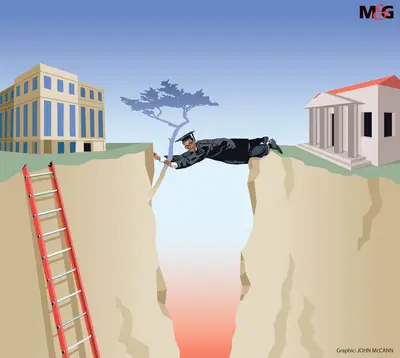
Every June, South Africa pauses to honor the courage and sacrifice of the youth of 1976. Political leaders give speeches about empowerment, resilience and the importance of investing in young people, while media platforms and social timelines are filled with commemorations that reflect the role of youth in resisting apartheid oppression and shaping the country's democratic future.
Youth Month has become a symbolic national moment that aims to recognize the importance of youth in society and reaffirm their place in the country's development path.
Yet, beyond the symbolism and annual celebrations, millions of young South Africans face a far harsher reality, defined by unemployment, economic exclusion and shrinking hope for the future. The gap between what is celebrated in June and what is experienced in everyday life has become hard to ignore, especially as youth unemployment remains one of the most persistent structural challenges.
South Africa's youth unemployment crisis is not only an economic crisis, but also a reflection of deep leadership failure in government, business and education institutions.
According to Statistics South Africa's quarterly labor force survey for the first quarter of 2026, unemployment among youth aged 15 to 24 is at 60.9%, while the rate among those aged 25 to 34 is 40.6%. These figures represent millions of young people who are either actively looking for work without success or who have been discouraged from entering the labor market.
In practical terms, this means that more than half of South Africa's young economically active population is excluded from formal employment.
Behind the statistics lies real life shaped by uncertainty and delayed progress. They are graduates who complete their studies with hope but return home without the opportunity to apply their qualifications. They are young people who spend months and sometimes years submitting CVs, attending interviews and receiving rejection or silence. They are families who invest limited resources in education in the belief that it will provide upward mobility, only to discover that there are no guarantees of transition from qualification to employment. The gap between education and employment has become one of the frustrations of a generation that was promised opportunity in a democratic South Africa.
The consequences of youth unemployment extend far beyond income. They affect dignity, identity and psychological well-being. Work is not only a source of financial stability but also the foundation of independence, social participation, and long-term life planning. When young people are unable to access employment, they are often forced to delay milestones such as financial independence, stable housing, and the ability to support their families. Over time, this creates emotional stress and a growing sense of exclusion from the broader national economy.
The youth of 1976 fought for the right to learn, yet today's youth are increasingly fighting for the right to work. The paradox is not merely symbolic, but points to a deeper question about what progress has been achieved since the end of apartheid and whether the systems that were meant to expand opportunities have largely succeeded in doing so.
While political leaders often talk about youth empowerment, entrepreneurship and innovation, these narratives often do not align with the lived reality. Leadership is ultimately measured not by rhetoric but by results. Persistently large-scale youth unemployment signals a failure in many of the systems that are supposed to provide opportunity.
Youth Month, in this context, risks becoming a moment of reflection without change, where the language of empowerment is repeated annually while structural barriers remain largely unchanged.
Government plays a central responsibility in this regard, particularly in its ability to create an enabling environment for job creation and economic growth. South Africa's economy has long suffered from weak growth, constrained investment and structural inefficiencies that limit its ability to absorb new entrants into the labor market. Policy uncertainty, infrastructure challenges, energy constraints and governance issues have contributed to an environment where job creation is inadequate relative to the size of the youth population entering the workforce each year.
In response to constraints, youth are often encouraged to pursue entrepreneurship, freelancing or informal economic activities as alternative avenues of survival and income generation.
Although entrepreneurship can play an important role in innovation and job creation, it cannot substitute for the need for a functioning and inclusive labor market. The expectation that young people must solve systemic unemployment through individual entrepreneurship shifts the responsibility away from the institutions that are largely meant to create stable employment opportunities.
The education system also plays an important role in shaping labor market outcomes. Universities, colleges and training institutes are producing graduates who often struggle to transition into employment due to the mismatch between academic training and workplace requirements.
Many graduates enter the labor market with theoretical knowledge but limited practical experience, while employers are increasingly demanding experience even for entry-level positions. The mismatch creates a structural barrier where young people qualify on paper but are left out in practice.
The private sector is not free from scrutiny. Many companies often highlight the skills shortage and difficulty of finding “work-ready” candidates, yet entry-level opportunities remain limited and structured pathways to employment are often inadequate. Internship programs and graduate schemes exist, but are not always large enough to absorb the number of young people entering the labor market and in many cases they do not guarantee long-term employment outcomes. This creates a cycle in which youth are required to gain experience in order to be employed, while being denied the opportunities needed to gain experience.
Structural contradictions reinforce inequality in the labor market. Access to employment increasingly depends not only on qualifications but also on networks, financial resources and geographical location. Young people from disadvantaged backgrounds are disproportionately affected because they are less likely to have access to professional networks, unpaid internship opportunities or financial support that would allow them to persist in looking for a job over the long term.
The result is a labor market that reproduces inequalities rather than correcting them. Therefore, youth unemployment becomes not only a symptom of economic weakness but also an indicator of deep social and structural imbalances in the country.
In this context, Youth Month risks becoming a symbolic exercise that rhetorically acknowledges young people while failing to meaningfully change their material conditions. The annual celebration of youth potential stands in stark contrast to the persistent reality of exclusion experienced by millions. This distinction between symbolism and substance is becoming increasingly difficult to reconcile in public discussion.
South Africa cannot continue to romanticize resilience while failing to provide opportunities. Without opportunity, resilience becomes endurance rather than progress. Over time, continued exclusion brings broader consequences for society as a whole, including weakened trust in democratic institutions, lower economic participation, and increasing social frustration among youth who feel disconnected from the country's economic future.
If Youth Month is to retain its meaning beyond commemoration, it must evolve into a moment of accountability that forces honest reflection on the effectiveness of the institutions responsible for youth development and job creation. This requires moving beyond speeches and symbolism to measurable progress in education-to-employment pathways, job creation strategies and private sector inclusion.
There is no shortage of talent among South African youth. There is a lack of coordination between its economic systems, educational outcomes and leadership priorities. The country is producing a generation that is capable, ambitious and educated, yet is structurally constrained from participating fully in the economy.
Unless this disconnect is addressed, South Africa will continue to celebrate a generation in speech while failing in practice. The legacy of 1976 deserves more than annual remembrance. It deserves a present and future in which youth can truly transform education into employment, potential into progress and ambition into economic dignity.
Nancy Dusani is a graduate of Public Relations and Communications from the University of Johannesburg and is pursuing an Advanced Diploma in Strategic Communications. She is interning at Decode Communications, a pan-African communications agency in Johannesburg.