
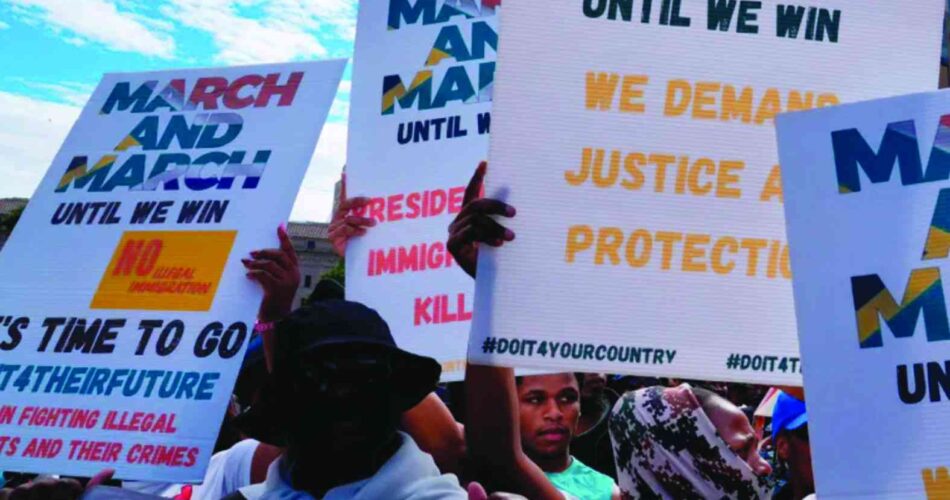
South Africa is seeing an alarming rise in anti-immigrant sentiment.
In recent months, vigilante groups have marched through communities, businesses have been targeted and migrants have increasingly been blamed for crime, unemployment and the collapse of public services.
The anger felt by many South Africans is real.
Millions of people face hardship daily.
Unemployment remains the highest in the world.
Poverty and hunger plague working-class communities.
Young people struggle to find work.
Public services are under immense pressure.
The entire community feels abandoned by political leaders who promised a better life but have failed to deliver.
Migrants did not cause the unemployment crisis in South Africa.
They did not cause the collapse of local government.
He did not industrialize the economy.
They did not cut public spending, close factories, privatize public services, weaken labor protections, or allow corruption to flourish.
Many of South Africa's crises have deep roots.
The country's extreme inequality is the result of centuries of colonial dispossession, racial capitalism and apartheid exploitation.
The democratic breakthrough of 1994 ended political apartheid, but it did not fundamentally change economic structures that continue to concentrate wealth, land, and economic power in the hands of a small minority.
Today, millions of South Africans are suffering the consequences of that failure.
Economic growth has been weak since the 2008 global financial crisis.
There has been a decline in manufacturing.
Stable employment has been replaced by precarious work and increasing informality.
Young people enter the labor market with little hope of secure employment.
The frustration generated by these situations creates fertile ground for scapegoating.
History teaches us that in times of economic crisis there is often an attempt to blame vulnerable groups rather than confronting the real sources of social suffering.
Instead of challenging those who benefit from inequality, attention is drawn to migrants, refugees and other marginalized communities.
This pattern is not unique to South Africa.
Across Europe, far-right political movements have gained support by blaming migrants for economic insecurity.
In the United States, anti-immigrant rhetoric has become a central feature of political discourse.
Similar trends have emerged as economic crises deepen and social divisions intensify in Latin America and elsewhere.
This distraction strategy is remarkably consistent.
People are encouraged to direct their anger horizontally toward other working-class people, not toward those who hold economic and political power.
When workers are divided by nationality, language, ethnicity or race, those who profit from exploitation emerge stronger.
Employers relying on cheap and vulnerable labor benefit when workers compete against each other rather than organizing together.
Corrupt politicians benefit when the public becomes frustrated with their failures.
Economic elites benefit when public debate focuses on immigrants rather than inequality, unemployment and wealth concentration.
This does not mean that governments should ignore immigration policy or border management.
Each country has the right and responsibility to regulate migration according to its own laws.
South Africa's immigration system needs reform.
The Home Department needs more capacity and resources.
Corruption within immigration and law enforcement institutions must be dealt with decisively.
Human trafficking and criminal networks that exploit vulnerable people must be dismantled.
Employers who knowingly exploit undocumented workers to avoid labor laws will face serious consequences.
At the same time, it needs to be made clear to disaffected youth that the solution cannot be vigilantism, mob justice or xenophobic violence.
No society can solve unemployment by attacking foreign nationals on the streets.
No economy will create jobs through intimidation and fear.
When vigilance replaces the rule of law, no community can be safer.
The Constitution of South Africa, born of a struggle against oppression and exclusion, demands a different path.
It affirms the dignity of all human beings and rejects discrimination.
These principles are not an obstacle to social justice; They are the essential foundation to achieve this.
At this time the labor movement has a special responsibility.
Trade unions were built on the principle that an injury to one is an injury to all.
Workers may come from different countries, speak different languages or have different identities, but they have a common interest in decent work, fair pay, safe workplaces and social justice.
The labor movement needs to press for clear and effective state policies on job creation, industrialization, public investment, quality public services and redistribution of wealth and opportunity.
It needs to put pressure on the government to tackle corruption, enforce labor standards, and meet the needs of its people.
South Africans face a choice.
We can follow the path of scapegoating, fear and social fragmentation or we can confront the real causes of our crisis and build solidarity in communities.
Only the second path offers any hope of justice, equality and lasting social peace.
lZwelinzima Vavi is the General Secretary of the South African Federation of Trade Unions