
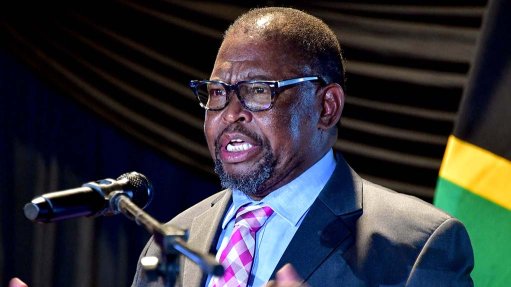
Fellow South Africans, members of the media, and colleagues in government,
Local government is the frontline of our democracy. It is in our municipalities, whether in bustling metropolises or rural towns, that citizens experience the state most directly. Municipalities are tasked with providing civic, social and economic infrastructure services: water, electricity, sanitation, housing and roads.
They are the guardians of community welfare, engines of local economies and guardians of social stability, thus, the financial conduct of municipalities has far-reaching socio-economic significance.
While public expectations have risen, the fragility of municipal finances and services has been exposed. The mismatch between municipal revenue authority and expenditure responsibilities has become a worrying factor, and its consequences are felt daily by households and businesses through service delivery challenges.
Importantly, this weakness is not simply the result of external socio-economic pressures such as rising wholesale service costs, consumer debt or weak local economies.
An important part concerns the internal organization of municipal finance itself. Many councils continue to adopt unfunded budgets, fail to process unauthorized, irregular, fruitless and wasteful expenditure (UIFWE) through their Municipal Public Accounts Committees and neglect results management.
These internal weaknesses, poor governance structures, lack of accountability and ineffective financial oversight add to external challenges and directly undermine service delivery.
There is therefore a need for a dual approach to addressing municipal financial vulnerabilities, improving internal financial management practices as well as tackling systemic socio-economic pressures. Only by strengthening both dimensions can municipalities achieve credibility, deliver services reliably and restore public confidence.
It is against this background that National Treasury has taken the extraordinary but necessary step of temporarily pausing the July 2026 equitable share transfers to sixty-nine municipalities. This decision taken under Section 216(2) of the Constitution and Municipal Finance Management Act (MFMA) is not punitive. This is corrective. It is designed to establish fiscal discipline, protect public funds, and ensure that municipalities comply with the law.
Why was this action necessary?
Despite years of support, guidance and training, many municipalities are doing the following:
- Adopt a non-funded budget;
- Deposit unauthorized, irregular, fruitless and wasteful expenditure (UIFWE);
- Failed to meet statutory obligations to Eskom, the Water Board, SARS, the Auditor General and the Pension Fund.
The numbers are worrying:
- Over 2021-22, municipalities have spent R24.12 billion in redundant and wasteful expenditure.
- They have accumulated R145.21 billion in irregular expenditure, with R40.14 billion in 2024–25 alone.
- They revealed R118.13 billion in unauthorized expenditure, more than half of which was on non-cash budget items.
- Budget credibility has deteriorated: in 2024–25, 116 municipalities, almost half, adopted unfunded budgets.
- By year end, municipalities owed R3.40 billion in interest to Eskom and R1.21 billion to the Water Board, while 48 municipalities owed third-party deductions.
This threatens the financial stability of wholesale suppliers, weakens statutory bodies and disrupts service delivery. Non-payment to service providers results in penalties, interest charges and service interruptions. Weak governance and failure to process UIFWE through Municipal Public Accounts Committees (MPACs) undermines accountability and public trust.
South Africans deserve municipalities that are economically strong, accountable and capable of delivering services. By invoking the Constitution, we are signaling seriousness about governance, fiscal responsibility and the rule of law.
This is not new and is not a punitive measure intended to punish municipalities.
We are fighting to improve governance within municipalities and with it the quality and continuity of service delivery, as well as tackle the harmful culture of non-payment.
Restoring the credibility of public finances at local and national level is a vital part of our growth strategy and we cannot turn our backs on the measures that get us there.
It's about protecting the integrity of our institutions, ensuring that public money serves the public, and restoring trust in local government.
Our work is to ensure that corrective measures are understood as safeguards, not sanctions. We have to demonstrate that fiscal discipline and service delivery can co-exist.
This is the moment to restore accountability, with the government standing firmly on the side of citizens, protecting their money, their services and their future
What are we going to do as a national treasury?
The funds are being redirected in tranches directly to Eskom, water boards and statutory bodies to safeguard electricity, water and pensions. Municipalities that demonstrate compliance will have their transfers reinstated.
Targets include a 15% reduction in irregular expenditure balances by August and 15% reduction by September, evidence of funded budgets, functioning disciplinary boards and results management.
This approach ensures that essential services continue while municipalities are forced to correct their financial practices. Provincial treasuries will monitor compliance, and National Treasury will continue to provide support through circulars, engagements and training.
The selected municipalities are: Eastern Cape – Buffalo City, Nelson Mandela Bay, Makana, Sundays River Valley, Inxuba Yethemba, Port St. John's; Free State – Mangaung, Letsemeng, Kopanong, Mohokare, Zaharip District Municipality, Massillonya, Tokologo, Matzhabeng, Nala, Dihalbeng, Nketoana, Maluti-a-Phofung, Phumelela, Mantsopa, Ngwathe, Mafube; Gauteng – City of Johannesburg, Emfuleni, Lesedi, Sedibeng District Municipality, Merafong City, Rand West City; KwaZulu-Natal – iMpendle, uMzinyathi District Municipality, Newcastle, eMadlangeni, Amajuba District Municipality, AbaQulusi, uMchanyakude District Municipality; Limpopo – Mopani District Municipality, Musina, Thabazimbi, Modimole-Mukgopong, Phetakgomo Tubatse; Mpumalanga – Victor Khanye, Imakhzeni, Nkomazi; Northern Cape – Kamiesberg, Khai-Ma, Ubuntu, Umsobomvu, Mthanzeni, Renosterberg, Thembelihle, Siathemba, !Kai!Garibe, Magareng, Phokwane; North West – Madibeng, Kgatalengrivier, Tsvaing, Mafikeng, Ditsobotla, Ngaka Modiri Molema District Municipality, Naledi, Mamusa, Dr Ruth Segomotsi, Mompati District Municipality, Matlosana City, Makwasi Hills, JB Marks; Western Cape – Thewaterskloof, Langsburg and Beaufort West.
Municipalities have been given adequate notice in writing and urged to take measures to change their financial management situation before the funds are stopped. They were also given a platform to send in writing why their money should not be withheld.
Prior to the withholding of funds, National Treasury has provided assistance to municipalities by issuing MFMA circulars that guide municipalities on what they must do to ensure compliance with specific provisions of the MFMA and its regulations; through one-on-one municipal engagements; and various training interventions either directly with municipalities or through nationally or provincially facilitated forums.
Despite these support interventions, many municipalities still fail to comply with the provisions of the MFMA and its supporting regulations insofar as they relate to adopting funded budgets, addressing UIFWE and ensuring that statutory commitments are met when due.
Non-compliance with the law is not only a dereliction of fiduciary duties by the political and administrative leadership of municipalities, but it is also jeopardizing the financial stability of the wholesale suppliers (Water Board and Eskom).
Furthermore, failure to make payments to third parties negatively impacts the ability of statutory bodies to continue optimal operations. The statutory bodies referred to are the Auditor General of South Africa (AGSA), the South African Revenue Service (SARS), and the Financial Sector Conduct Authority (FSCA).
The persistence of UIFWE is also indicative of weak governance within municipalities and there are instances where this negatively impacts financial deficit as well as service delivery. Additionally, non-payment to service providers leads to unnecessary and wasteful expenditure due to interest and penalties and disruption in service delivery. Some affected municipalities have failed to process UIFWE in accordance with section 32 of the MFMA.
Section 32 of the MFMA provides that a municipal council must recover UIFWE from liable persons unless, after investigation by a council committee, the expenditure is certified as irrecoverable and written off.
The council committee referred to in section 32 is the Municipal Public Accounts Committee (MPAC). Some municipalities have failed to properly deal with UIFWE because the MFMA requires municipalities to investigate such expenditures, determine accountability, recover losses where appropriate, and take corrective action.
National Treasury has found that many municipalities have not processed UIFWE cases through their MPACs who are responsible for overseeing accountability in some municipalities.
This means that the MPACs are not working effectively. Furthermore, some affected municipalities have also failed to demonstrate that results management is being implemented, including on a timely basis. This includes referrals to disciplinary boards, investigations, disciplinary actions, recovery stages and, where necessary, criminal referrals. These duties arise under Chapter 15 of the MFMA read with the Municipal Regulations on Financial Misconduct Procedures and Criminal Proceedings, 2014.
in conclusion
Transfers will resume after municipalities fulfill the required conditions and submit proof. Compliance will be strictly monitored. City councils should take action on UIFWE through their MPACs, compensate for losses and implement consequences management. Political and administrative leaders must perform their statutory duties.
National Treasury will continue to work with municipalities, provincial treasuries, COGTAs and other cooperative governance structures to strengthen sound financial management. This is not a one-time intervention. It is part of a broader effort to restore credibility, accountability and stability in local government.