
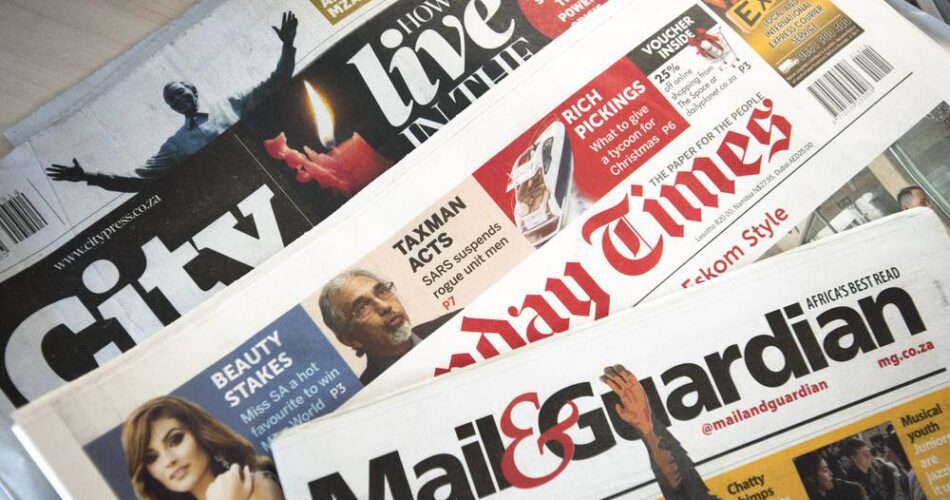
Dying breed: In the 1980s and early 1990s, labor reporting became an important part of South African journalism. Photo: supplied
As the country celebrates the 32nd anniversary of May Day since its democratic breakthrough, an uneasy question arises: who will tell Labour's story and how, in a context where Labour's heartbeat is increasingly missing from the mainstream media?
Throughout much of South Africa's democratic journey, labor occupied a visible space in the public debate. Workers were present not only in protest actions and bargaining rooms but also in daily news reporting.
Labor disputes, wage struggles, and union intervention were once considered central political developments because they reflected broader questions of democracy, citizenship, and social justice.
But today that visibility has become very weak. Labor appears less in the headlines and when it does, it is often limited through economic language rather than its broader democratic meaning.
In the 1980s and early 1990s, labor reporting became an important part of South African journalism. Newspapers followed strikes, factory occupations, wage negotiations and worker mobilization as major developments shaping the anti-apartheid struggle. Journalists understood that workplace conflicts were inseparable from larger political battles.
This was a period that scholars such as Philip Hirschsohn describe as social movement unionism, a form of unionism in which workplace demands were linked to broader community and political struggles.
However, some argue that, after apartheid, organized labor movements such as Cosatu moved towards “political unionism” by becoming part of alliances with the ANC and SACP, as noted by Devan Pillay.
Nevertheless, the visibility of labor changed with the restructuring of the media industry after 1994. This was a period when some sections of the alternative press shifted toward commercially driven operations as donor funding declined and market pressures intensified.
In this context, newsrooms were forced to reduce specialist reporting areas. Labor journalism was one of the first casualties. Dedicated labor reporters dwindled, newsroom layoffs intensified, and many publications focused on areas considered more commercially lucrative.
The result is that labor now appears in the news mainly in moments of crisis. Strikes are covered when they disrupt production, transportation or public services.
Pay disputes become news when they affect markets or investor confidence. The language of reporting often foregrounds costs, instability, and economic harm, while paying less attention to why workers mobilize, what conditions they face, and what broader structural inequalities shape labor conflict.
This change is also visible in publications such as mail and guardianOne of the few surviving titles of South Africa's alternative press tradition.
During apartheid, alternative newspapers considered labor central to the democratic struggle. But, like many institutions in the post-apartheid media environment, they have had to adapt to commercial realities. Labor pain remains present but less frequently than before and through more episodic treatment.
This is not simply a matter of editorial preference. This reflects deep structural changes in how news is produced under capitalism. In the commercial media environment, newsworthiness increasingly follows profitability.
Expert reporting that requires historical depth, institutional memory, and long-term attention becomes expensive to maintain. Labor reporting, which depends on context and continuity, is affected in such circumstances.
The consequences are serious. Labor remains central to South Africa's democratic life. Questions of wages, public services, unemployment, social inequality and economic restructuring continue to shape everyday political life. Yet journalism is increasingly struggling to represent these questions through workers' own voices.
Even when labor leaders appear in the media, their contributions are often limited to immediate economic results. Public discussion quickly turns to production losses, fiscal pressures or market reactions. The larger political meaning of labor as a democratic force disappears.
Ownership patterns further deepen this trend. South Africa's media is concentrated within a small number of corporate groups. Of course, such concentration does not mechanically determine content, but it does influence editorial priorities and newsroom culture.
Labor perspectives therefore compete in an environment where the voices of business, finance and political elites are often structurally privileged. This helps explain why labor anniversaries, worker campaigns and union interventions do not receive the same sustained attention as corporate developments or financial events. Labor often appears only when conflict becomes unavoidable.
Another complication is now emerging through artificial intelligence. Since the advent of generative AI systems, newsrooms have increasingly adopted digital tools to summarize reports, automate routine tasks, and accelerate content production.
In South Africa, editors are cautiously integrating AI due to financial pressures and newsroom constraints. But this technological change raises a significant concern.
If labor reporting has already weakened due to reduced human capacity, automation may accelerate this trend. AI systems rely on existing datasets and visibility of key patterns. Where labor is already under-represented, automation risks reproducing that absence.
This means that the marginalization of workers is no longer just an editorial issue; Instead, it may become embedded in digital systems of knowledge production in the future. Without conscious intervention, technology can deepen an already unequal communication field.
So the issue goes beyond restoring the traditional reporting beat. It is related to democratic communication only. A democracy in which workers are less visible in public storytelling risks undermining public understanding of inequality, labor rights, and economic justice.
South Africa needs a renewed public interest journalism capable of restoring balance. Community media, labor publications, progressive digital platforms, and public broadcasters have an important role to play in ensuring that labor remains visible in the national conversation.
Digital tools, including AI, can support this work, but only if they are guided by ethical commitments that prioritize social inclusion over speed alone.
So the disappearance of the labor beat is not just a newsroom issue. This reflects a widespread weakening of class visibility in public discourse. Journalism that loses labor loses part of its democratic function.
As the country celebrates another May Day, the central question is not one of nostalgia for a past media moment. The question is whether democratic communication can still make workers visible enough to equal their continuing role in shaping South African society.
If labor disappears from the headlines, an important part of democracy also disappears from public understanding.
Mandla J. Radebe is Professor of Strategic Communications at the University of Johannesburg and author of Apartheid Did Not Die: South Africa's Unfinished Revolution. He writes in his personal capacity.