
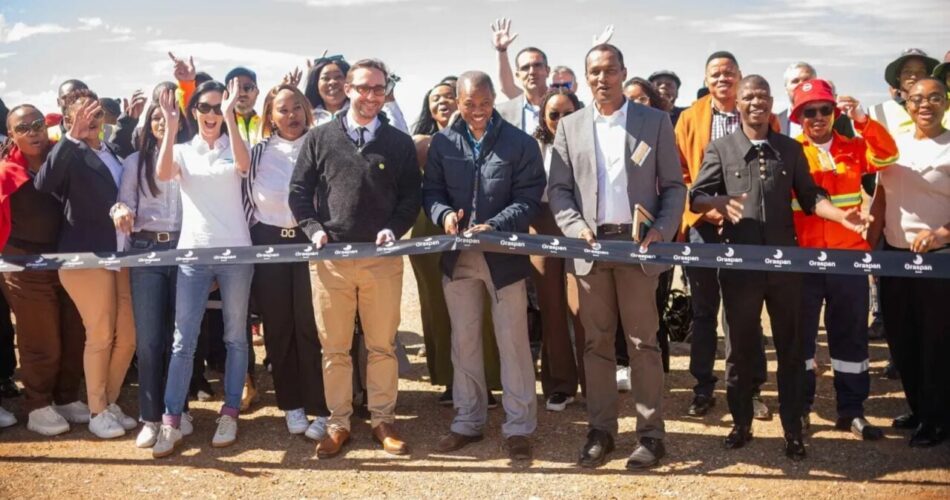
The project was awarded as part of South Africa's Renewable Energy Independent Power Producer Procurement Program (REIPPPP) scheme, a government-backed program to provide offtake agreements for renewable energy projects. Graspan was announced in bid window 5 of the REIPPPP programme.
“These projects demonstrate what matters most in the current environment, which is implementation,” said Sanjeev Mungru, managing director of renewable energy and batteries at ENGIE South Africa. “Graspan is an operating asset contributing electricity to the grid today. This is important as South Africa works to reduce its supply gap and build a more resilient electricity system.”
South Africa is known for its grid instability, which has reportedly led the national grid operator, Eskom, to conduct “load-shedding” or planned blackouts to manage demand and supply.
The country has set quite ambitious targets for new renewable energy capacity development – Minister of Power and Energy, Kgosiantsho Ramokgopa, announced plans to add approx. 29GW of new solar PV capacity across South Africa By 2039, with 35GW of wind power capacity. Recently, the government approved the South African Renewable Energy Master Plan (SAREM), which will aim to add 5GW of new renewable energy capacity every year.
In an announcement, Pele Green Energy said: “Beyond its immediate contribution to supply, Graspan is part of a broader shift in the way energy infrastructure is delivered in South Africa. As more renewable capacity comes online, projects like Graspan play a stabilizing role within a diversified generation portfolio, complementing other technologies and reducing reliance on a single power source.”
Pele has developed more than 2GW of renewable energy capacity across South Africa, notably the 100MW Sonnevanger solar plant, which it is developing on behalf of mining giant Glencore. The site is under construction EPC contractor JUWI RENEWABLE ENERGY Using modules from Chinese solar manufacturing giant JA Solar.