
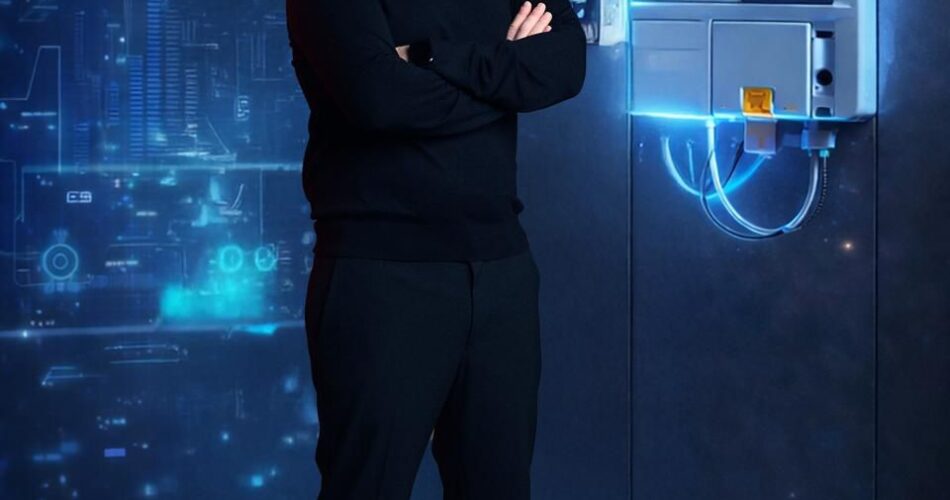
Can the necessary infrastructure drive the next wave of financial inclusion? Will utilities evolve as major players in consumer finance? And who should drive household data in this emerging market?
For more than a decade, Africa's fintech story has become synonymous with mobile money. Services like M-Pesa have reconfigured payments, savings and micro-credit, creating new business models and bringing millions of people into formal financial activity. They showed that innovation could overtake traditional banking and still achieve scale.
But as mobile money matures, a quiet debate is taking shape among regulators, utilities, investors and policymakers across the continent. The central question is deceptively simple: If mobile behavior powered the previous era of inclusion, could everyday utility behavior power the next era?
At the center of this discussion sits a largely unglamorous device – the prepaid utility meter. Millions of these meters are now installed inside African homes and small businesses, continuously recording consumption and payment behaviour. Unlike mobile use, which may be sporadic, utility use is continuous and essential. Households may give up digital transactions for a few days, but their need for electricity or water rarely stops.
That distinction matters. Mobile data is often divided across SIM cards, devices and wallets. In contrast, meter data is tied to a fixed location and rooted in basic household needs. In countries where large sections of the population remain “thin file” or invisible to formal credit systems, this consistency provides a potentially transformative source of behavioral insight.
A growing number of companies are experimenting with utility-linked finance. Some offer simple emergency loans when prepaid balances run out; Others are testing integration with meter vendors or billing platforms. The sector remains early stage and uneven in quality.
Among the more ambitious entrants is Finergy, which has adopted an explicitly intellectual property-led strategy rather than treating utility finance as a short-term product. The company is led by CEO and co-founder Avi LaSarro, who previously helped grow Prenetics into a global diagnostics business and led it through a NASDAQ IPO. Analysts say their approach is consistent: secure secure patents first, embed technology in regulated systems, and treat innovation as infrastructure rather than marketable add-ons.
Finnergy's model does not rely on consumer apps. Instead, its architecture is designed to sit behind the meter and within the utility workflow. Its patents attempt to formalize how utility data can trigger, control, and recover small advances by aligning with existing utility operations. This matters because simple stopgap loans are easy to counterfeit; There are no deep, multi-vendor integrations and embedded recovery mechanisms.
In practice, the system works as follows. When the prepaid balance gets low and the family faces a disconnection, a small automatic advance amount can be increased. The consumer does not download a new app or negotiate for a loan separately. The support meter is built into the experience and is gradually repaid through future top-ups.
Proponents argue that it addresses structural weaknesses in earlier mobile-based lending. SIM swapping, handset change and wallet deactivation have often weakened identification and repayment. In contrast, a meter is installed at home and is used continuously, creating a more stable behavioral footprint.
For households, the immediate benefit is the continuity of essential services during short-term cash stress. For utilities, potential benefits include fewer connections, smoother revenue flows and lower reconnection costs. For regulators, the model could reduce reliance on subsidies while improving service flexibility.
Perhaps the most disruptive implication concerns the role of the utilities themselves. If utility-linked finance scales, electricity and water providers could shift from pure infrastructure operators to influential financial intermediaries. They already have nearly universal reach, trusted billing relationships, and rich behavioral data on household spending patterns.
With proper administration, utilities can offer structured hardship buffers or micro-advances as part of standard service. It redefines the utility not just as an energy provider, but as a fundamental financial actor embedded in daily life.
It also reshapes competition. The next battleground in African fintech may not just be pitting banks against digital lenders; This could see financial institutions competing with the utilities themselves. Over time, utilities may become important players in consumer finance, especially for low-income households that banks have long neglected.
Beyond credit, the deeper opportunity lies in meter data. These tools capture how households budget under pressure, how they prioritize spending and how they respond to economic shocks. If handled responsibly, this data can complement banking and telecommunications information to create a more accurate picture of domestic reality.
See bank deposits.
Wallet flow is visible in telecom.
The meter shows how families really live.
Across Africa, where inequality, unemployment and energy access remain severe, this visibility could expand financial identity for millions of people. The combination of utility, telecom and banking data – under strong regulation – can enable unbiased risk assessment compared to any single dataset alone.
Yet the risks are real. Integration with national and municipal utilities requires technical depth, political sensitivity and long-term partnerships. This is not a digital app that can scale overnight; This is critical infrastructure that must work reliably for vulnerable families.
Governance will be decisive. Utility data is sensitive. Clear rules on consent, transparency, pricing, dispute resolution and consumer protection will determine whether this model empowers families or establishes new forms of dependency.
Finergy positions itself not as a lender, but as an infrastructure that enables utilities to participate in financial inclusion securely and at scale. Its patent portfolio is designed to assure utilities that integrations between vendors are robust, defensible, and interoperable.
Some analysts see this as a potential third wave of African fintech. The first wave focused on payments. The second focused on debt. A third – rooted in essential infrastructure rather than discretionary finance – could tackle both inclusion and sustainability simultaneously.
If this proves true, the simple utility meter – long dismissed as a simple household appliance – could become one of the most important engines of Africa's financial identity and resilience.
When asked about this change, Avi Lasaro said:
“The most transformative fintech innovations in Africa may come not through smartphone screens, but through the cool wall-mounted box that powers every home.”
Whether that cool box will become Africa's next financial engine will depend on implementation, regulation and trust – a debate now going on far beyond the energy sector.