
The South African Revenue Service (SARS) has collected more than R2 trillion in tax revenue in the 2025/26 financial year, the first time the country's tax taking has crossed that threshold and part of what the agency says is a structural reform of revenue administration rather than a temporary windfall from commodity prices.
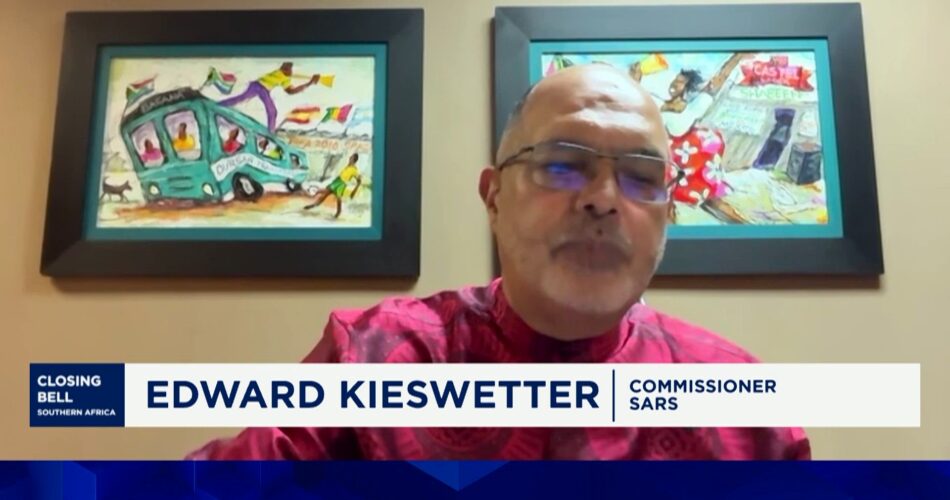
The total was R155 billion, or 8.4%, higher than the previous financial year, according to outgoing SARS Commissioner Edward Kieswetter, who said the result reflected broad-based tax collection performance across the economy, not just growth from mining profits or a favorable commodity cycle.
Speaking in a television interview after the figures were released, Kieswetter rejected the idea that South Africa's strong revenue result was driven primarily by precious metals miners. While acknowledging that commodity cycles may have spillover effects, he said mining and quarrying made a relatively modest contribution to the overall tax burden.
“Individuals are still the largest contributor to finances,” Kieswetter said, adding that personal income tax contributed R794 billion. This was followed by a value-added tax of about R500 billion, and customs and excise duties, totaling about R500 billion. In contrast, companies contributed R350 billion, making corporate tax the smallest of the major categories highlighted by them.
Kieswetter said that the largest contributions within company taxes came from the financial, business services and insurance sectors, not mining. Mining and quarrying contributed about R25.5 billion, he said.
The decline is significant for investors and policymakers as it shows that South Africa's revenue base remains largely dependent on household income and consumer activity, with lower-than-expected contributions from sectors often associated with cyclical windfalls. The Commissioner argued that this demonstrated the flexibility of the tax authority's performance in changing business cycles.
“SARS has outperformed the economy throughout the business cycle,” he said. “It says revenue performance is not cyclical. It's structural.”
He said this structural reform stems from years of investment in compliance, enforcement, data capabilities and technology. Kieswetter credited the work of SARS's 14,500 employees, saying they have diligently pursued efforts to clear outstanding debts, late returns, audits, investigations, additional assessments and broaden the tax base.
According to the Commissioner, those efforts have generated approximately R360 billion of additional revenue that would not otherwise have formed part of the tax base. He described the gains not as the result of any one intervention, but of “many, many little things” that collectively increased the collection.
Compliance revenues emerged as one of the standout themes in the latest performance. Kieswetter said compliance-related collections exceed R300 billion, which is about 15% of total revenues. He linked that result to a revised operating model that combines employee capabilities, data insights and increasingly advanced technology.
SARS now processes about 30 million tax returns across VAT, personal income tax, company tax and other categories, he said. What once took months or years to assess can now be done in seconds. Previously, an individual valuation could take an average of six months, while a company valuation could take three to four years. Today, SARS can complete an assessment in less than five seconds, according to Kiesewetter.
He said that this boom has been made possible by data science, machine learning algorithms and artificial intelligence. In addition to expediting evaluations, those tools also allow the agency to identify and prevent impermissible and fraudulent refunds.
Over the past seven years, the deployment of data science, AI and staff efforts has helped SARS raise an additional R1.6 trillion in revenue, Kieswetter said. This includes a total of more than R650 billion in fraudulent or inadmissible refunds that the agency had blocked from paying.
Strong revenue performance could also strengthen the argument that better governance could reduce pressure for tax increases in the near term. South Africa's recent budget cycle included debate over a potential VAT increase, but Kieswetter said SARS had consistently argued that more efficient revenue administration could help avoid such a move.
“I don't think any finance minister can ever say that it is not entirely appropriate to increase taxes,” he said. “But we have consistently said that we believe we can avoid an increase in VAT by more efficient revenue administration.”
Kieswetter said the latest result provides “indisputable evidence” that increased investment in SARS can be translated into additional collections. In his view, this has helped negate the need for a 2 per cent VAT increase this year and such measures can be deferred in the future if the Revenue Service remains adequately funded.
He also described what he described as a large revenue gap of between R500 billion and R600 billion, arguing that this should be a primary area of focus for the government rather than placing a heavy burden on already overstretched taxpayers.
Nevertheless, the Commissioner cautioned that risks remain for the year ahead, particularly from higher fuel prices, disrupted trade flows and the uncertain global geopolitical backdrop. While South Africa's direct trade dependence on the Middle East is relatively low, the country remains highly sensitive to oil imports from the region.
“Eighty percent of our oil comes from that part of the world,” Kieswetter said, noting that both price and supply security can affect inflation, consumers and ultimately tax receipts such as VAT.
He declined to make any concrete forecasts for VAT collections in the next financial year, saying the outlook was very uncertain and dependent on global conflicts and the course of energy markets. But he said that, all else being equal, SARS had demonstrated that it could be a “first resort” for the finance minister when looking for additional revenue before a tax increase.
This milestone also highlights the pace of SARS' long-term spread. The interviewee said it took the agency 10 years to take revenue collection from R1 trillion to R2 trillion. With compliance systems becoming more efficient and technologically sophisticated, the question for South African financial authorities will now be whether the next trillion can be reached faster and more sustainably.
For now, the record collection gives the government a welcome fiscal buffer and provides new evidence that tax administration reforms can have a significant impact on state finances, even in a sluggish growth environment. It also reinforces the central role of households and consumption in South Africa's tax base, a reality that may shape budget choices in the years to come.