
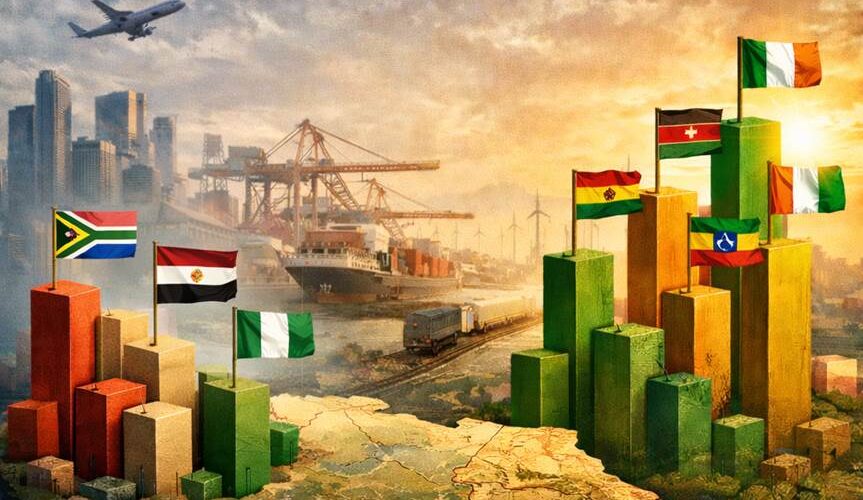
For decades, Africa's economic identity rested in a familiar trinity: South Africa, Egypt and Nigeria. Overall, these three countries made up the bulk of the continent's economic output in nominal terms. According to the International Monetary Fund's latest projections for 2026, South Africa's economy is expected to reach about $444 billion, Egypt's about $399 billion and Nigeria's about $334 billion.
“For years, the spotlight has been on these three giants. But a new wave is rising, and it's impossible to ignore,” Ali Imam, business director of MEA and Turkiye at Evonik, said on his LinkedIn handle. This shift is now visible in countries that are quietly crossing the $100 billion GDP threshold and reshaping Africa's economic geography in real time.
According to IMF estimates, Kenya's economy is expected to reach about $141 billion, while Ethiopia's is on pace to reach about $126 billion. Ghana and Côte d'Ivoire are both estimated to exceed $110 billion, while Angola lags behind at $110 billion. The World Bank said that although African economies have shown resilience in the face of global shocks, growth remains uneven across countries, underscoring the gap between established and emerging economic centres.
Overall, these data point to a clear change. Growth is no longer concentrated in a handful of major economies, but is increasingly distributed across many regional centers of activity.
Also read: Nigeria bets on satellites, startup partnerships to unlock $1.5 billion digital economy growth
3.3 trillion dollar economy
Africa's total nominal GDP is projected to reach approximately $3.3 trillion in 2026, closer to $3 trillion than previously estimated. Analysts attribute this expansion to structural reforms, demographic growth and deeper integration into global value chains. The IMF says that in 1990, the continent's GDP was about $631 billion, meaning Africa's total economic output will more than quadruple by 2026.
This scale changes the narrative from untapped potential to current economic reality. Investors, policymakers and strategists are increasingly recognizing that while the largest economies remain important, most of the growth momentum is emerging from mid-tier markets.
According to the IMF, growth in sub-Saharan Africa is expected to be strong in the near term, supported by a decline in inflation and an improvement in private consumption and investment. East Africa provides a clear example of this. Kenya's economy is not only exceeding nominal limits but also expanding at a steady pace. According to the Kenya National Bureau of Statistics, gross domestic product growth in the third quarter of 2025 accelerated to 4.9 percent year on year from 4.2 percent in the same period last year, supported by improvements in construction and agriculture.
In other emerging markets, growth is increasingly multidimensional. The African Development Bank has highlighted that services now account for an increasing share of economic expansion in many African economies, reflecting a gradual move away from reliance on goods alone. Ghana is benefiting from cocoa, gold and energy exports, while Côte d'Ivoire is strengthening its position as a regional transport and logistics hub. Together, these trends show that Africa's development is broadening in both scope and structure.
shifting the axis of influence
The implications of this change are far-reaching. Economies once considered peripheral are becoming important nodes in regional supply chains. Investments in infrastructure, from ports in Mombasa and Tema to rail links across West Africa, are strengthening inter-African connectivity and supporting trade integration.
Market diversification is also gaining momentum. Kenya's fintech ecosystem has become a leading example of Africa's digital transformation, attracting capital and expanding access to financial services. Additionally, Ethiopia's industrial parks and manufacturing sector are attracting interest from global companies seeking alternative production bases.
Also read: When Nigeria's economic expansion fails its people
Yet the continent's largest economies face challenges. Nigeria, despite expansion in sectors such as services and digital commerce, continues to struggle with currency instability and macroeconomic pressures, which could weigh on growth in 2023 and 2024. Early signs suggest the outlook is beginning to stabilize with recent improvements, but risks remain.
Africa also faces broader structural constraints. According to S&P Global Ratings, sovereign debt outstanding across the continent is projected to exceed $90 billion in 2026, with Egypt accounting for a significant share. High debt servicing costs continue to limit fiscal flexibility and could hinder growth-enhancing investment if not carefully managed.
what the data shows
The emerging pattern is clear. Africa's future development will not be concentrated in a handful of megastates. While South Africa, Egypt and Nigeria remain the economic mainstays, countries such as Kenya, Ethiopia, Ghana and Côte d'Ivoire are increasingly acting as engines of regional expansion.
For investors, this dispersion challenges long-held assumptions about where the opportunities lie. Markets once considered secondary are now attracting capital in infrastructure, real estate and services. For policy makers, the implications are equally important. Sustaining this transformation will require deeper regional integration, stronger human capital development, and a more competitive business environment.
strategic signals
This is not a static map. This is a sign that Africa's economic trajectory is evolving in real time. The World Economic Forum has consistently identified Africa as one of the fastest growing regions in the long term due to accelerating demographics, urbanization and digital adoption.
The question for global investors and policymakers is no longer whether Africa offers opportunities, but where those opportunities are most sustainable and impactful.
Regional centers are increasing. The center of gravity in Africa's economy is shifting. Understanding these changes will be important for anyone wishing to establish capital or policy in one of the world's most dynamic economic frontiers.