
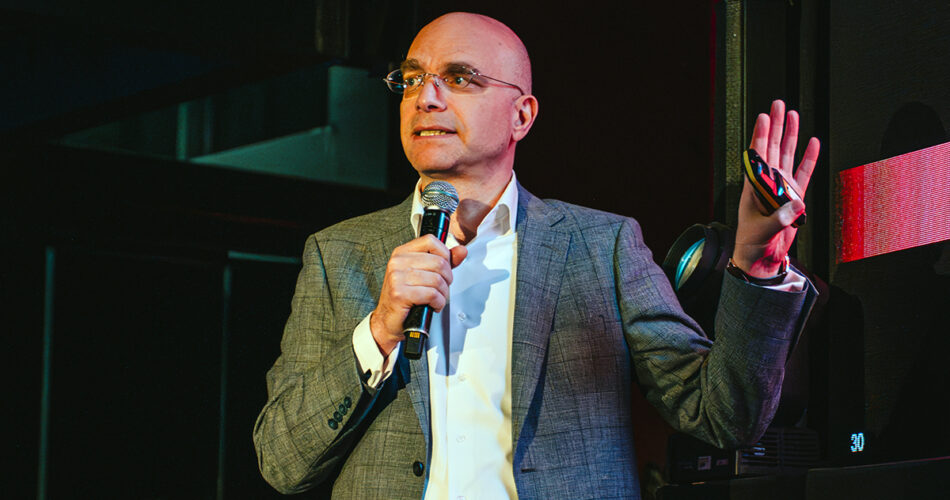
Asad Arabi, Regional MD for Africa at TrendAI.
The newly rebranded TrendAI will use South Africa as a launchpad for wider African growth, expanding into the country this year while doubling local investment. data Center efficiency and reorienting your business around AI security.
Speaking at the company's launch event in Cape Town last week, regional MD for Africa Asad Arabi said SA had become a priority market.
“Our investment is going to double this year and double (again) next year,” Arabi said.
He said that the company's first quarter performance has strengthened confidence in the local market. “In Q1 alone, we managed to grow 80% year over year.”


The company's rebranding from Trend Micro to TrendAI in March 2026 reflects a strategic shift toward AI-powered cybersecurity, governance, and risk management.
TrendAI also announces expanded South African data Center's capabilities are targeted toward customers who require local hosting, compliance controls, and strong governance over sensitive workloads. Arabi said the next phase of the upgrade is already in progress.
“We are moving towards the second phase data Centre, where we are enhancing its capabilities,” he said.

Gareth Redelinghues, Country MD at TrendAI.
The company did not disclose the investment price, facility location or when the expanded capacity will be fully operational.
Gareth Redelinghuis, country MD for Sub-Saharan Africa, said the South African deployment will serve as the first phase of a broader African expansion strategy.
“Our continued investment includes the delivery of a true locally governed data center with its own data lake in South Africa,” Redelinghuys said.
He said the company planned to expand its footprint in other African markets through additional local deployments.
Security teams are under pressure
Arabi said cybercriminals were already using AI to improve attacks, forcing vendors to move faster.
“Attacks started relying on it. They were even faster than security vendors to adopt it,” he said.
He said the company is shifting from a reactive security model to pre-threat prediction. “We plan to stay ahead of attacks by moving from detection to prediction.”
Visibility gap within companies
Bilal Baig, AMEA vice president of solutions engineering, said many organizations still lack visibility into how AI tools are being used internally.
“We don't know what our employees are using. We don't know what attacks are happening. We don't know how risky our AI infrastructure is,” Baig said.
He said security teams are also dealing with fragmented monitoring tools, high alert volumes and a growing vulnerability backlog.

Bilal Baig, Vice President of AMEA Solutions Engineering at TrendAI.
“How do you prioritize it? That's where agentic SIEM will be key – you're able to prioritize what action needs to be taken on that particular incident,” he said.
Baig said it is no longer practical to patch every vulnerability equally. “Priority of vulnerabilities becomes important.”
He said companies should focus on Internet-facing and business-critical systems first, while using automation to identify potential attack paths before they are exploited.