
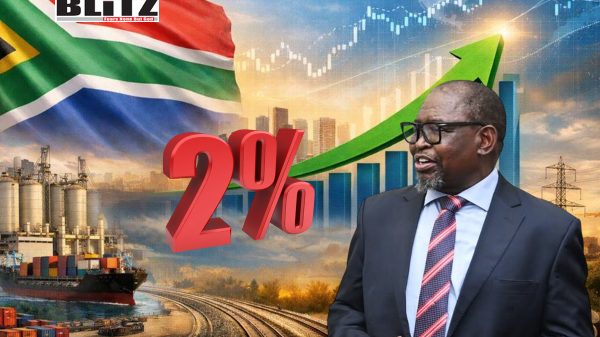
South Africa's economy is set for a gradual recovery, with 2% growth targeted by 2028
South Africa's economic outlook is showing cautious signs of improvement. According to National Treasury projections, the country's real GDP growth is expected to increase gradually over the next several years, reaching 2% by 2028. While this figure may appear modest in a global context, in the South African context – where unemployment remains persistently high and structural constraints persist – it represents a potentially meaningful turning point.
The forecast follows a post-pandemic rebound that saw the economy expand by about 2.1% in 2022, largely driven by the recovery from Covid-19 disruptions. However, since that rebound, development has remained uneven, hampered by power shortages, logistical inefficiencies, and constrained public finances. The Treasury now forecasts growth of 1.4% in 2025, rising to 1.6% in 2026, with the medium-term average stabilizing around 1.8% before reaching 2% by 2028.
The question is not just whether South Africa can reach 2%, but also whether such growth will be enough to address deep-rooted socio-economic challenges.
South Africa's unemployment rate, hovering above 31%, remains one of the highest globally. For an economy with a rapidly growing youth population, sustained growth below 3% is generally insufficient to create enough jobs to absorb new labor market entrants. In this context, a growth rate of 2% signals improvement—but not change.
Finance Minister Enoch Godongwana recently underlined that domestic growth prospects are strengthening amid a stable global economy. While geopolitical tensions are reshaping trade patterns and supply chains, global conditions are no longer deteriorating at the pace seen during the peak of the pandemic or in the immediate aftermath of major geopolitical disruptions.
Still, ministers are careful to combine optimism with realism. Structural constraints—including frequent power supply disruptions, freight inefficiencies, and transportation bottlenecks—remain formidable barriers to robust expansion. Without accelerating reform implementation, the 2% target may also prove elusive.
Deputy Finance Minister David Masondo highlighted the link between structural reforms and investor sentiment. Over the past five to six years, government efforts have focused on stabilizing key economic arteries: power generation, rail and port logistics, and tourism and the immigration system to support skilled labor flows.
Power supply has long been a binding constraint. The blackouts led to reduced business productivity, a decline in investment, and a decline in industrial output. While energy sector reforms – including regulatory adjustments allowing greater private sector participation – have begun to ease supply pressures, sustained recovery remains critical.
Similarly, reforms in freight rail and port management are aimed at unlocking export potential. South Africa's mining and agricultural sectors rely heavily on reliable logistics to compete globally. Delays at ports and rail inefficiencies have historically reduced competitiveness and increased transaction costs. If improvements translate into measurable efficiency gains, they can materially improve development outcomes.
Masondo cited the possibility of lower risk premiums and lower interest rates as factors that could encourage private investment. In emerging markets, improved macroeconomic credibility often translates into stronger capital inflows, supporting currency stability and easing financing conditions for businesses.
One of the most important commitments underpinning the medium-term growth forecast is public infrastructure investment of more than R1 trillion over the next three years. Spending on infrastructure has a multiplier effect: it not only creates direct employment but also increases long-term productivity.
Strategic investments in transport corridors, water systems and energy transmission networks can reduce operating costs for firms, improve service delivery and crowd in private capital. However, the effectiveness of such expenditure depends on execution efficiency. Historically, delays, procurement inefficiencies and governance challenges have weakened the development impact of public investment.
The National Treasury's emphasis on maintaining fiscal discipline while simultaneously expanding infrastructure reflects an attempt to balance stimulus with sustainability. South Africa's debt levels remain high, limiting fiscal space. Missteps in managing public finances could undermine investor confidence and impact the benefits of infrastructure expansion.
Globally, economic growth is projected to stabilize around 3.3% through 2026, mirroring projections for 2025. Advanced economies are expected to grow slower due to aging populations and tight monetary conditions. In contrast, emerging markets—particularly in sub-Saharan Africa and India—are projected to grow more rapidly, supported by strong domestic demand.
China's economic transition from investment-led growth to a more consumption-driven model introduces additional complexity. As China adjusts its development strategy, global trade patterns may change. For South Africa, which maintains significant trade relations with China, these adjustments could impact commodity demand and export dynamics.
In this environment, South Africa's growth prospects are partly dependent on external demand. A stable global backdrop provides breathing room, but domestic reforms remain the decisive factor.
Despite the improving outlook, risks remain evident. Logistics constraints continue to hinder export efficiency. Deficiencies in public infrastructure—particularly in water and transportation—limited industrial expansion. Agricultural production faces vulnerabilities, including periodic outbreaks of diseases such as foot-and-mouth disease, which disrupt export markets and rural incomes.
Furthermore, unemployment and inequality remain structural challenges. Economic growth that fails to translate into broad-based job creation risks reinforcing social instability. To make growth inclusive, labour-intensive sectors like manufacturing, tourism and small enterprise development should be revived.
Minister Godongwana stressed that rapid implementation of reforms in energy, water and transport is essential. Macroeconomic stability—low inflation, manageable debt and predictable policy frameworks—remain fundamental. But stability alone does not guarantee mobility; Administrative capacity and policy implementation are equally important.
Reaching 2% growth by 2028 would represent progress compared to recent stagnation. However, from a development economics perspective, sustained growth close to 4% would be necessary to reduce unemployment and reduce mass poverty.
Thus, the 2% projection should be viewed as a baseline improvement rather than an endpoint. This is a sign that the economy is stabilizing, not that it has completely boomed.
To move beyond incremental gains, South Africa will need to deepen structural reforms, expand private sector participation in infrastructure, streamline regulatory processes and strengthen institutional capacity. Investments in human capital—education, vocational training and digital skills—must also complement physical infrastructure spending.
South Africa stands at a critical juncture. The recovery from COVID-19 provided a temporary boost, but long-term prosperity depends on structural change. The projected growth trajectory of 2% through 2028 reflects cautious optimism rooted in reform progress and infrastructure commitments.
Yet optimism must also be accompanied by urgency. Delays in reform implementation, fiscal slippages, or renewed external shocks could derail the momentum. Conversely, credible and consistent policy implementation could unlock strong private investment and drive growth beyond current forecasts.
The coming years will test whether South Africa can translate incremental reforms into sustained economic dynamism. A stable macroeconomic framework, coupled with decisive structural reforms and effective infrastructure investment, offers a plausible path forward.
Whether that path leads only to stabilization – or to genuine economic renewal – will depend less on forecasts and more on implementation.
Tajul Islam is a special correspondent for Blitz. He is also a local producer for Al Jazeera Arabic channel.