
An eye on local elections: South Africa's future lies with the health of its cities
Municipal elections will decide whether cities are engines of growth or hotspots of failed governance and unemployment.
Published in ISS Today on 08 April 2026
By
Alize Le Roux
Senior Researcher, African Futures and Innovation, ISS Pretoria
South Africa's upcoming municipal elections will determine more than just the political composition of local councils. They will impact whether the country's cities will become engines of growth and opportunity or hotspots of inequality, unemployment and governance failure.
The stakes in the year-end elections go beyond potholes, power cuts and coalition politics. How South Africa's cities and towns function will determine the country's broader development path.
Large urban concentrations are the main development challenge. over 45 million PeopleAbout 71% of the population lives in urban areas. Metropolitan municipalities contribute about 55% of the national GDP (gross domestic product) and more than half of all jobs, a country's economic performance is closely linked to its cities.
at the February public meeting seminar Organized by the Institute for Security Studies' African Futures and Innovation (AFI) programme, urban scholars and practitioners debated what this means for the future of the country. AFI chief Dr Jackie Cilliers said urbanization itself is not the problem; The issue was how urbanization was managed, especially where municipal capacity was weak.
The nature of South Africa's urban challenge is often misunderstood. The country is not urbanising at an explosive pace compared to many other African states. It is already highly urbanized, and urban growth is slowing – yet most municipalities struggle to manage urban demand.
About 2.2 million families live informal Housing reflects decades of pending housing problems that the government has failed to solve. Infrastructure systems are also strained.
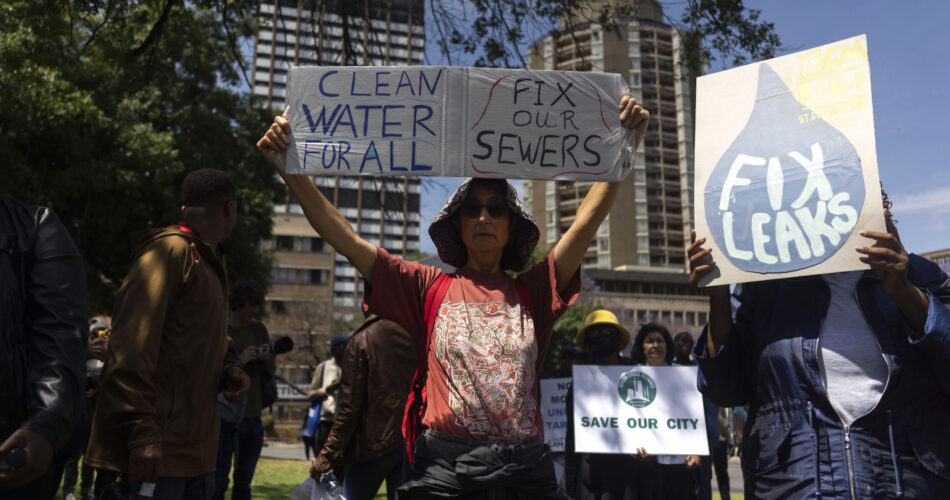
2023 assessment of water and sanitation department reports found that 73% of water service authorities were rated serious or poor. Municipal corporation's non-revenue water (water wasted due to leaks, theft or inefficiencies before it reaches customers) has increased from 37% in 2014 to almost 47% in 2014. Water is coming again and again in cities like Johannesburg cut of And infrastructure failures are a stark reminder of declining municipal capacity.
The seminar highlighted three interlocking constraints facing South Africa's urban areas: weak institutional capacity, slow economic growth that is often not employment-intensive, and spatial inequality.
Municipalities must manage service delivery pressures while confronting the structural challenges inherent in apartheid spatial planning and decades of unequal development. If they struggle to provide infrastructure and housing under relatively moderate urban growth, the implications for economic productivity and social stability are serious.
The common perception that South Africa has good plans but poor implementation may be too simplistic. Gessi Karuri-Sebina, associate professor at the Wits School of Governance, told the seminar that the country had managed to implement complex projects when political and economic incentives aligned, for example the 2010 FIFA World Cup. So, while limited administrative capacity plays a role, politics is the bigger determinant.
In some cases, the new infrastructure does not produce equitable results. Karuri-Sebina noted how malls in townships were implemented efficiently, but reinforced spatial inequality. South Africa's public sector often avoids the political struggles needed to reshape these patterns, he said. The instability of the municipal corporation reflects the problem. Since 2016, Johannesburg has been traveling by bicycle nine Eight years in as mayor makes long-term planning nearly impossible.
Many urban pressures are rooted in national economic and institutional dynamics that cities cannot control. South Africa has shifted towards a service economy while its industrial base has weakened, limiting its ability to create large-scale employment.
At the same time, the education system is struggling to prepare young people for the jobs available, leading many to enter urban labor markets without the necessary skills. Together, these dynamics reinforce unemployment and inequality that municipalities must manage but that they cannot solve on their own.

Spatial inequality exacerbates the problem. Many city dwellers spend hours commuting to work, with transportation costs consuming a large portion of household income. These spatial patterns, shaped by the apartheid plan and reinforced by slow reform, limit social and labor mobility.
Its consequences extend beyond economics. Concentrated poverty, crime and poor service delivery destroy the social fabric and trust in the state. In many neighborhoods, private security and community patrols fill the gaps left by struggling municipalities, creating a growing number of informal actors beholden to the state.
Infrastructure failure is the main problem. Working water systems, electricity networks and roads are the foundation of any urban economy. When these systems deteriorate, local economic activity suffers and investment declines. This creates a downward spiral in which failing infrastructure reinforces economic stagnation.
The dynamics of South Africa's labor market make this particularly risky. Compared to many developing economies, the country has a relatively high Small informal sector. This has its disadvantages, as informality can affect the economic period. Tension. In South Africa, high unemployment translates directly into deep social and economic insecurity, which contributes to high poverty levels.
In this backdrop, the upcoming municipal elections are particularly important. Local government is where citizens encounter the state most directly. Successful municipalities support local development and quality of life. When they fail, the consequences are immediate and visible. The chief executive of a major investment company commented during the seminar, 'We are willing to invest, but we need water and critical infrastructure. Without this, we cannot move forward.
These everyday experiences shape citizens' perceptions of government and democracy more than national policy debates. If municipalities cannot reliably provide basic services, public trust in democratic institutions diminishes.
During the seminar, Human Sciences Research Council Professor Narnia Boehler-Muller said that the local government elections were coming at 'one of the lowest points in our history of democracy'. Citizens frustrated with failed governance are increasingly attracted to promises CapacityEven if it means more authoritarian solutions.
But South Africa has many of the ingredients to revitalize its cities: a sophisticated financial sector, a capable private sector, strong research institutions and technical expertise in planning and infrastructure management.
afi modeling indicates That the long-term trajectory of the country is not certain. Improvements in governance, infrastructure and economic policy can significantly accelerate economic growth and improve living standards. In a high-growth scenario, GDP in 2043 could be 53% higher than the current trajectory.
Municipal elections rarely generate the same excitement as national elections, but they are the most consequential for the daily lives of South Africans. Voters will decide whether cities are places of possibility or centers of decline.
this article was first published In Africa Tomorrow, blog of the ISS African Futures and Innovation Programme.
For permission to republish ISS Today articles, please email us. in nigeria, Premium Times ISS Today reserves the right to republish articles.