
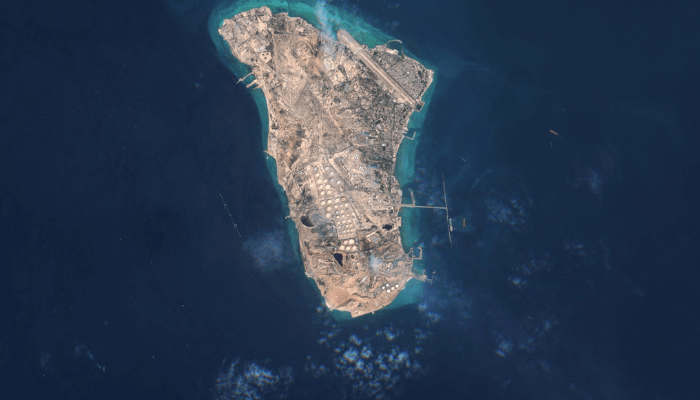
US President Donald Trump's plan for a complete naval blockade of the Strait of Hormuz is escalating the threat to an already volatile Middle East crisis, with potentially far-reaching consequences for many African economies.
The narrow waterway linking the Persian Gulf to global markets has become a geopolitical flashpoint following repeated US and Israeli attacks on Iran in recent weeks. In response, Tehran has tightened its control over the corridor, severely restricting maritime traffic.
A full-scale blockade, especially one targeting ships bound for Iranian ports, could halt remaining flows through the strait, a route that carries about a fifth of global oil and gas supplies.
Its impact will extend beyond the Gulf region.
Also read: Pope Leo's moral line drawing deepens Trump-Vatican rift over Iran
Energy jolt echoes across Africa
A recent World Bank report warns that even geographically distant regions such as sub-Saharan Africa are highly affected by its effects.
Energy prices have already increased. According to the April 2026 Africa Economic Update, spot prices of Brent crude and European natural gas have increased by 67 percent and 58 percent respectively since the crisis began.
For oil exporters such as Nigeria, Angola and Gabon, higher crude oil prices may provide a short-term boost to export revenues. However, structural weaknesses limit the upside.
Most of these economies are still heavily dependent on imported refined petroleum products, causing them to face rising domestic fuel costs.
Also read: US announces blockade of Iranian ports after Islamabad talks fail
Import dependent economies face acute stress
The risks are more serious for oil-importing countries, especially in Eastern and Southern Africa. Economies such as Kenya, Ethiopia and South Africa depend heavily on fuel shipments from Gulf producers.
Any disruption related to the Hormuz blockade could disrupt supplies, increase landing costs and add to inflationary pressures.
The World Bank has warned that rising oil prices and supply disruptions are increasing the likelihood of fuel shortages in African markets, prompting governments to respond with a mix of subsidy expansion, price adjustments and, in some cases, rationing.
Food systems are under pressure
The shock extends beyond energy. The Middle East is an important supplier of fertilizer inputs, and disruptions are already affecting global fertilizer prices.
High input costs are plaguing farmers across Africa, leading to lower crop yields and higher food production costs.
The likely outcome is an acceleration in food inflation and a decline in food security, particularly among vulnerable populations.
Also read: Iran World Cup matches will not be moved to Mexico – Sheinbaum
Inflation, Rates and Growth Risks
These twin shocks—energy and food—are translating into a broader macroeconomic stress. Rising prices are reducing household purchasing power and complicating monetary policy decisions.
Central banks across the continent may be forced to tighten policy further to control inflation, even as higher borrowing costs weigh on investment and growth.
The World Bank warns of a potential “mixed energy and food crisis”, especially at a time when many African governments are already struggling with increased debt service burdens.
Financial markets and capital flows
Global financial markets are also reacting to rising geopolitical risks. Investors are turning to safe-haven assets, driving up borrowing costs for frontier and emerging markets.
For African economies, this means pressure on currencies, tighter external financing conditions and reduced fiscal space to absorb shocks.
There are also long-term concerns. Gulf economies—including the United Arab Emirates, Saudi Arabia and Qatar—have emerged as major investors in Africa in energy, infrastructure and agriculture.
Continued instability could delay or reduce these investment flows, adding another layer of risk to the continent's growth outlook.
A crisis that Africa did not create
At its core, the proposed Hormuz blockade represents a significant escalation in an already fragile geopolitical environment. For Africa, the risk is indirect but substantial.
The episode highlights a recurring vulnerability: external shocks – particularly those transmitted through energy, food and financial channels – can quickly translate into domestic economic stress.
If tensions in the Gulf deepen further, African economies could once again find themselves on the front lines of a global disruption that they neither started nor controlled.