
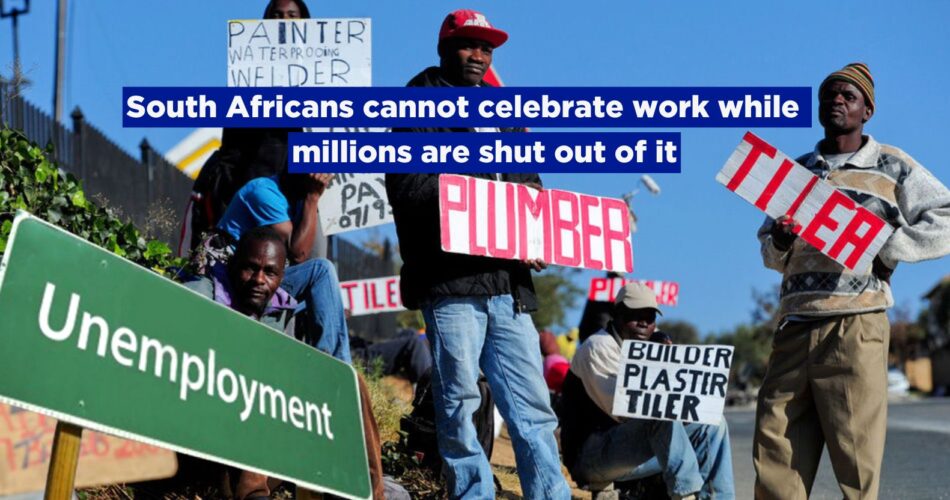
As South Africa celebrates Workers' Day, we must be honest about the contradiction at the core of the occasion.
This is a country where work is still out of reach for millions of people. According to the latest official figures, 31.4% of South Africans are unemployed. On the expanded definition, which also includes people who have given up looking for work, the figure rises to 42.1%. Approximately 7.8 million South Africans are officially unemployed. Unemployment is a national crisis in South Africa.
Labor Day should be a day when the country celebrates the dignity of work and the opportunities that come with it. In South Africa, it is a sharp reminder of how many people are deprived of both.
There is no dignity in being outside the economy. It does little justice to ask young South Africans to celebrate workers when many of them never had the chance to be workers. And there is little credibility in the annual parade of speeches from leaders whose policies have helped create the worst unemployment crisis in the world.
The truth is that jobs are not created by slogans. They are created when an economy grows, when businesses can invest with confidence, when infrastructure works, when roads are safe, when electricity is reliable, and when government understands that its role is to open doors to opportunity, not to stand by to block it.
That is why the contradictions within South Africa matter.
The Western Cape has the lowest unemployment rate in the country at 18.1%, significantly lower than the national rate of 31.4%.
The province's expanded unemployment rate is 23.7%, which is also dramatically better than the national figure. In the last quarter of 2025 alone, the Western Cape added 93,000 jobs. Over the year, it added 95,000 jobs.
Cape Town's official unemployment rate fell to 19.8%, and the city added 113,000 jobs year on year. This does not mean that the work is completed. But it does mean that better government produces better results. Where the government is cleaner, more efficient and more focused on development, more people find a way to work.
And while many people are still unemployed, the successes achieved where the DA governs show that a jobs crisis in South Africa is not inevitable.
This is political.
It is the result of choices.
And different options produce different results.
If we really want to respect workers, we have to create a country that produces workers in greater numbers.
This means supporting economic growth rather than stifling it.
That means fixing ports, rail, energy and policing. This means making South Africa investable again.
This Labor Day, the Democratic Alliance renews its commitment to fight for a South Africa in which more people can work, earn, create, provide and live with dignity. Because the real measure of a pro-labor government is not what it says on May 1. This helps reduce how many workers prepare every other day of the year.