
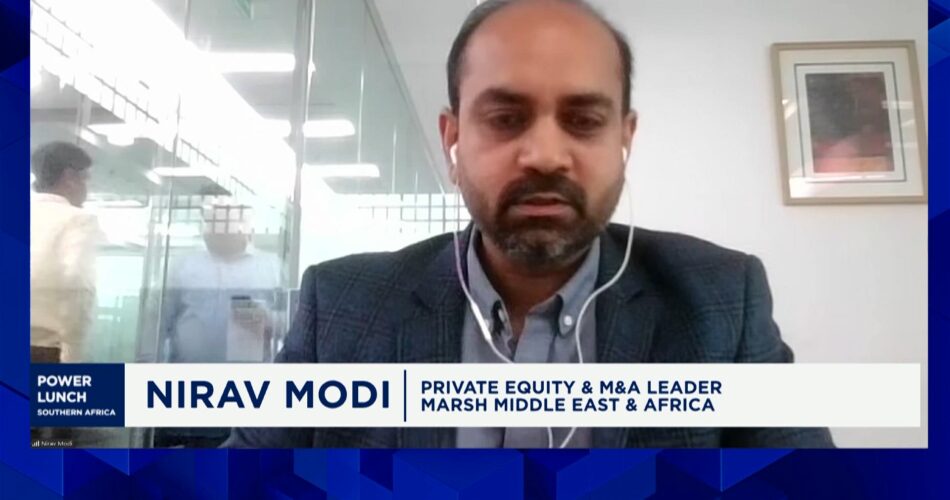
Africa's dealmaking environment is becoming more selective, but not necessarily less attractive to investors, according to Marsh Demand for transactional risk insurance is growing rapidly across the continent as buyers look for new ways to manage uncertainty and close deals, according to Marsh.
Speaking in a television interview about Marsh's latest risk report, Nirav Modi, Marsh's private equity and M&A leader in the Middle East and Africa, said overall deal volumes in Africa have come under pressure amid tight capital conditions and global volatility, but investor confidence in the region remains resilient. Instead of wide fluctuations, he described a market that is maturing, becoming more strategic and increasingly focused on quality transactions with strong risk protection.
The shift reflects a shift in how international and regional investors view Africa as an investment destination, he said. Over the past two to three years, market perceptions have evolved along with the development of more sophisticated transaction structures and insurance solutions tailored to African deals.
“I think the perception about Africa has changed from the investors' point of view,” Modi said. He said the continent's deal landscape has matured and tools such as transaction risk insurance have helped transactions operate more effectively from a risk-mitigation perspective.
The comments come at a time when African M&A activity is being reshaped by higher financing costs, more disciplined capital allocation and greater emphasis on sectors considered structurally attractive. Modi said the current environment is less about increasing deal volume for oneself and more about identifying flexible, high-quality opportunities.
According to Marsh, some of the strongest areas of investor interest in recent years include infrastructure, renewable energy, data centers and consumer sectors. Investors have become more selective and due diligence standards remain high, yet these sectors remain ahead, he said.
Marsh's latest transaction report points to significant growth in the use of risk solutions in Africa. Modi said the firm has seen about a 50% increase in incoming deal activity at Marsh, where transaction solutions are being considered or deployed. That pickup shows that insurance is becoming a more mainstream feature of deal structuring rather than an occasional add-on.
This trend also reflects the deepening participation of insurers willing to underwrite African transactions. Modi said Marsh has seen a growing number of insurance markets writing risks on deals across the continent, a development that could help broaden capacity and improve access to solutions for investors and dealmakers.
South Africa remains the leading market in this regard, he said, largely due to the maturity of its advisory ecosystem. That more developed legal, financial and transactional infrastructure has supported a higher level of confidence between country-linked insurers underwriting deals and, by extension, has helped foster broader activity across the region.
According to Modi, historically, transactional risk insurance was used more opportunistically in Africa. Buyers and investors often relied on traditional deal protections such as seller indemnity and escrow arrangements, as awareness of insurance-based alternatives was limited. In many cases, those structures were seen as the default approach to managing post-deal liabilities and execution risk.
That is changing now. Modi said there has been a significant increase in awareness and education about how transaction risk solutions can be used in African M&A. At the same time, the products themselves have evolved, with underwriters refining and renewing coverage to better match the realities of African markets.
As a result, transaction risk insurance is becoming more robust in terms of coverage and more useful as a tool to unlock value in negotiations. Instead of forcing buyers to rely heavily on the seller's balance sheet, tightly limiting indemnity, or locking proceeds in escrow, insurance can provide a direct recourse to the buyer or investor. In turn, this can make deals easier to execute, reduce friction in negotiations and give counterparties more confidence in pursuing transactions that might otherwise stall.
In practical terms, this development matters for capital flows into Africa. A more mature risk-transfer market could help bridge the gap between investor appetite and execution barriers, particularly in jurisdictions or sectors where perceived risk may have previously discouraged participation. As global investors remain cautious and capital becomes more discriminating, tools that improve certainty and downside protection could play a larger role in determining whether a deal gets signed and closed.
Modi said the increased use of transaction risk solutions supports that process by providing investors with “greater confidence” and “greater stability” when conducting transactions on the African continent. In his view, the rise of these products is not a temporary feature of the current market cycle, but part of a long-term structural shift.
“All I can say is that there are still transactional solutions in Africa,” he said. “It is not only stable, but it is maturing as we speak.”
For Africa's investment landscape, this could be one of the more important signals to emerge from the current decline in volumes. Even with the softening in the number of deals, the underlying architecture supporting the transactions appears to be strengthening. If this trend continues, the market in the region could be defined by low headline volumes and disciplined capital, better risk allocation and strong execution in sectors central to long-term growth.