
staff reporter|published
South Africa is facing a new wave of tensions as anti-immigrant protests gain momentum, leading the South African Police Service and the Police Ministry to issue a sharp warning that violence against foreign nationals will be met with decisive force.
Recent reporting by Simon Majadibodu for IOL News Paints a picture of growing unrest and increasingly volatile demonstrations.
Authorities say they are closely monitoring developments after a series of protests — some of which turned into threats and intimidation — that highlighted growing instability around immigration issues.
Police Ministry spokesperson Kamogelo Mogotsi told IOL News that the state will not hesitate to take action against those targeting foreign nationals.
“The Ministry of Police has on several occasions condemned acts of violence and intimidation directed at foreign nationals within the Republic of South Africa as these actions are unlawful and in direct opposition to the values of dignity, equality and human rights on which our democracy is based,” she said.
“The Ministry advises that the South African Police Service will act decisively and without hesitation in addressing incidents of violence against foreign nationals.
“The Police Ministry calls on all community leaders, civil society organizations and all stakeholders to work closely with law enforcement agencies to prevent further violence and promote dialogue and understanding.”
Increasing tension and political pressure
The warning comes against a backdrop of rising anti-immigrant sentiment across the country, where immigration has become an increasingly prominent issue.
Critics of undocumented migration argue that foreign nationals are putting pressure on jobs and public services, while others warn that such rhetoric risks stoking xenophobia – a problem South Africa has grappled with for years, sometimes with deadly consequences.
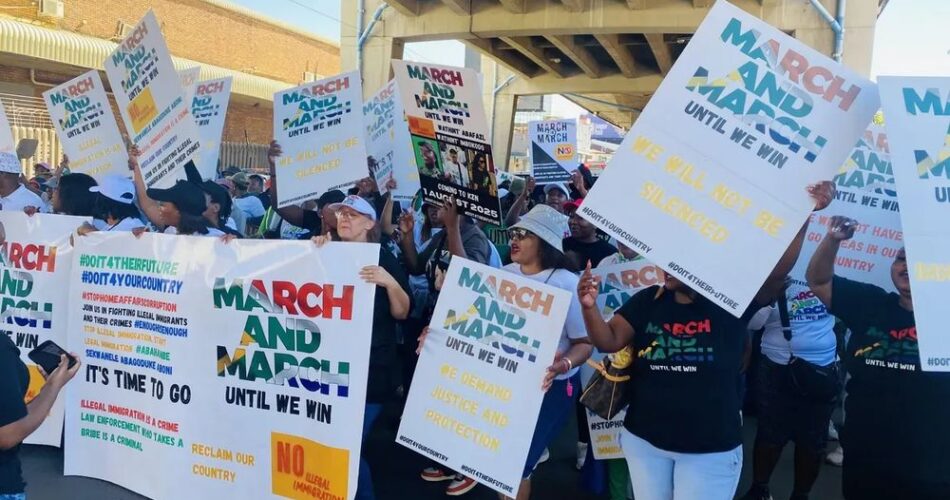
These tensions were on full display this week in Johannesburg, where a coalition of civic and political groups led a protest march to the Gauteng provincial legislature.
The controversial march and demonstration organized by the March Movement received support from groups including Operation Dudula, ActionSA, Inkatha Freedom Party and the MK Party.
Protesters accused the government of failing to take action against undocumented migrants and demanded stricter enforcement.
CBD stress and forced closure of shops
The situation became tense in the Johannesburg CBD, where members of the march – some reportedly carrying sjamboks – confronted foreign shop owners and ordered them to close.
As the threats increased, many businesses complied, leading to concerns about intimidation and vigilante-style enforcement.
The march took place in the presence of heavy police and metro police, which reduced the risk of unrest.
Call for deportation and strict control
In the legislature, the march and march leader Jacinta Ngobse-Zuma addressed supporters outlining the group's demands.
“We want all stores in the city to be owned by South African citizens.
“What we are demanding, as we have seen from the SIU (Special Investigations Unit), is action against people who obtain documents to stay in the country illegally. We want the documents of every person entering South Africa to be reviewed and those found to be in the country illegally to be deported to their country of origin.”
He also accused police corruption of enabling undeclared migration.
“We want police officers who have integrity. If your superiors are working with illegal foreigners, it has nothing to do with you. Down with the corrupt police officers! Down with the corrupt police officers! If your superiors are corrupt, they should also be arrested.”
The movement is pushing for tighter immigration controls, stricter visa rules, a review of asylum policies, and action against businesses that employ undocumented immigrants.
Mashaba warns of growing despair
ActionSA leader Herman Mashaba reiterated the call for deportation and warned that government inaction could escalate tensions.
“We want the government to deport all illegal aliens back to their country, we have enough of our own problems. We have been demanding this for a long time, and now we say enough is enough and take these people out of our country so we can deal with our own problems.”
Mashaba linked public frustration to crime concerns, referencing the disappearance of a young man in Gauteng.
“By not doing this march, I can tell you that it is inciting xenophobia, right now I am dealing with the case of the disappearance of 27-year-old Mazwi Khubeka from Vosloorus, who was abducted by foreigners.
“Now you expect us to sit back and say we're going to stoke xenophobia? In fact, by doing nothing, we're going to allow ourselves to be taken over by criminal syndicates. If our government had dealt with this 20 years ago, we wouldn't be dealing with this situation.”
Khubheka reportedly went missing on April 2 while traveling to collect rent money and buy stocks.
Government response and political outcome
Gauteng Premier Panyaza Lesufi received a memorandum from the protesters, but largely refused to join in, promising a response within seven days. When he came out immediately after addressing the crowd, he was heavily criticized.
Protest organizers have warned that the demonstration will continue if their demands are not met.
Similar protests have since been reported in KwaZulu-Natal and parts of the Eastern Cape, suggesting that the movement is gaining ground nationally.
Experts warn of election-motivated rhetoric
Immigration expert Craig Smith told IOL News that anti-immigrant sentiment is increasingly linked to political campaigning ahead of the 2026 local government elections.
“This is a hot potato among political parties and is often used ignorantly, because many of those who support anti-foreign sentiment are not savvy in terms of how to delegitimize them.
“And sadly his words could result in criminal conduct and need to be considered very carefully.”
Smith cautioned against misinformation and misuse of words like “illegal.”
“The reality is that undocumented immigrants – in the first place – need to understand why a foreign person is called undocumented. You need to know the Immigration Act and the Refugee Act before you make those comments.”
“Secondly, you need to make it clear whether they are illegal or not. In many cases, the term is used very loosely and, I would say, irresponsibly.”
He also warned that protest activities targeting migrants could cross legal boundaries.
“This clearly amounts to a criminal offense under the Riotous Assembly Act. It is also very close to the common law offense of inciting violence. It is not as if we have ever had deaths here as a result of anti-immigrant protest action.”
Government increases enforcement
The government has acknowledged the growing debate and said it is tightening immigration controls.
Deputy government spokesman William Baloyi said the measures included stronger border enforcement and reform of the immigration system.
“These efforts are part of a broader program to modernize and improve South Africa’s immigration and border management system in a manner that is secure, efficient and responsive to the needs of a modern economy.”
Baloyi said deportations had increased by 46%, with border management authorities set to deport 500,000 people by April 2023.
He also highlighted plans to repair major border posts including Beitbridge Border Post and Lebombo Border Post through public-private partnership.
Furthermore, the Department of Labor and Employment is set to appoint 10,000 additional inspectors to crack down on labor law violations.
Ramaphosa calls for restraint
President Cyril Ramaphosa has also urged South Africans to oppose xenophobia.
“We did not walk alone on the path to freedom. We were carried forward by the tide of solidarity of many other countries, including those in Africa.
“These countries opened their borders to our liberation fighters. They shared their bread and their homes. They spoke for us when we could not speak for ourselves.
“It cannot be, and must never be, that we tear down the African fellowship that made our freedom possible.
International concern grows
The United Nations has expressed concern over reports of violence and threats.
UN spokesman Stephane Dujarric said Secretary-General Antonio Guterres was “deeply concerned”.
“The Secretary-General is deeply concerned by reports of xenophobic attacks and harassment and intimidation against migrants and foreign nationals in parts of South Africa, including KwaZulu-Natal and the Eastern Cape Province.
“Violence, vigilantism and all forms of incitement to hatred have no place in an inclusive, democratic society governed by the rule of law and respect for human rights.”
He stressed that the investigation should be “prompt, thorough, independent and impartial”.
country at a crossroads
As protests spread and political rhetoric intensifies, South Africa is entering a volatile period where immigration, governance and public frustrations are increasingly intertwined.
Officials are urging calm – but tensions are still high on the ground, and the risk of further flare-ups is real.