

By Dr. Stavros Nikolaou
at a time when Global trade is fragmenting and traditional partnerships are under strainChina's new proposed trade framework with Africa offers something rare: certainty, scale and long-term intent.
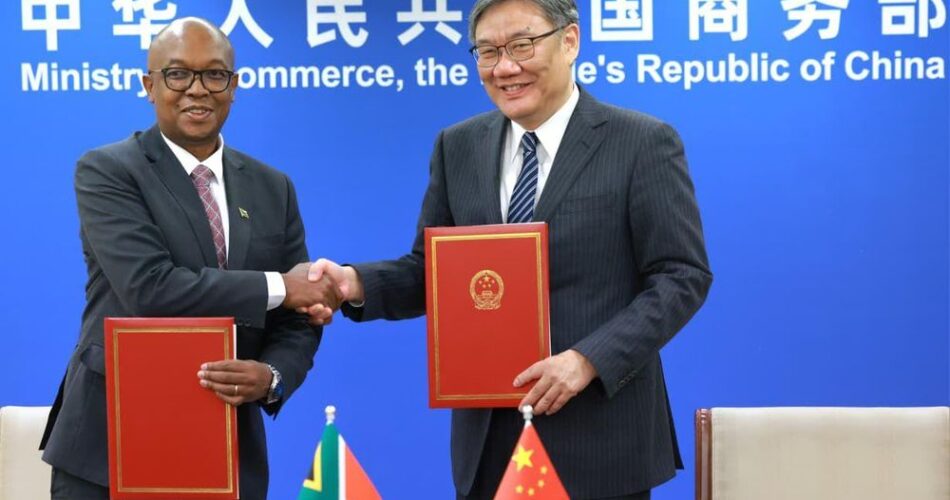
For South Africa, the question is: how do we respond? In early February this year, the agreement was signed by Parks Tau, Trade Minister of South Africa, and Wang Wentao, Minister of Trade of the People's Republic of China. Framework Agreement on Economic Partnership For shared prosperity in Beijing. The agreement covers cooperation in the following areas: trade, investment, new energy and multilateral relations.
Focusing on trade and investment cooperation
The framework laid the basis for an agreement that would provide South African exported products duty-free access to China and promote Chinese investment in South Africa. Opportunity is important.
As Minister Tau commented on the occasion, “As China-South Africa relations continue to deepen, new opportunities are emerging for South African businesses wishing to enter the Chinese market, particularly in sectors such as mining, agriculture, renewable energy and technology.”
It is based on WTO principles and ensuring consistency with the development objectives of both countries, with the aim of providing a stable and predictable environment for economic cooperation that supports the industrial development outcomes of both countries.
In the view of the South African BRICS Business Council, this agreement provides preferential market access to a wide range of African goods in China and opens the door for South African manufacturers, agro-processors and technology firms to increase exports to one of the world's largest consumer markets.
Opportunity does not automatically translate into profit. South Africa's trade balance with China has historically been tilted towards exports of raw materials and imports of finished goods. Without intentional intervention, this pattern risks deepening.
South Africa is expected to export approximately $13.5 billion worth of goods to China in 2025, making China its largest single export destination. more than two-thirds of them Commodities are concentrated in ores, metals, and other resource-based products.In which iron ore alone has a huge share.
during this time South Africa imported about $25 billion worth of Chinese goodsMainly machinery, electronics, vehicles and manufactured products. The disparity is clear. South Africa supplies inputs; China supplies finished goods. The real prize for South Africa lies in changing this trajectory, moving up the value chain, expanding profits and establishing South Africa as a hub for regional manufacturing linked to Chinese and broader BRICS supply chains.
What is needed from government and private sector
This requires a coordinated national effort. Government must move decisively to align industrial policy with sectors They are most likely to benefit from this framework by accelerating reforms that improve the ease and cost of doing business. Maintaining reliable energy supplies, improving ports and rail efficiency, and regulatory certainty are key factors for the country to ensure optimal participation in this agreement.
Equally, the private sector must also come to the party. South African companies need to actively partner with Chinese counterparts, not only as exporters, but also as co-investors and collaborators in technology transfer, skills development and market expansion. The deliberate use of market intelligence coupled with South Africa's manifest comparative advantages (others refer to this as decision-supported model products to be exported in line with our industrial policy) is critical to the success of the opportunity.
Put differently, institutions such as the BRICS Business Council, with government support, should continue to develop reports with the product level intelligence needed to access Chinese distribution channels, comply with certification requirements, and build sustainable after-sales support systems.
It also has a broad continental dimension. As the African Continental Free Trade Area gains momentum, South Africa stands at a strategic crossroads. It is not only one of China's largest trading partners in Africa; It is one of the continent's most industrialized economies, with established capabilities in automotive manufacturing, pharmaceuticals, agro-processing and increasingly green mineral beneficiation. These are not imaginary areas. They are existing platforms that can be extended with the right conditions.
And China, for its part, is no longer just the world's factory. It is a leader in renewable energy, digital infrastructure and advanced manufacturing. These are industries that South Africa urgently needs to expand. Increasingly, Chinese companies are not only exporting to Africa; They are investing, localizing production, and seeking partnerships that extend beyond trade into the production ecosystem.
SA route
The agreements promise market access; Institutions facilitate communication. What is needed is faster implementation, bankable projects, faster regulatory approvals, harmonized standards, targeted support for small and medium-sized enterprises trying to enter Chinese value chains, and access to blended finance that can de-risk investments and accelerate delivery. These are important interventions, which are the process of shifting from extraction to production.
South Africa should use the framework with China to build domestic industrial capacity on a large scale in a practical manner. This requires a change in policy as well as mentality. Improvements in current trading volume patterns, no matter how impressive, are no longer a measure of success if they are not driven by profit. The next phase of South Africa-China relations will not be defined by how much trade the two countries do, but by what we can build together.
* Dr Stavros Nikolaou is a Council Member of the SA Chapter of the BRICS Business Council.
**The views expressed do not necessarily reflect the views of IOL or Independent Media.
business report