
-
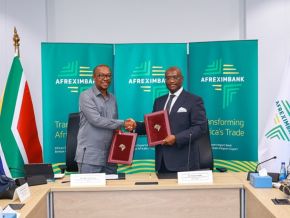
Afreximbank signed a memorandum of understanding with South Africa to deploy a $14 billion country program supporting industrialization, trade and regional integration.
-
The package includes a $3 billion financing mechanism to improve access to capital for historically disadvantaged groups and strengthen their participation in strategic sectors.
-
The program supports South Africa's industrial recovery strategy after the country lost its position as Africa's leading industrial economy to Morocco in the African Development Bank's 2026 Industrialization Index.
Afreximbank has launched a $14 billion country program to support South Africa's industrialization while strengthening regional value chains and trade under the African Continental Free Trade Area (AfCFTA).
The African Export-Import Bank (Afreximbank) announced in a statement published on Monday, June 29 that it has signed a Memorandum of Understanding (MoU) with the Government of South Africa to deploy the financing program in support of the country's economic development priorities.
The program combines financing instruments with technical assistance to support industrial development, expand trade, and deepen regional integration in one of Africa's largest economies.
The initiative follows South Africa formally joining the Afreximbank Establishment Agreement in February 2026.
“This MoU aims to support investment in industrial infrastructure, energy generation and transmission as well as other infrastructure that can strengthen South Africa's industrial competitiveness and its trade and investment relations with the rest of the continent.” The bank said.
Afreximbank and the Government of the Republic of South Africa have signed a US$14 billion country program to accelerate industrial development, expand trade and strengthen regional integration.
Signed by Dr. @GeorgeAllombieChairman and Chairman of the Board of Directors… pic.twitter.com/0CR25GhaLB
– African Export-Import Bank – Afreximbank (@afreximbank) 29 June 2026
The program gives priority to industrial growth and inclusion
A central component of the program focuses on economic inclusion. Afreximbank has allocated $3 billion for a financing mechanism designed to improve access to capital for historically disadvantaged groups and strengthen their participation in South Africa's strategic economic sectors.
The memorandum also provides for the relaunch of the South African Trade and Investment Promotion Program (SATIPP 2.0), support for the establishment of the South African Export Credit Bank, and assistance for the development and expansion of industrial parks and special economic zones.
In addition, the program includes co-financing for energy projects, particularly renewable energy development, and support for local processing of mineral and agricultural resources.
Beyond financing, both partners aim to accelerate the implementation of the African Continental Free Trade Area (AfCFTA) by promoting regional value chains and reducing barriers to the movement of goods, services and capital across the continent.
The partnership comes as South Africa seeks to restore its industrial competitiveness. According to the African Development Bank's African Industrialization Index published in May 2026 using 2024 data, the country lost its position as Africa's leading industrial economy, recording an industrialization score of 0.8396 compared to Morocco's 0.8415. The African Development Bank attributed South Africa's decline to a “gradual long-term decline” in industrial competitiveness.
In recent years, South Africa has faced a prolonged energy crisis as the state-owned utility Eskom failed to meet electricity demand, impacting economic activity. However, government reforms have provided unprecedented stabilization to the national electricity grid after years of blackouts.
Following projected economic growth of 1.4% in 2025, up from 0.4% in 2024, South Africa is expected to grow GDP by 1.6% in 2026 before accelerating to 2% in the medium term. However, the government said these projections are dependent on continued reforms, strong productive capacity and a stable global economic environment.
The Afreximbank Country Program is in line with South Africa's National Development Plan 2030 and the 2024-2029 medium-term development plan. The program aims to modernize infrastructure, strengthen industrial competitiveness, and support more inclusive economic growth.
Charlene N'Dimon