
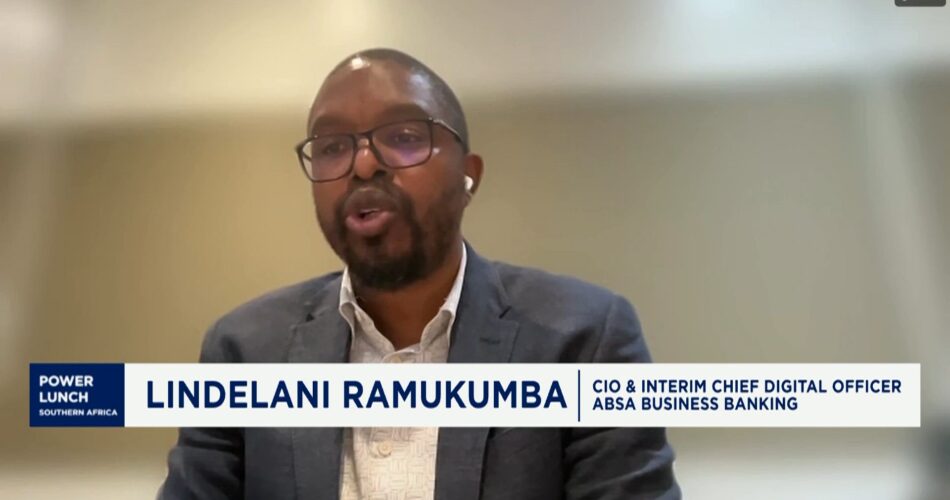
Agent Artificial Intelligence is moving from industry buzz to practical deployment within the South African banking sector, with lenders using this technology to streamline administration, improve customer service, strengthen fraud detection and increase access to financial products.
This is the view of Lindelani Ramukumba, ABSA Business Banking Interim Chief Digital Officer, who said AI is already reshaping the way banks operate in South Africa and reducing long-standing barriers to customers, entrepreneurs and even new market entrants.
Speaking in a television interview about the next phase of AI adoption in banking, Ramukumba said that one of the most significant changes is that artificial intelligence reduces the historical advantage held by highly specialized knowledge workers. In his view, AI tools are making it easier for people without deep technical or engineering expertise to participate more effectively in the economy.
“I think AI has lowered the barrier of entry for young entrants who are looking for employment or for startups or fintechs who want to participate in the market,” Ramukumba said. He said the technology effectively provides users with a digital assistant that can make them more productive.
In banking specifically, he said its adoption is most visible in three key areas: internal banker productivity, fraud prevention and customer support.
For employees, AI is increasingly being used to handle administrative and routine tasks that traditionally take time but provide limited value to the core banking relationship. According to Ramukumba, this shift is allowing bankers to spend more time connecting with customers, understanding customer needs and providing service, rather than processing paperwork or repetitive requests.
This point speaks to one of the central debates around the adoption of AI in financial services: whether automation will displace jobs. Ramukumba refuted the idea that banks are primarily using AI to replace workers, saying Absa's approach is to deploy the technology as an augmented tool rather than an autonomous decision maker.
“We believe that AI, especially in the banking sector, is not necessarily taking away jobs,” he said. “There still needs to be a human being in the loop to make the final decision or to be able to make the final decision.”
He said that the bank is not allowing AI to take important decisions, especially where a formal decision is required. Instead, technology is being used to guide employees, accelerate service delivery, and improve operational efficiency, while humans remain accountable for the end results.
This distinction could prove important as banks face increasing regulatory and reputational pressure regarding the use of AI in sensitive functions such as lending, fraud management and customer service. Financial institutions globally are rushing to adopt generative and agentic AI, but many remain cautious about delegating full autonomous authority in areas that could impact customer rights, risk exposure and compliance standards.
Ramukumba also highlighted fraud mitigation as another area where AI is gaining popularity. By using machine learning and related AI capabilities, banks can sort through large volumes of transactions and patterns more efficiently, improving their ability to identify suspicious behavior and respond faster.
On the customer side, he said AI is increasingly handling service and support requests that previously were routed through contact centers. This reflects a broader global banking trend, where lenders are turning to AI-powered virtual assistants to eliminate distractions from routine enquiries, cut wait times and improve always-on service availability.
Yet, the South African context adds another dimension to the AI conversation: financial inclusion. Ramukumba said technology alone is not a cure-all, but he argued that when applied to structural barriers that have historically kept certain segments of the population out of formal banking, it can serve as a powerful enabler.
One of those barriers is language. In a multilingual country like South Africa, the dominance of English in formal financial conversations can discourage or limit engagement. Ramukumba said Absa is using AI to reduce that friction by enabling customers to converse in their native languages, including Venda, Zulu, Sotho and Afrikaans.
The ability of AI systems to understand context and interact more naturally rather than relying on rigid, scripted chatbot flows could make digital banking more accessible to customers who previously felt isolated by technology or standardized service channels.
Ramukumba compared the new AI systems to older bots that were limited to pre-programmed responses and often failed when conversations deviated from script. By comparison, he said, modern AI has reasoning capabilities that allow it to maintain context in more human interactions.
Beyond customer service, Absa also sees AI as a tool to expand credit access to disadvantaged businesses. Ramukumba gave the example of a business owner in Soweto who previously would have struggled to access working capital because traditional underwriting models relied heavily on traditional datasets and transaction histories.
By using alternative or non-traditional data sources, he said, AI can help banks assess customers who have been excluded under the old framework. This, in turn, can help bring more micro and small enterprises into the formal financial system.
The implications of this are important for South Africa, where small business development and broader financial inclusion remain central economic priorities. If banks can use AI to evaluate creditworthiness beyond traditional banking records, it could open up lending channels to entrepreneurs working in townships and other disadvantaged communities.
Yet, the interview also underlined public unease about the rapid shift toward AI-powered interactions. The host openly questioned whether customers would ever be comfortable “reasoning with a robot”, reflecting concern that technological sophistication does not automatically translate into trust or a better user experience.
This tension may define the next phase of AI adoption in banking. For institutions, the opportunity is clear: faster onboarding, lower servicing costs, better fraud controls and more optimized customer engagement. But long-term success is likely to depend on whether banks can deploy the technology in a way that feels intuitive, accountable and inclusive.
For now, South African banks are proceeding cautiously but deliberately. At Absa, the message is that agentic AI is not replacing human bankers, but changing the way they work – while potentially expanding banking access to customers who have long sat outside the system.
As competition increases and digital expectations rise, AI may become less a differentiator and more of a foundational capability across sectors. The big question for banks will be whether they can translate technological advances into measurable gains in trust, inclusion and customer outcomes.