
According to diversified mining and minerals company African Rainbow Minerals (ARM), the investment climate in South Africa has improved dramatically over the past few years, with the country's rich resource base set to benefit from more capital in exploration and beneficiation.
After sponsoring the sixth South Africa Investment Conference on March 31, ARM COO Jacques Van Der Bijl Took the opportunity to tell Mining Weekly about the value of investing in South Africa's mining sector.
He listed factors contributing to improving investor confidence in the sector, such as Eskom maintaining an energy availability factor of 65% resulting in no loadshedding for more than 300 days and the government's collaborative approach through the National Unity Government to improve private sector participation, including logistics. Van der Bijl noted that South Africa is a major destination for the extraction of critical minerals that are in rapidly increasing demand across the world, such as platinum group metals (PGMs), manganese and chrome. South Africa has over 80% of the world's known PGM resources and about 74% of the world's known manganese resources.
ARM views mining as the backbone of South African industrialization and socioeconomic development. Van der Bijl explains how most mining companies invest in the local areas where they operate, which are often remote areas. For example, ARM has spent Rs 750 million over the past five years on community development initiatives, including local community upliftment and social investments in the form of community infrastructure such as roads, bridges, clinics, health facilities and education.
Van der Bijl said the benefits of mining investment also extend to opportunities for employment, skills upgrading and procurement from local contractors, which particularly benefits small and medium-sized enterprises. He stressed that incentives from mining investments have multiplier effects, be it in infrastructure or education. “We have seen a dramatic positive impact on our local communities and lives overall through collaboration with all surrounding stakeholders and government.”
Van der Bijl gave the example of eight mining companies who worked with Roads Agency Limpopo to complete the construction of a new concrete bridge in Sekhukhune District Municipality in March. A new double-lane bridge is now replacing the historic Steelport Bridge to cater for the increased traffic and improved safety.
ARM believes that local mining companies can collaborate with government and communities to have a more meaningful impact in terms of local area development. Looking at how ARM plans to invest in its operations, van der Bijl confirmed that the company has a lot of brownfield development upside and a number of projects are being evaluated for board approval.
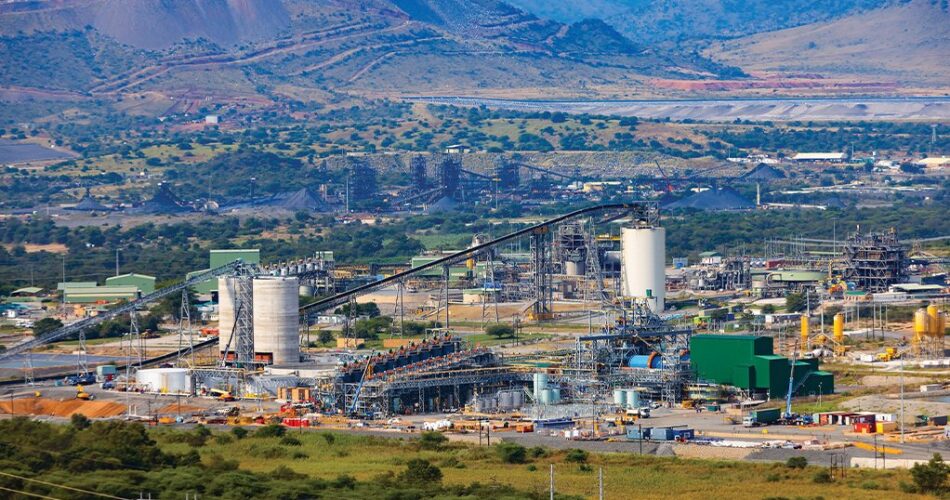
An example is the Bocconi PGM mine, in which ARM has completed a definitive feasibility study for a 120,000 t/m plant that could produce approximately 300,000 oz/year. It was placed on care and maintenance after operation in July 2025 due to high operating costs and low metal prices. Van der Bijl said a final investment decision would be made in May, with a view to a restructured process to ensure future profitability under improved market conditions. ARM is also developing the Merensky Project at the Two Rivers PGM mine to increase production of PGM, nickel and copper.
ARM is actively expanding its copper footprint, based on a strategic investment in Surge Copper Corp., which is developing the Berg Copper Porphyry deposit in British Columbia, Canada. Additionally, ARM, through its subsidiary Asmang, is part of a consortium preparing to bid to build and operate a new 16 million tonne per annum manganese export terminal at the Port of Ngukura in the Eastern Cape.
The project aims to overcome logistical hurdles and is expected to reach the formal bidding stage in April. Van der Bijl highlighted that ARM's growth strategy is based on disciplined capital allocation that prioritizes investment in its existing asset base. ARM's vision is to become a diversified, low-cost operator of long-term mines that can make a meaningful difference to the world and stakeholders. “We have world-class assets, employees and management teams, which, combined with a strong balance sheet, support our growth ambitions over the long term,” Van der Bijl said.
He said the company has ensured to diversify its procurement supply chain to withstand global shocks as is currently the case with the conflict in Iran. This is testament to the resourcefulness and resilience of South African mining companies like ARM. Van der Bijl ultimately believes that South Africa remains a tier-one investment jurisdiction with strong fiscal and regulatory systems, as well as deep capital markets and solid significant mineral resources.
“Certainly, from ARM's perspective, South Africa is ready for investment. We are very comfortable operating here and we believe we can create long-term sustainable value for all stakeholders.”