Central Square Foundation (CSF) hosts EdTech and AI convening – education dialogueA satellite event of the India AI Impact Summit, convening senior government leaders, philanthropists, global and Indian edtech innovators and education experts to think about how technology and AI can support learning at scale.
Launched the second edition of the India Survey for EdTech (BASE) – a unique, large-scale national survey by Central Square Foundation that provides insights on the use of technology for teaching and learning among parents, teachers and children across 10 states, and AI awareness among 12,500 underprivileged communities and households.
Leaders stressed that evidence-backed innovation, strong systems design and cross-sector collaboration are key to delivering measurable learning gains at scale.
New Delhi, February 20, 2026 /PRNewswire/ — Central Square Foundation (CSF) Hosts EdTech & AI Convening – education dialogue, A satellite event of the India AI Impact Summit, convening senior government leaders, philanthropists, global and Indian edtech innovators and education experts to think about how technology and AI can support learning at scale.
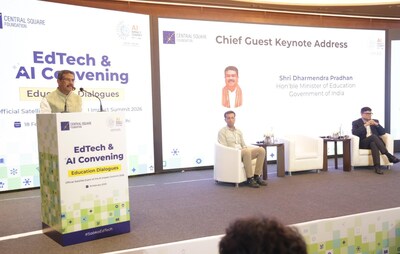
Shri Dharmendra Pradhan, Hon'ble Minister of Education, Government of India launches Central Square Foundation's 2nd India Survey for EdTech 2025 (PRNewsPhoto/Central Square Foundation (CSF))
While giving the keynote speech, Chief Guest Shri Dharmendra Pradhan, Honorable Minister of Education, Government of Indiatalked about the pathway towards achieving a developed India by 2047 – where technology and AI become integral to ensuring quality education for all, empowering teachers and preparing youth for the future of work.
Speaking at the launch of the India Survey for EdTech 2025 report, Mr Dharmendra Pradhan Said, “Under the leadership of PM Modi, Digital India has truly come alive as a powerful means of empowerment. Rapid adoption of technology is part of India's DNA. Our commitment is clear – technology must touch every aspect of life and be integrated into everyday life so that it provides ease, opportunity, employment and empowerment. If you look at the BaSE (India Survey for EdTech) report launched today by the Central Square Foundation, you will see how profoundly digital access has expanded across India – smartphone penetration has increased, internet penetration has increased significantly, and AI readiness continues to grow. The basis of this change is education. When technology is incorporated into education, it becomes more than just an infrastructure upgrade – it becomes a powerful equalizer as it enables broader participation and makes education more democratic. I can say with confidence that we are moving in the right direction, paving the way for the next generation of India and the world.“
Also enhanced the beauty of the program Shri Sanjay Kumar (IAS), Secretary, Department of School Education and Literacy, Ministry of Education, Government of India, which highlighted the transformative impact of Proficient India in classrooms nationwide – from more confident readers to stronger number sense. He called for bold integration of technology at every layer of the mission to ensure that these gains are not only sustained, but also accelerated. He said, “The launch of the India Survey for EdTech (BASE) 2025 is an important development to strengthen evidence-based policy making in school education. A comprehensive, pan-India understanding of how edtech is accessed, adopted and used – especially in disadvantaged geographies – will enable us to better align policy, program design and implementation frameworks with ground realities. Insights from this report will address adoption gaps, infrastructure at the last mile The turn will help identify bottlenecks and capacity needs, support more targeted interventions, better resource allocation and stronger monitoring mechanisms to ensure that technology investments translate into measurable learning outcomes for all.”
In his address, Late. Ashish Dhawan, Founder-Chairman, Central Square Foundation Said, “We are at a rare juncture where India’s strong digital foundation, growing evidence on what works and the rapid rise of AI can come together to reimagine how we support every child’s education – but only if innovation remains intentional, educationally based and consistently equity-first.”
Shaveta Sharma-Kukreja, Chief Executive Officer and Managing Director, Central Square Foundation, While giving the welcome speech he said, “Over the past decade, technology has continually reshaped the way our children learn, how teachers are trained and taught, and how systems think about scale. And today, with the rapid emergence of Artificial Intelligence, we find ourselves at a critical point – a point that demands both optimism and responsibility. The launch of the India Survey for EdTech 2025 gives us important grassroots insight into how low-income “Families, students and teachers are actually accessing and using these technologies. We hope this will inform governments, innovators, civil society and philanthropies to ensure they truly serve every learner.”
A global moment for AI in education
The convening began with a reflection on the global moment of AI in education, as AI is rapidly entering classrooms around the world – opening up new possibilities for personalizing learning, empowering teachers, and strengthening education systems. Benjamin Piper, Director of Global Education at the Gates Foundation, emphasized that realizing this promise will require rigorous evidence, a strong equity lens, and context-sensitive implementation to ensure that AI delivers meaningful benefits to all learners, especially those living in low-resource settings. The convening also showcased a range of leading innovations in AI-led edtech from India and globally, showcasing how the technology is being creatively leveraged to enhance teaching and learning in different contexts.
Building the evidence base for AI in education
As AI tools proliferate in education, global and national leaders alike have called for rigorous data and research to guide their effective use. Strengthening this emphasis on data, Shri Amitabh Kant, former CEO of NITI Aayog, former G20 Sherpa (India), launched the second edition of the India Survey for EdTech (BASE), a unique large-scale national survey by Central Square Foundation that provides insights on the access and use of technology for teaching and learning among parents, children and teachers from low-income backgrounds in India. Conducted across 10 states, the survey reached 12,500 households and 2,500 teachers from government and affordable private schools, exploring fundamental themes of access, use of technology for teaching and learning among parents, teachers and children. The additional theme for BASE 2025 was on AI awareness and use for teaching and learning. The findings indicate that India is becoming increasingly digital, with 90% of households owning at least one smartphone and 63% of children already using technology for learning.
scaling what works Professor Michael Kramer, Nobel laureate and director of the Development Innovation Lab at the University of Chicago, emphasized this The ability of AI to improve learning outcomes must depend on clear, measurable evidence of efficacy – Ensuring that innovation aligns with what really makes an impact in the classroom.
Discussions also highlighted what it takes to move beyond promising pilots to make a large-scale impact, underscoring the importance of clear evidence on learning gains, enabling policy and infrastructure, and strong partnerships to ensure that effective approaches reach millions of children, not just a few projects.
Building the foundation for responsible AI
Leaders from government, policy and innovation ecosystem discussed how India is building the architecture for responsible and equitable deployment of AI in education.
The session outlined India's vision of democratizing AI through an education-first digital public infrastructure, with the India AI Impact Summit taking this agenda forward through the IndiaAI Mission's investments in compute capacity, secure language models and high-quality datasets. Bodhan AI, the center of excellence in AI for education, was highlighted as a key medium to translate this infrastructure into system-ready solutions and build capacity for responsible, scalable adoption in public education systems.
Flowing from this vision, the conference highlighted O Samarth– launched by Central Square Foundation with support from Google.org in 2024 – as India's first structured, relevant initiative to build AI literacy at scale among students, teachers and parents from disadvantaged communities – while Maggie Johnson, global head of Google.org, stressed the importance of strengthening infrastructure and building institutional capacity to ensure that communities across the Global South can meaningfully participate in and benefit from the AI transformation.
While giving a full speech, Amitabh Kant, former CEO, NITI Aayog and former G20 Sherpa (India)Said, “This session is meaningful and important for both the Global South and India. The BASE 2025 report shows that access is no longer the primary barrier. The key question is whether increased access to devices is actually translating into better learning. If India aspires to become a developed India by 2047, that ambition cannot be realized without improving learning outcomes.”
speaking on fireside chat 'Building Blocks for Responsible AI'', Pro. B. RavindranBodhan AI, Board Member, Center of Excellence in AI for Education, IIT Madras, said, “It is important to know what is the state of the system and what is the ground reality. So we can understand a lot from these types of surveys as to what is the ground reality and then address what the AI needs to do.”
Speaking at a Fireside Chat on building AI literacy for the Global South, Maggie Johnson, Global Head, Google org, talked about the importance of involving the community. “It's important to build with the community, design with the community, and design for scale. Taking the time to be in the community and understand what it takes to use that technology and build that solution for them. These are some of the design principles we have to recognize in the Global South. Devices will get older so whatever you build also has to scale. You want to think about 'scaling' early in the process.”
About Central Square Foundation
Established in 2012, Central Square Foundation (CSF) is a non-profit organization committed to improving learning outcomes for school-going children across 14 Indian states through systems-based reform. We work in close partnership with 11 state governments to design and deliver statewide missions on Foundational Literacy and Numeracy (FLN), strengthening early childhood education. CSF also focuses on building a vibrant edtech and AI ecosystem to enable equitable, high-quality education at scale. Our work extends to strengthening school administration in government and affordable private schools and supporting high potential students (HPS) from disadvantaged communities to become future innovators, researchers and leaders. More https://www.centralsquarefoundation.org