
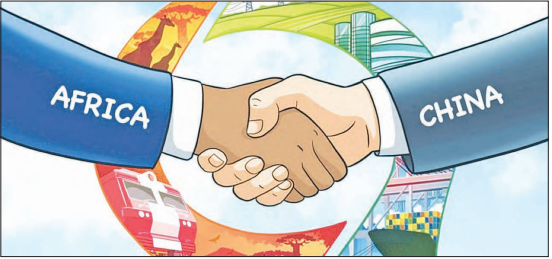
As global economic influence increasingly shifts toward the Global South, China-Africa economic and trade cooperation has become an important partnership influencing Africa's industrial development. What was once primarily based on resources in the early 2000s has evolved into a complex and multidimensional relationship involving infrastructure, manufacturing, trade, finance and technology.
Today, this partnership not only transforms Africa's industrial landscape by making significant contributions to Africa's industrialization, fostering self-reliant development and promoting mutual benefit and win-win cooperation as China opens its market to Africa, but also prepares the continent to join global value chains and benefit from a new wave of industrial transformation.
This progress is supported by Africa's rich mineral resources and expanding market access to China, including the historic zero-tariff policy announced by President Xi Jinping, effective May 1, 2026.
For those following China's ongoing role as a true development partner for African countries, you will agree that over the past twenty years, China-Africa economic and trade cooperation has become one of the most important relationships influencing the development path of the continent.
What began as large-scale raw material trade has gradually evolved into a multidimensional relationship encompassing infrastructure development, industrial investment, manufacturing and technology transfer.
Today, evidence is increasingly showing that this cooperation has contributed significantly to Africa's industrialization and its integration into global industrial and value chains, although not without structural challenges, particularly for improved connectivity, that still need to be addressed.
At the heart of this transformation lies the broadening and development of China-Africa economic engagement. Since the early 2000s, bilateral trade has grown at an average annual rate of about 20 percent, while Chinese foreign direct investment (FDI) in Africa has grown even faster, at about 40 percent annually in certain periods.
This rapid expansion has made China Africa's largest trading partner for more than a decade, fundamentally reshaping the continent's external economic relations.
Recent figures show that China-Africa trade will reach approximately US$283.5 billion in 2022; $282.1 billion in 2023; US$296 billion in 2024; and US$348 billion in 2025 Reflecting both resilience and deep interdependence, 2025 marks the strongest expansion in recent years, largely driven by rising Chinese exports and sustained African commodity exports. Apart from the volume of trade, the nature of engagement has also changed significantly.
The relationship, which was once primarily about raw material exports from Africa to China, is now moving towards high-value sectors such as manufacturing, the digital economy, agro-processing and green energy.
This shift is important because industrialization is more than just making goods; This involves upgrading the value chain from exporting raw materials to manufacturing finished and semi-processed products.
The most tangible contribution of China-Africa cooperation to industrialization has been the development of infrastructure, which is the backbone of any industrialized economy.
Chinese financing and construction companies have historically led and still lead efforts in the development of roads, railways, ports, power plants, airports, and industrial parks throughout the continent.
Additionally, when learning opportunities arise, provide practical training for friendly nationals through the Beijing-based AIBO Institute, helping them see and understand how policy and ideological shifts promote a country's development.
These investment and educational efforts tackle Africa's sustainable infrastructure gap that has historically hindered industrial development. As improved transportation networks reduce logistics costs, reliable electricity boosts manufacturing, and improved ports increase export capacity, these improvements help African economies more successfully integrate into global value chains.
Equally important is the development of economic and trade cooperation zones (industrial parks), a model that China has successfully exported to Africa. China-built industrial zones across Africa have attracted more than 1,000 companies and created more than 1.1 million local jobs in recent years, according to official figures.
These areas are not just clusters of factories; They act as ecosystems that integrate manufacturing, logistics and services, thereby accelerating industrialization. Countries such as Ethiopia, Egypt and Nigeria have taken advantage of these sectors to develop export-oriented manufacturing sectors, particularly textiles, footwear and light industry.
Also read: Anonymous guardians of the night: Tanzania sees the hidden value of bats
These industrial parks also serve as entry points to global value chains. By hosting export-oriented firms, many of which are integrated into Chinese or global production networks, African countries gain access to international markets, technology, and managerial expertise.
This step is important for industrial upgrading. Instead of remaining at the upper end of the value chain providing raw materials, African economies begin to participate in downstream activities such as assembly, processing and manufacturing.
Another major dimension of China-Africa cooperation is technology transfer and skills development. Chinese companies operating in Africa often bring with them technical knowledge, production techniques and management practices. Over time, this promotes the development of local human capital and industrial capabilities.
The growing influence of Chinese private enterprises has supported this growth, with more than 70 percent of Chinese companies currently investing in Africa adopting more flexible and market-driven business models.
The impact of this cooperation is also evident in the diversification of African economies. Despite traditionally relying on a limited number of commodities, many African countries are now developing new sectors such as manufacturing, telecommunications, digital services and renewable energy.
Chinese investment has expanded beyond traditional sectors such as mining and construction to include technology, finance, green development and aviation, indicating a more advanced form of engagement.
This diversity of sectors helps strengthen economic resilience and reduces sensitivity to commodity price fluctuations. Furthermore, trade and investment between China and Africa has driven export growth and foreign exchange earnings, which is important for macroeconomic stability and industrial progress. China-backed industrial projects have expanded Africa's export capacity, especially in processed goods.
At the same time, policy initiatives such as zero-tariff access for African exports to China are opening new opportunities for African producers to access one of the world's largest markets. From its initial application in Africa's 33 least developed countries in December 2024, to its full expansion to all African countries with diplomatic relations with China by 2026, the policy covers all sectors including agricultural products, minerals, light industry and manufacturing.
Green channels for African agricultural exports to China, digitalization of rules of origin and supporting measures such as mutual recognition of inspection and quarantine are being simultaneously advanced, significantly reducing customs clearance costs and times and enabling quality African products to directly reach the Chinese market.
This is the first time that a major global economy has imposed zero tariffs on African products, with the aim of breaking down trade barriers and upholding multilateralism. In addition, there are also supporting measures such as the China International Import Expo (CIIE), which fully takes advantage of the functions of the four major platforms of international procurement, investment promotion, people-to-people and cultural exchanges, and open cooperation.
Relying on China's extremely large market, it connects China to Africa and China to the world. Another emerging trend is the development of the Chinese financing model.
Recent data indicate that Chinese lending to Africa has declined from its peak, and there has been a shift towards more commercially viable, smaller-scale projects, often supported by FDI rather than large sovereign loans.
This reflects a more sustainable approach, but also signals a transition from state-led infrastructure financing to market-driven investment, which may require African countries to strengthen their investment climate to attract private capital. Despite these challenges, the overall trajectory of China-Africa cooperation points towards deeper integration into global value chains.
The growing role of intermediate goods trade, which now constitutes a significant part of bilateral trade, shows that African economies are becoming more integrated into global production networks. It is a leading indicator of industrial development, as it reflects participation in multi-stage production processes rather than simple commodity exports.
Furthermore, China's global leadership in areas such as clean energy, digital infrastructure and manufacturing creates new opportunities for Africa to integrate into emerging global industries. For example, investment in renewable energy not only supports sustainable development, but also places African countries in the global green value chain, which is expected to boost economic growth in the future.
The truth remains constant, even if some people do not fully understand China's role in supporting African countries or other countries where it operates. China-Africa trade and economic cooperation has played an important role in promoting Africa's industrial development and linking it more closely to global value chains.