
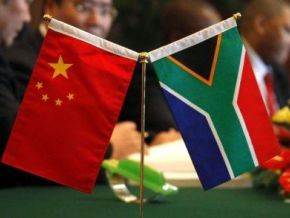
- China will provide duty-free access to South African goods without the need for reciprocal tariff reductions.
- Pretoria and Beijing signed the CAEPA framework on 6 February and aim to conclude an “early harvest agreement” by the end of March 2026.
- Bilateral trade is set to reach $53.58 billion in 2025, while South Africa wants to offset US tariffs of up to 30% imposed under the Trump administration.
Chinese Ambassador to Pretoria Wu Peng announced that China would not seek reciprocity under the recently signed Economic and Trade Partnership Agreement with South Africa.
“In this process, China will fully consider South Africa's interests and will not seek reciprocity,” the diplomat said in comments reported last week by the South China Morning Post.
As a result, South African goods will enter the Chinese market duty-free, while Pretoria will not be required to reduce its own tariffs on Chinese imports.
China and South Africa signed a framework economic partnership agreement on February 6, known as CAEPA (Framework Agreement on Economic Partnership for Shared Prosperity). The agreement aims to increase trade flows and investments between the two BRICS members.
However, CAEPA does not yet constitute a full free trade agreement. Instead, the framework establishes a negotiation architecture that both parties intend to develop further. Pretoria and Beijing have committed to concluding an “early harvest agreement” by the end of March 2026. A partial trade deal should include tariff preferences and could provide duty-free access for selected South African exports.
Yet the agreement has raised concerns in South Africa about potential reciprocity requirements that could destabilize many domestic industries, including the automotive sector. Beijing's decision to waive reciprocity directly addresses those concerns.
China announced the move as it prepares to eliminate tariffs on all imports from African countries with which it has diplomatic relations from May 1, 2026. Chinese President Xi Jinping announced the generalized relaxations during the 39th annual summit of the African Union held in Addis Ababa on 14 and 15 February. The measure does not include Eswatini, which remains Taiwan's last diplomatic ally in Africa.
Beijing aims to rebalance trade relations with the continent through tariff exemptions. China remains Africa's largest trading partner and has a high trade surplus with the continent, which has been criticized for many years.
In January, the South African government threatened to increase tariffs on Chinese and Indian vehicles to prevent a sharp increase in imports from those countries.
Chinese Africa-focused trade lawyer Cai Xue said the agreement between Beijing and Pretoria “Chinese companies operating in South Africa should also benefit,” According to South China Morning Post.
He said offering non-reciprocal and duty-free access to the vast Chinese market to all African countries except Eswatini is aimed at strengthening the viability of special economic zones and industrial parks where many Chinese companies operate.
Meanwhile, Pretoria is looking to diversify its trading partners to protect export competitiveness after the Trump administration imposed tariffs of up to 30% on many South African products.
South Africa is China's largest trading partner in Africa. Africa's most industrialized economy exports wine, fruit, grains, rooibos and a wide range of minerals to Asian economic giants. Bilateral trade to reach $53.58 billion in 2025.
walid kefi