
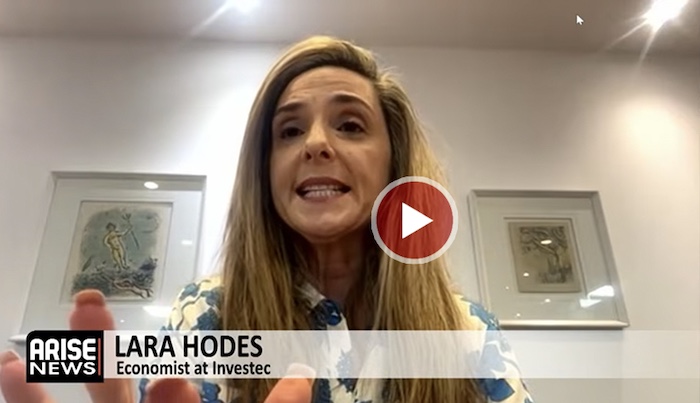
According to economist Lara Hodes, South Africa's economy is set to grow 1.1 percent in 2025, with the finance, real estate and business services sectors emerging as the largest contributors to the country's economic expansion.
Speaking during an interview on ARISE News on Wednesday, Hodes made the revelation while analyzing South Africa's latest gross domestic product (GDP) figures.
According to the latest data, South Africa is set to add about 289 billion rand to its economy in 2025, taking the country's nominal GDP to about 7.6 trillion rand and maintaining its position as Africa's largest economy.
Hodes reported that although agriculture recorded strong growth during the year, the overall expansion of the economy was not widespread as some sectors experienced contraction during the same period.
“It was not broad-based growth,” he said, adding that while some industries recorded growth, others experienced declines.
They identified the finance, real estate and professional services sector as the leading contributors to economic growth, accounting for half of the total expansion recorded in 2025.
“The biggest contributor to the 1.1 percent growth was the finance, real estate and business services sector, which contributed 0.5 percent,” Hodes said.
Agriculture also played a major role in supporting economic growth, particularly after a strong improvement in crop production during the year.
According to him, the sector is projected to register an impressive 17 percent growth by 2025, mainly driven by increased production of field crops and horticultural products.
The economist said the strong agricultural performance was supported by favorable weather conditions and improved rainfall, which led to an increase in crop yields.
“We had a fantastic maize crop and this was supported by favorable weather conditions, including adequate rainfall,” he said.
However, Hodes pointed out that part of the strong growth in agriculture was also influenced by statistical base effects.
He said the sector had previously declined by about 8.4 percent in 2024, meaning the rebound in 2025 represents a recovery from that earlier decline.
The trade sector also contributed to the overall expansion of the economy, adding about 0.3 percentage points to the country's 1.1 percent growth rate.
Despite the improvements, Hodes described overall economic performance as modest and employment levels insufficient to significantly improve.
“This is certainly not a light-hearted growth figure. It is still very weak and certainly not enough to see a significant increase in employment,” he said.
He noted that although the economy has begun to address some structural challenges, particularly in the power sector, a number of issues continue to limit robust economic growth.
One of the key reforms, according to him, is progress in addressing load-shedding, which has disrupted economic activity in the country for long.
However, he stressed that South Africa still faces serious infrastructure challenges, particularly in water systems and logistics networks.
Hodes also said global geopolitical developments could impact the country's economic outlook, particularly as ongoing tensions in the Middle East have created uncertainty in global markets.
He said the conflict has hit global oil prices, although recent developments have helped push prices below $90 a barrel.
On the expenditure side of the economy, Hodes highlighted the improvement in gross fixed capital formation, which increased by 1.3 percent.
According to him, this growth reflects strong private sector spending along with increased investment in infrastructure development.
He said part of the investment growth came from increased spending on computer software and information and communications technology equipment as companies pursue digital transformation.
“Other asset categories were largely responsible for this, including spending on computer software and ICT equipment,” he said.
Domestic consumption also recorded moderate growth, rising by about 1.2 percent during the period.
Hodes said consumer spending remains a key driver of the South African economy, accounting for more than two-thirds of economic activity.
He said several factors supported household spending, including low inflation, monetary easing and a slight improvement in employment conditions.
Although unemployment remains at more than 31 percent, he said a slight decline in the unemployment rate and improving consumer confidence had helped support spending.
Looking ahead, Hodes expressed cautious optimism about South Africa's economic outlook for 2026.
He estimated that the country's economy could grow by about 1.5 percent, reflecting gradual improvement in key sectors and continued policy reforms.
According to him, progress has already been made in many areas, including improvement in investor confidence and positive developments in the country's financial position.
However, he warned that global uncertainty, including geopolitical conflict and increasingly protectionist trade policies, could still weigh on the pace of economic growth.
“We are expecting 1.5 percent growth this year,” Hodes stressed. He stressed that the global environment remains unpredictable.
He said that although the economy is showing signs of recovery, continued reforms and infrastructure improvements will be essential for South Africa to achieve stronger and more inclusive growth in the coming years.
Vijay Ojo
What should I follow: