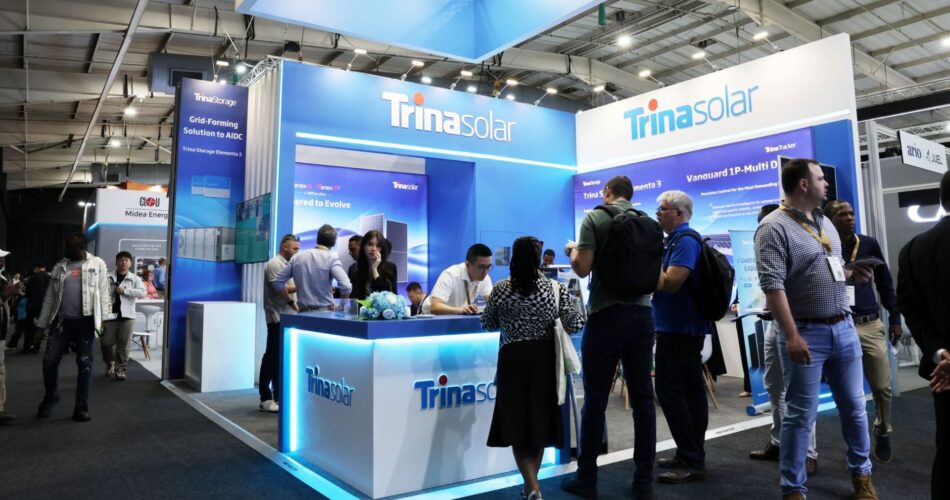
Last week, Johannesburg's Gallagher Convention Center hosted Annual Solar & Storage Live Africa The event, where key players in the country's renewable energy sector showcased their latest solutions, highlighted growing local trends, and shed light on what's to come in the near future in terms of projects.
one of those companies was TrinasolarA global operator specializing in smart photovoltaic (PV) and solar storage solutions. Thus, Solar & Storage Live Africa served as a perfect venue to showcase how TrinaSolar plans to disrupt the local solar industry.
In South Africa, recent years have witnessed a significant change in how solar energy is implemented and regulated. During the peak of loadshedding, investment in solar energy was substantial, particularly in the enterprise sector, where organizations focused on securing their energy needs were less dependent on the degraded power grid.
However, more recently, Eskom has proven to be more stable, and this has put those aforementioned solar investments in a different lens.
So, what now, and is the South African renewable energy sector as important as it was just two years ago?
This and more was answered by Zaheer Khan (pictured below), Regional Director for South Africa at Trinasolar MEA, who explained what the company thinks and where it is going locally.
Speaking on TrinaSolar’s partnership with Solar & Storage Live Africa, Khan said it provides an opportunity to highlight a recent milestone.
partner, partner, partner
“We are announcing the completion of module delivery on the 510MW Khouta solar project – one of the largest solar installations in Africa – and the signing of our new 220MW Orkney solar project with Mulilo. These are important milestones and this is the perfect platform to share them,” he shared.
He also stressed the importance of deepening ties within the country. “The South African solar market is built on trust and long-term partnerships. The developers, EPCs, financiers and policymakers participating in this program are the people who make projects happen. Being present, visible and interacting with them is how we continue to grow in this market.”
When asked about the recent South African budget speech and the apparent lack of announcements regarding the renewable energy sector and any incentives in that regard, Khan pointed to the fact that consumers and businesses do not need to rely solely on the government to provide incentives for investment in renewable energy and especially solar energy.
“Our approach at Trinasolar is a measured one. The fundamentals of solar energy adoption in South Africa are structural, not entirely incentive-driven. Electricity tariffs have increased rapidly and are continuing – with the above-confirmed inflationary increase of 8.76 per cent in April 2026 and 8.83 per cent in April 2027 – making solar a financially compelling decision for businesses and developers regardless of additional fiscal support. The business case for solar energy in South Africa is not dependent on government incentives,” he explained.
“What we would welcome – and what the wider industry consistently points to – is continued investment in grid infrastructure and the successful implementation of the wholesale electricity market SAWEM (South African Wholesale Electricity Market) planned for April 2026. These structural reforms will do more for long-term solar growth than any single budget line item. IRP 2025, which targets 28.7GW of new solar by 2039, provides the long-term policy framework that will give developers and investors what they need. Gives them the certainty they need to do that in a big way,” Khan continued.
Here he emphasized that waiting for incentives to guide development and planning is not the best approach.
“Incentives matter, but policy certainty, grid access and bankable procurement frameworks matter more. South Africa has the foundation. The priority now is implementation,” he said.
Roaming
Subsequently, the Regional Director highlighted the 510MW Khauta Project, one of the above mentioned milestones for the company. Apart from the additional power, it is also intended to provide some other tangible benefits to the national grid, he said.
“The 510 MW Khauta solar project – delivered on two simultaneous contracts in Welkom, Free State – is significant for much more than its contribution to the national grid, although this contribution alone is substantial. For the local community, a project of this scale generates meaningful employment during the construction phase, bringing economic activity to an area that has faced significant challenges following the decline of its gold mining industry. Construction jobs, logistics, procurement and site services all create a ripple effect across the local economy,” he explained.
“Beyond employment, Trinasolar supports the community through direct outreach initiatives – contributing welfare days to people working on the project and sponsoring football and netball kits for local youth programs in the Wellcome area. These are not big gestures in the context of the 510MW project, but they reflect a real commitment to leaving a positive legacy in the communities where we work,” he shared.
As for future projects, Trinasolar recently signed a contract for the 220MW Orkney Solar Project muliloWhich has been described as one of South Africa's most active and experienced renewable energy developers.
This latest effort, along with Khauta, will form part of a pipeline that is expected to exceed 2GW, building on the foundation of delivering more than 1GW of solar equipment to South Africa in a single year.
“The progression from 1GW to 2GW in the pipeline is the most honest indicator I can give you of where developer confidence is in Trinasolar,” Khan enthused.
“More broadly, 2026 is going to be the biggest year for solar deployment in South Africa. The REIPPPP bid window 7 has delivered almost 4GW of solar energy across 18 IPPs – the largest solar procurement in the country's history – and those projects are at various stages from financial close to procurement stage which leads to active construction. Every major developer in that pipeline needs a technology partner they can trust. We are in exactly the same position,” he highlighted.
rapid growth
Looking ahead to 2026, a local sector that has already proven to be in a state of flux, Khan outlined three areas he believes will shape the renewable energy landscape over the next few years.
“First, solar-plus-storage becomes the default rather than the premium option. Almost half of South Africa's 220GW renewable energy pipeline now integrates battery energy storage – this figure tells you that the market has already made this decision. The question now is not whether to include storage, but which storage technology to choose,” he explained.
Subsequently, he stressed the importance that Launch of SAWEM will be held, which will see the country transition from a single-buyer model to a more competitive, open market. “This is not an incremental improvement. It changes the commercial logic of each project in the pipeline, and it creates new opportunities and new responsibilities for each participant in the value chain,” he said.
Finally, he highlighted the need for South Africa to significantly expand its high-voltage transmission network, to unlock the generation capacity already waiting to be connected. He further said, “The Transmission Development Plan has identified the need for 14,500 kilometers of new high-voltage lines over the next ten years. Private sector participation in transmission will be one of the most consequential developments in the sector over the next decade.”
With Trinasolar operating in South Africa for more than a decade, Khan is optimistic about the country's renewable energy future, but only if access is prioritized at every level.
“The bottleneck in South Africa right now is not hunger or capital – it's grid access. Projects are ready, partners are ready, the technology is ready. The region needs grid expansion to unlock the next phase of growth,” he concluded.
Get the tech news you want to read. Take our reader surveys and tell us how we can better help you.