
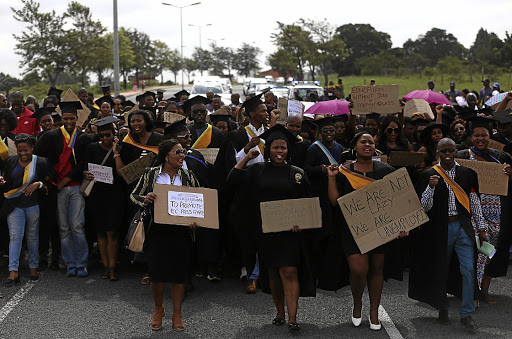
The group of unemployed: many young people – often graduates with skills, yet standing outside the economy, impatient and clearly angry.
On 1 May, South Africa once again celebrates Workers' Day. This is a day with real historical meaning. It honors the dignity of work, the struggle of workers and the role of the labor movement in the fight for justice in our country.
But this year, like many years before, the occasion comes with a bitter irony: millions of South Africans are expected to celebrate workers, while not being given the chance to become workers themselves.
This is the central tragedy of South Africa in 2026. According to the official definition, unemployment is 31.4%. On the expanded definition, which includes discouraged job seekers who have given up looking, it is 42.1%. This means that approximately 7.8 million South Africans are officially unemployed. To me, these are not abstract figures from the Quarterly Labor Force Review.
There are parents who can't provide, young people who can't get started and families who are hollowly told to just wait a little longer for the economy to improve.
Labor Day should be a celebration of progress through work. In South Africa, it often becomes a rite of denial. On this day, South Africans are often faced with the stale theater of political self-congratulation. Yet the lived reality of millions of citizens is not respectable work, but exclusion from work: no ladder into the economy, but a wall around it.
No country can call itself serious about workers unless many of its people have work.
The first truth we have to understand is that jobs do not come from rhetoric. Jobs come from growth, investment and confidence in the economy.
Jobs require functioning and maintained infrastructure, reliable electricity, safe roads, efficient transportation, clean governance, and a state that understands its job is to enable enterprise, not stifle it.
A society does not become more pro-labor by making it harder to hire, manufacture, trade, and invest. It becomes more pro-worker by paving the way for breakout growth, making it easier for millions of people to enter the world of work. This is why the contradictions within South Africa matter so much.
The Western Cape now has the lowest official unemployment rate of any province in the country, at 18.1%, compared to the national rate of 31.4%. Even on the extended definition, the Western Cape performs better at 23.7% compared to 42.1% nationally.
Between the third and fourth quarters of 2025, the Western Cape added 93,000 jobs and 95,000 jobs year-on-year. These are not miracles and do not mean that everything is fine. But they show that better policy, better governance and a more functional state can deliver better outcomes for working people.
The same is true in Cape Town. The latest figures from Stats SA show Cape Town's official unemployment rate fell to 19.8% in the fourth quarter of 2025. The metro added 69,000 jobs quarter-on-quarter and 113,000 jobs year-on-year, taking the number of people employed in the city to 1.895 million. The city's employment-to-population ratio also increased to 57.6%.
These are encouraging numbers and evidence that where a government does its basics well – where it keeps the lights on, maintains infrastructure, manages finances responsibly and works to create an environment for growth – people have a better chance of finding work and building lives.
In places where the Democratic Alliance (DA) governs, the growth you see is the result of leadership, setting a clear vision, making it easier to do business by cutting red tape, focusing relentlessly on the fundamentals and creating an environment that attracts investment and job creation, not repels it – a government that gives people a better chance to find work and build lives.
Of course, no one should pretend that Cape Town or the Western Cape has solved unemployment. He hasn't. Many residents are still looking for work.
Too many young people are still left out of the economy, impatient and understandably angry. But there is a deep difference between a government that faces the problem seriously and one that merely makes noises about it.
There is a difference between a state that sees business and the private sector as partners in job creation and one that treats enterprise as a political enemy. There is a difference between ruling for headlines and ruling for results.
This is the lesson that South Africa's national government has refused to learn.
You can't regulate your way into collective employment. You cannot tax, threaten and block the path to prosperity.
You cannot build a thriving labor market on a foundation of failing infrastructure, collapsed railways and ports, municipal dysfunction, crime, cadre deployment, corruption and ideological hostility towards development.
And, importantly, you certainly can't respect workers while presiding over one of the highest unemployment rates in the world. Being truly pro-labor doesn't just mean talking warmly about labor. This is to build a country in which work is possible.

It has to be understood that the unemployed are not a separate class that is pitied in every election cycle and then forgotten. They are South Africans whose dignity is being denied by a state that has failed in its most basic economic duty. The best labor policy is one that prepares more entrants to the labor market.
The best social policy is one that increases the number of earners. The best dignity policy is a job.
So this Labor Day, South Africans should ask a simple question: What does it mean to celebrate workers in a country that is creating unemployment?
The answer to this cannot be any other speech or any other slogan. It must be a commitment to growth, reform, clean government, safe communities and credible
For infrastructure and an economy that rewards rather than punishes effort.
Geordie Hill-Lewis is the DA federal leader and Mayor of Cape Town.