
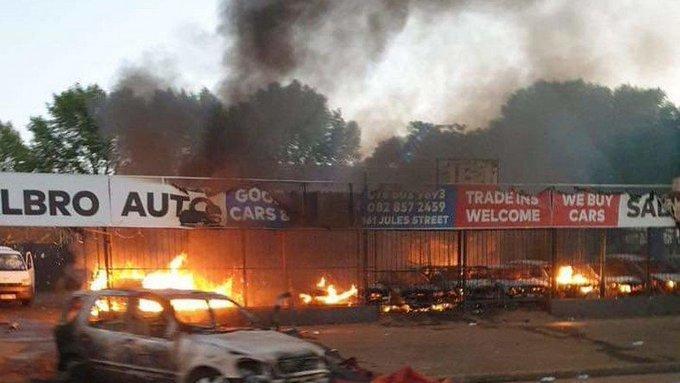
Tensions have risen in South Africa's Eastern Cape following a wave of xenophobic attacks targeting Nigerians amid outrage over reports of the installation of a Nigerian, Solomon Eziko, as Igwe Ndigbo (Igbo leader) in the region.
The unrest that erupted in the east London city, which includes areas such as Albany and Buffalo under Kugompo, saw protesters take to the streets on Monday over what they said was a violation of South Africa's traditional authority system.
This installation was said to have taken place in early March, which locals interpreted as an attempt to establish a parallel traditional leadership structure.
The protests soon turned into violence, with at least 26 Nigerians reportedly injured and hospitalized.
Property worth millions of rand, including shops and vehicles, was looted or destroyed.
Viral videos circulating online show scenes of Nigerians being beaten, harassed and forced to close their businesses, while others fled for safety amid the chaos.
Frank Onyekwelu, president of the Nigerian Civil Union South Africa, charged that the controversy only provided a pretext for long-standing anti-foreign sentiments.
According to him, tensions were rising before the incident, with some South Africans demanding the expulsion of foreign nationals.
Onyekwelu said, “They used the coronation as an excuse. There is a growing campaign to reclaim South Africa for South Africans, as well as hate speech on media platforms.”
He said Nigerian-owned businesses were deliberately targeted, particularly in the Eastern Cape and parts of KwaZulu-Natal, with reports of looting, arson and threats to life.
Onyekwelu described the attacks as “xenophobic and prejudicial”, noting that similar hostility is rarely directed at non-African immigrants such as Europeans or Asians.
However, not all Nigerians in South Africa share the same views with a community source who spoke anonymously criticizing the installation of the Igbo leader, calling it ill-timed and provocative.
“The coronation was a mistake, especially during a municipal election year when anti-immigrant sentiment is already high,” the source said, warning of possible renewed protests.
He said that although Nigerians were the primary targets, other foreign nationals including Somalians, Pakistanis and Ethiopians also suffered harm during the unrest.
The source further revealed that some community leaders had warned against the move before the event but they were ignored.
Defending the action, Onyekwelu insisted that the Igwe Ndigbo title is purely ceremonial and is intended to preserve Igbo culture among Nigerians in the diaspora, and not to challenge South African sovereignty.
Similarly, Smart Nwobi, President-General of the Nigerian Union of South Africa, described the crisis as a “misinterpretation of a cultural event”.
“Our people are living in fear. Many businesses are closed, and many Nigerians have remained indoors for safety,” he said.
He said the situation requires immediate clarification from stakeholders.
President ABC Okokoh of Ohana Ndigbo in South Africa also denied that any formal coronation had taken place, saying the event was merely a symbolic recognition during a private gathering.
Okokoh explained, “It was not about kingship or rule. There was no attempt to establish traditional authority.”
However, the South African government has taken a strong stance on the matter.
Cabinet spokesperson Khumbudzo Ntshavweni criticized the incident and described the alleged coronation as illegitimate and disrespectful to local customs.
“Our heritage and customs must be respected, especially by visitors,” he said.
He warned that traditional leadership structures in South Africa are strictly governed by law.
Ntshavweni accepted an apology from Nigerian authorities, but stressed that any grievance should not lead to violence, urging protesters to act within the law.
Nigerian immigration authorities have begun a review of the situation. The Nigerians in Diaspora Commission (NIDCOM), through its spokesperson, Abdu-Rahman Balogun, confirmed that investigations were ongoing.
NiDCOM Chairman Abike Dabiri-Erewa had called for calm, blaming “misperception and misinterpretation” of the cultural festival for the crisis.