
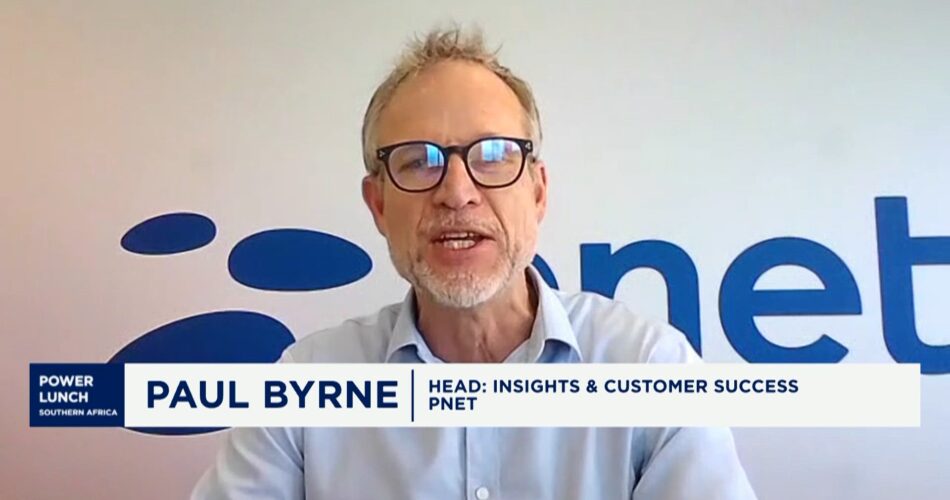
According to a new report discussed by Paul Byrne, PNET's Head of Insights and Customer Success, South Africa's artificial intelligence jobs market is expanding well beyond its traditional base in software development and data roles, with new demand emerging in business management, education, administration, finance, manufacturing and other sectors.
Speaking to CNBC Africa, Byrne said the clearest takeaway from the company's latest research is that AI is no longer a niche recruiting trend limited to highly specialized technical positions. Instead, he said, technology has increasingly become mainstream, reshaping job requirements and creating new opportunities across a wide spread of industries.
“I think the key part, if we really look at the fundamental thing that our research is showing, is that AI is no longer limited to just the realm of software developers and data experts,” Byrne said. “It's really become mainstream now.”
This shift is important for South African job seekers, employers and education providers alike, as businesses are increasingly looking for workers who can use AI tools to improve efficiency, decision making and productivity.
Not surprisingly, the IT sector remains a major source of AI-related opportunities. Byrne said this has been the case for years, with the foundations of AI-related work beginning to appear as early as 2010, even before the term was in widespread commercial use. However, the pace of adoption accelerated rapidly after the launch of ChatGPT in late 2022, helping to bring AI into everyday business interactions.
Within IT, the strongest opportunities are associated with building AI systems and integrating AI into software development, testing, and deployment processes. But Byrne emphasized that the bigger story is the growing footprint of AI skills in non-technical occupations.
One of the most notable areas of development is business and management. Byrne said companies are increasingly looking for managers who understand how to use AI for operational decision making and strategic planning. This signals a shift in the labor market: Employers are now recruiting not only technical experts to build AI tools, but also leaders who can apply them to business problems.
According to Byrne, there is increasing pressure on managers to use AI to improve planning processes and boost the effectiveness of decision making. In practical terms, this means that AI literacy is becoming a valuable workplace skill for supervisors, executives, and operational leaders across all industries.
Education and training is another sector showing remarkable progress. Byrne said institutions appear to be recognizing that they must equip students and workers with the building blocks needed to engage with emerging technologies. The growing presence of AI in education reflects both the immediate demand for digital skills and a long-term effort to prepare the workforce for changing job requirements.
Administrative, office and support roles are also being reshaped by AI, particularly through the automation of routine tasks and workflow management. Byrne said employers are increasingly using AI in these tasks to increase productivity, suggesting that even roles once considered less exposed to technological disruption are being redefined.
Finance is another key sector in South Africa’s AI hiring landscape. Byrne said finance professionals have been using forms of AI for years, particularly in bookkeeping, reporting and data processing. Like IT, adoption in finance predates the current AI boom, but the pace has accelerated in the post-ChatGPT environment.
Beyond those areas, Byrne said, Pinet's research is tracking AI-related activity in design, media and the arts, marketing, architecture and engineering, sales, and manufacturing and assembly. The breadth of that list points to a labor market in which AI capabilities are becoming increasingly relevant across a broader range of occupations.
Manufacturing represents the clearest example of practical AI use outside of office-based tasks. Byrne highlighted predictive maintenance as a particularly compelling application. In this context, AI is being used to predict when machinery or parts of the production process may require maintenance, allowing firms to act before output is disrupted.
This can improve productivity, reduce downtime and make production planning more accurate – a solid example of how AI adoption is changing operational value in industrial settings.
Still, Byrne suggested that not every part of the economy is experiencing AI disruption at the same pace. He pointed to business and artisan roles as an area where direct AI use is so far limited, aside from the planning, purchasing and management functions around those businesses. Still, his broader message was that few employees could afford to ignore change.
Byrne said AI is increasingly affecting “all of us” and argued that workers should focus on learning the foundational skills to use AI tools effectively. He emphasized that such education is not only the responsibility of institutions or employers, but also of individuals who want to protect their future employability.
In his view, self-driven learning will be important as companies look for employees who can use AI to find answers faster and work more effectively than in the pre-AI era.
The discussion also underlined a growing concern in the labor market: that AI could not only replace jobs entirely, but also harm workers who fail to adopt the technology. The topic has become increasingly central to debates around the future of work, especially for young people deciding what to study and how to set themselves up for the changing economy.
For South Africa, the findings show that AI is no longer a distant or purely technological trend. This is becoming embedded in the structure of the labor market, influencing hiring patterns across different sectors and placing a premium on digital adaptability. As the technology continues to penetrate deeper into business operations, the opportunity appears to be shifting away from a narrow group of AI experts toward a larger group of workers able to apply AI tools in practical, sector-specific ways.
The message from Pynet's research is clear: in South Africa's emerging employment landscape, AI skills are becoming less about working in technology alone and more about remaining relevant across the economy.