
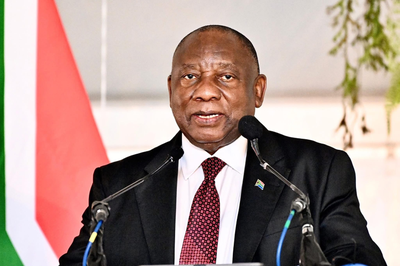
In his weekly letter, Ramaphosa said the government's investment program is beginning to show results, with major capital investments being made in key sectors supporting job creation across the country, according to the President.
He said the engagement helps connect investors to opportunities in South Africa by bringing together governments, businesses, banks and development finance institutions.
“These engagements are not 'just for show', as some have suggested. They are an opportunity to connect investors with local opportunities,” Ramaphosa said.
Ramaphosa highlighted a number of major investments, including BMW's R4.2 billion project to electrify its Rosslyn plant in Gauteng, Tetra Pak's R500 million plant upgrade in KwaZulu-Natal and Microsoft's multibillion-rand expansion of cloud and AI infrastructure in South Africa.
Despite the progress, Ramaphosa acknowledged that the country still faces challenges in reaching its investment targets.
“We are creating conditions for development and providing the necessary policy certainty, we are improving project planning, financing and execution,” the President said.
Read the full letter below:
Investment conference commitments are turning into jobs
Dear fellow South Africans,
Since the beginning of this year, we have organized several high-profile events with domestic and international investors.
These include a business forum during a visit to Brazil and Spain, the sixth South Africa Investment Summit in March and last week an infrastructure investment summit hosted by BlackRock, one of the world's largest infrastructure investment managers.
These engagements are not 'just for show', as some have suggested. They are an opportunity to connect investors to local opportunities and bring together governments, business, banks and development finance institutions.
Around the world, investment conferences and summits are platforms to attract foreign direct investment in a global investor landscape that has become increasingly competitive. The fact that international and domestic investors are willing to commit capital to South Africa shows confidence in our country as an attractive investment destination.
Since we launched our first National Investment Campaign in 2018, we have attracted investments in energy, telecom, infrastructure, automotive, mining, advanced manufacturing and many other sectors.
Based on the R1.5 trillion pledges, a total of R634 billion has already been invested in factories, mines, data centres, power plants and other infrastructure, creating jobs.
These include a R4.2 billion investment by BMW to electrify its Rosslyn plant in Gauteng and support new energy vehicle production; A R500 million investment by Tetra Pak to upgrade its plant in KwaZulu-Natal; Corobrick's R500 million investment to build its Quastina plant in Gauteng; and the Newlin PX Terminal in the Port of Durban which begins operations in 2024.
Last year, I opened the Ivanplats Platreef mine in Mokopane, generated from a R2.8 billion investment conference pledge.
In addition to creating jobs, these investments are supporting the skills development of young South Africans to better prepare them for the rapidly evolving world of work. For example, Microsoft has partnered with Youth Employment Services (YES) to provide globally recognized certification in high-demand AI skills. This is part of a more than R5.4 billion investment by Microsoft to expand its cloud and AI infrastructure in South Africa by 2027.
We welcome all types of investments, whether planned or new.
Investing is a long term commitment. Moving from promises to large-scale development and job creation takes time, especially in areas where projects take years to reach implementation.
The reality is that we are far away from where we should be.
One of the most commonly used measures of investment in the economy is gross fixed capital formation (GFCF), which currently stands at about 14% of our GDP. The National Development Plan challenges us to reach 30% by 2030.
Our GFCF reached approximately 21% in 2008, driven by the continued commodity boom, the start of Eskom's construction program and infrastructure expansion ahead of the 2010 FIFA World Cup. There has been a steady decline since then, as the global financial crisis and a period of state capture gradually reduced private investment and business confidence.
Since 2018 we have tried to stop this decline. We have matched intention with action to stabilize public finances, solve the energy crisis and pursue structural reforms.
Yet there is still a gap between improved investor sentiment and more investment.
The message we are conveying in our meetings with investors is that we are creating the conditions for growth and providing the necessary policy certainty. As we reiterated at last week's Infrastructure Investment Summit, we are improving project planning, financing and execution.
Through this, we aim to bridge the gap between investment pledges, implementation and ultimately job creation.
Our goal is to encourage the substantial private capital in reserve to be used for productive domestic investment. According to the South African Reserve Bank, South African non-financial companies held R1.8 trillion in reserves as of July 2025.
Building more prosperous, inclusive societies is a collective task. It depends largely on productive investment. That's why we are encouraged that the largest number of pledges at the sixth South Africa Investment Summit were from domestic investors. Local businesses – who know our economic and social conditions best – are making substantial investments in our economy.
As we move forward with efforts to attract new investment, we call on the local private sector to be at the forefront of rebuilding the investment momentum in our economy. Their confidence will encourage more international capital to follow.
It is now crystal clear that the commitments and commitments made in the conference hall are consistently and rapidly translating into economic activity that creates jobs and opportunities for South Africans.
Best wishes,
Jacaranda FM