
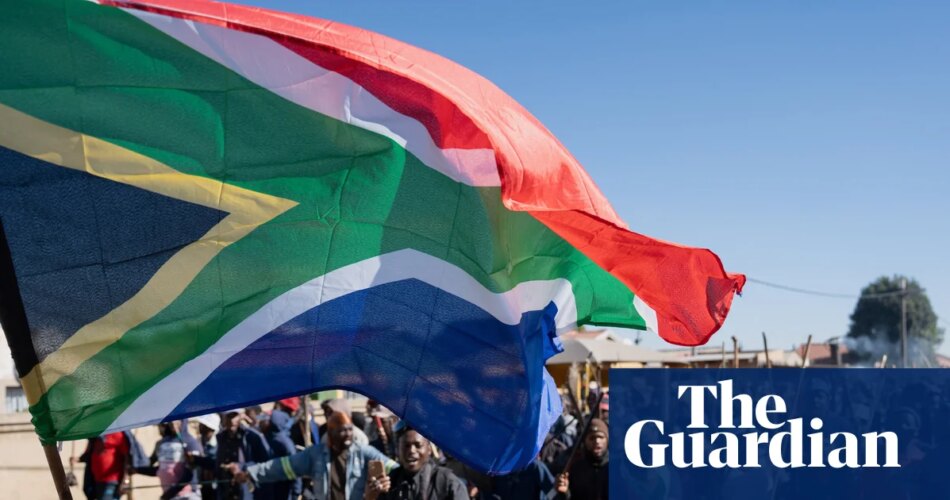
african diaspora South Africa They say they are living in fear after several marches called for illegal immigrants to leave the country's long-standing xenophobic sentiment.
March & March, a campaign group at the forefront of the recent protests, has given people living in the country illegally until June 30 to leave the country, without saying what will happen to those who do not do so.
Mozambique said five of its citizens were killed in “xenophobic attacks” in late May. South African police said Two Mozambicans and a South African were killed when violence broke out in Mossel Bay on the southern coast.
About 100 people from Mozambique and Malawi, about 60 miles south-east of Cape Town Seeking shelter in Kleinmond Town Hall Last week, an angry mob reached an informal agreement with the foreigners telling them they would have to leave.
Many told Reuters news agency that they wanted help from their governments to return home. Ghana has arranged flights hundreds of its citizens To leave South Africa.
“Every day and almost everyone I meet is scared, extremely scared,” said an Ethiopian entrepreneur who moved to the south. Africa In 2000 and married a local woman. The couple have a 19-year-old daughter.
“The sad thing is that this is not because they are undocumented… but that no amount of legal documentation will protect you from violence.”
South Africa has long imported migrant workers, particularly to work in its mines. After his election in 1994 ended white-minority rule, Nelson Mandela welcomed African immigrants. Meanwhile, poverty and economic conflict in many neighboring countries, including hyperinflation in Zimbabwe, pushed people south.
Endemic unemployment and inequality led many South Africans to blame African immigrants for their problems, causing resentment to occasionally erupt into violence. sixty-two people died During the riots in 2008, 21 South Africans were killed and more than 150,000 people were displaced. in 2015At least five people were killed.
The proportion of South Africans who said they would welcome all immigrants fell by a quarter in 2020 to 15% last year. According to surveys by the Human Sciences Research CouncilA state body. Unemployment rate has increased by 3.4 percentage points 43.1% From 2020.
Sharon Ekambaram, who leads the refugee and migrants program at Lawyers for Human Rights, said: “People are struggling to hold the government to account and it's easy to blame migrants.”
South Africa's foreign-born population is set to almost triple to 2.4 million between 1996 and 2022. According to census dataWhich aims to include undocumented people. This represents 3.9% of the population of 62 million, up from 2% in 1996.
The march and march leader, Jacinta Ngobse-Zuma, who has campaigned for mass deportations, claim that illegal immigration “From 15 million to about 30 million”.
“South Africa is currently under attack. South Africans have become refugees in their own country,” he said last month.
Founded in March 2025, March and the March have organized protests across South Africa. After angering local people, the group led a demonstration in the town of Kugompo (formerly East London) on 30 March. Later rejected reports That a Nigerian was crowned king. Since then, marches have taken place in cities including Durban, Johannesburg and Pretoria.
Asked how the group was funded, Ngobse-Zuma told local outlet Daily Maverick: “We get funding from concerned South Africans, but we also have a social media page where our supporters can contribute. They contribute financially, but some contribute in other ways.”
Another prominent personality Ngizwe Mchunu was included in the march. The radio DJ was acquitted of inciting riots in July 2021 More than 350 people died After former President Jacob Zuma was sent to jail.
Ahead of local elections in November, some smaller parties including ActionSA and Jacob Zuma Umkhonto we Sizwe (MK)Trying to gain support by associating themselves with the protests.
African National Congress politicians have tried to walk a better line. “South Africans from all walks of life have raised concerns about migration and illegal immigration… These concerns are real. They deserve to be heard. They must be addressed,” said Cyril Ramaphosa, President of South Africa. said in a televised address on Sunday night.
He promised a tough crackdown on illegal immigration and corruption within the country's border officials, and stressed that only state officials are allowed to ask for proof of nationality.
Ramaphosa said, “We will not allow groups to use the legitimate concerns of South Africans to destabilize our country by inciting chaos and violence.”
Otloteng Mokgatal, a political analyst at consultancy firm Control Risks, said: “This issue is highly volatile and even for parties that may see it as an opportunity, it brings with them quite large reputational and even internal stability risks.” He said that parties supporting anti-migrant marches could be blamed for incidents of looting.
Meanwhile, African immigrants face great uncertainty. “Of course I'm worried, because I don't know what's going on, what's going on,” said Sandy Khumalo, who has a residency permit and runs Makhumalo, a restaurant in downtown Johannesburg that provides food for fellow Zimbabweans. “I have been here since 2009, so this is my home. I am under a lot of stress.”