
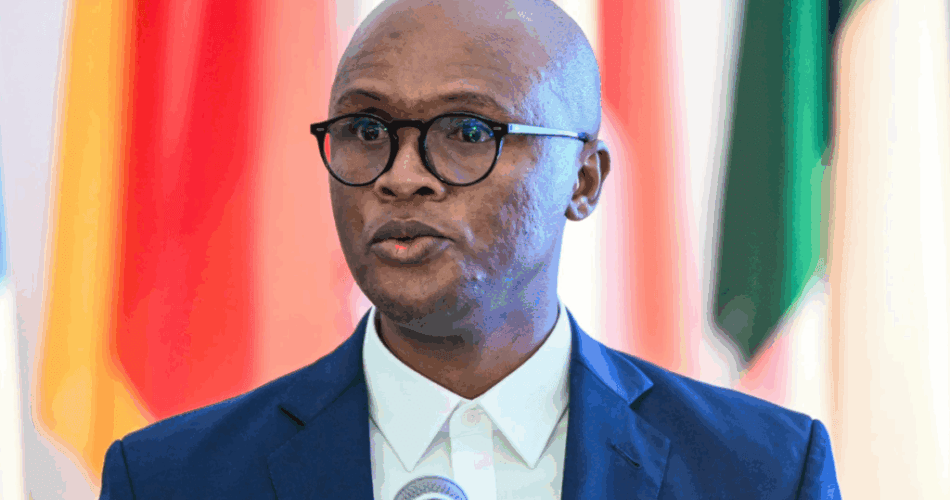
Communications Minister Solly Malatsi has appointed an independent panel of AI researchers, lawyers and governance experts to reconstruct the draft of South Africa's national AI policy, a document she was forced to withdraw last month after academic citations in its bibliography were found to have been fabricated by a generative AI tool.
“We cannot discuss the policy issue without discussing the matter of the draft National Artificial Intelligence Policy, and the revelation that generative AI was used irresponsibly during the drafting of this policy,” Malatsi told MPs on Tuesday as he presented the R2.55 billion budget for the Department of Communications and Digital Technologies for the financial year 2026/2027. “We will implement an internal responsible AI use policy, and review our policy development process, to ensure this type of incident does not happen again. South Africa deserves better.”
The panel will be chaired by Wits University AI researcher Benjamin Roseman, who was named in Time's list of the 100 most influential thinkers in AI in 2025. Other members include Vukosi Mariwet of the University of Pretoria, Alison Gilwald of Research ICT Africa, lawyers Heather Irwin, Tshepo Phyla, CSIR's Jabu Mtsweni and Lufuno Tshiklange. The group spans AI research, law and digital governance.
Malatsi said the panel is tasked with ensuring that the revised policy is based on the best available evidence and consistent with South Africa's national priorities before it is re-introduced for public comment. No deadline was given for the new draft.
The original draft AI policy was approved by the Cabinet on March 25 and gazetted on April 10 for public comment. It was withdrawn within two weeks of its release. At least six of the 67 entries in the document's reference list were taken from journals that did not exist or were attributed to journals that never published the cited work. The editors of the South African Journal of Philosophy, AI & Society and the Journal of Ethics & Social Philosophy independently confirmed to News24 – which first broke the story – that the articles credited to their publications had never appeared.
Malatsi described the use of generative AI in the drafting process as irresponsible and acknowledged that the episode had damaged the credibility of the document. Return was the only viable option, he said.
The political fallout has been considerable. ANC MP Khusela Diko, who chairs parliament's communications portfolio committee, called for the policy to be repealed and accused Malatsi of seeking a “rape-bot”. Public Works Minister Dean McPherson, a fellow Democratic Alliance cabinet minister, publicly defended Malatsi. Technology investor Stafford Massey previously published an open letter via TechCentral warning that the policy risked “deregulating” South Africa's participation in the global AI economy by prioritizing governance over infrastructure investment.
The withdrawn draft proposed the creation of seven new institutions, including a National AI Commission, an AI Ethics Board, an AI Insurance Superfund, and a National AI Safety Institute.
Separately, Malatsi told MPs the department has begun finalizing the audio-visual services and media policy and will advance the Electronic Communications Amendment Bill to modernize the licensing regime and address convergence in the sector.
Until a revised AI policy is gazetted, South Africa remains without a formal national framework to regulate the technology – at a time when AI is increasingly being woven into both public administration and private sector workflows. Malatsi told lawmakers that Roseman and the rest of the panel would get the country back on track after the shock.