
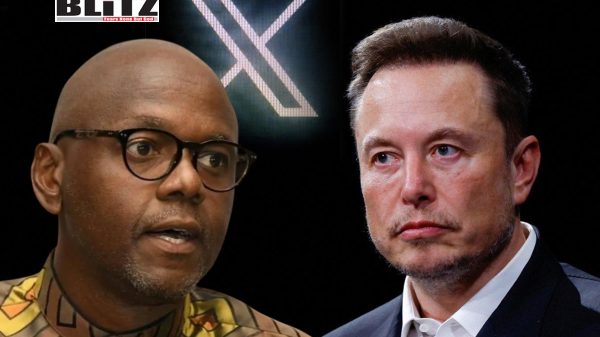
The South African government has come down heavily on Elon Musk, accusing the billionaire entrepreneur of spreading “lies and disinformation” about the country while ignoring its laws and policies. The criticism comes after Musk exaggerated claims on social media that white farmers are being systematically targeted and killed in South Africa – a claim Pretoria strongly denies.
Controversy increased after Musk Post A video from April 12 showed a long row of crosses, reportedly marking the graves of murdered white farmers. The accompanying caption claimed that each cross represented a victim of such murders. The post quickly gained popularity online, reigniting a long-running and highly controversial story about violence against white farmers in South Africa.
Responding to Musk's statements, President Cyril Ramaphosa's spokesperson Vincent Magwenya said, rejected The claims are misleading and inflammatory. Magwenya urged Musk to “move on”, saying his continued rhetoric undermines any constructive engagement he expects with the country.
“The relationship he is forcefully seeking will not be realized under these circumstances,” Magwenya said, stressing that Musk's comments reflected a lack of respect for South Africa's legal framework and socio-political realities. He further said that the government considers such claims not only wrong but also harmful to the country's international reputation.
At the center of the controversy is South Africa's Black Economic Empowerment (BEE) policy, a cornerstone of its post-apartheid transformation agenda. The policy aims to address historical inequalities by promoting greater economic participation among black South Africans, who were systematically excluded during the apartheid era. Musk has repeatedly criticized these laws, arguing that they are discriminatory and have hindered his satellite internet venture, Starlink, from securing a license to operate in the country.
Earlier in a post on April 12, Musk claimed Government officials immediately reacted to a statement that South Africa is blocking Starlink's entry “just because I'm not black.” Magwenya responded candidly, noting that South Africa is one of 193 member states in the United Nations, suggesting Musk has ample opportunities to expand his business elsewhere.
“It's OK to move on,” Magwenya commentedWhich means Musk's complaints don't warrant concessions from Pretoria.
The dispute is also linked to broader geopolitical tensions. Relations between South Africa and the United States have become increasingly strained in recent months, particularly over Pretoria's foreign policy positions. South Africa's decision to bring a case against Israel in the International Court of Justice over its military operations in Gaza has been criticized by Washington.
US President Donald Trump has further inflamed the situation by accusing South Africa of allowing what he has described as “genocide” against African people – who are mainly descendants of Dutch settlers, who make up about 7% of the population. These claims have been widely rejected by South African authorities, who insist that crime remains a serious issue, affects all communities and is not racially targeted in the manner alleged.
Pretoria says the “white genocide” narrative is a distortion of reality, often inflated by external actors and lacking reliable statistical support. Official crime statistics indicate that farm attacks do occur, but experts and government officials insist that they are part of a broader criminal pattern rather than evidence of a coordinated campaign against a specific ethnic group.
Musk's intervention therefore touched on deeply sensitive issues within South Africa, including land reform – a policy area that remains politically and socially charged decades after the end of apartheid. The government has defended its land redistribution efforts as necessary to correct a historical injustice, given that a disproportionate amount of agricultural land is in the hands of the minority white population.
Critics, including Musk and some international observers, argue that such policies risk undermining property rights and economic stability. However, South African officials say the reforms are being carried out within the law and are necessary for long-term social cohesion.
The confrontation also highlights the growing influence and controversy surrounding global tech figures like Musk, whose social media activity can have far-reaching political implications. As the head of companies like Tesla and SpaceX, Musk has a massive online following, which enables his statements to shape public discussion across borders.
In this instance, South African authorities argue that such influence carries a responsibility to ensure accuracy and avoid escalating tensions. They argue that by promoting controversial claims, Musk risks contributing to misinformation that could have real-world consequences.
Despite the heated rhetoric, there has been no sign that either side is trying to immediately de-escalate the situation. Musk has not publicly retracted his statements and South African officials maintain their stance that his claims are baseless.
The dispute highlights the complex interplay between business interests, national policies and global narratives in an increasingly interconnected world. For South Africa, the priority is to defend its domestic policies and international position against what it sees as mischaracterizations. For Musk, the episode reflects ongoing frustration with regulatory hurdles and broader ideological disagreements over governance and economic policy.
As tensions persist, the broader implications for US-South Africa relations and foreign investment in the country remain uncertain. What is clear, however, is that the intersection of technology, politics, and social media is creating new arenas for conflict – often with consequences that extend far beyond a single post or statement.
Tajul Islam is a special correspondent for Blitz. He is also a local producer for Al Jazeera Arabic channel.