
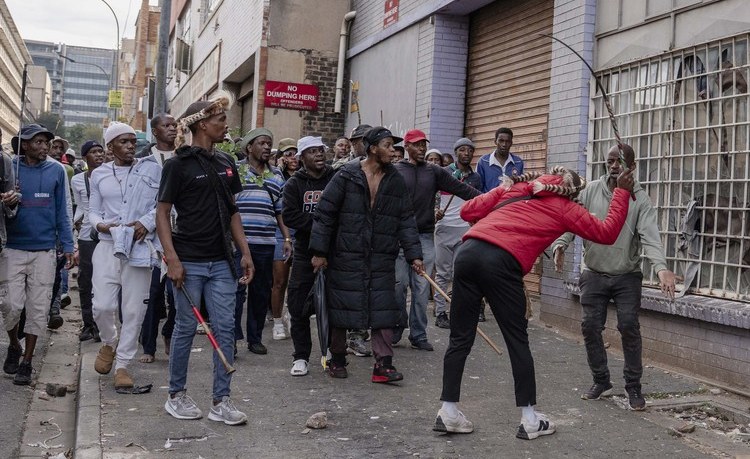
The Equal Education Law Center (EELC), Equal Education (EE), the Children's Institute (CI), Section 27, Copnang Africa Against Xenophobia (KAX), and human rights lawyers unequivocally condemn the recent wave of intimidation and violence targeting migrant persons, including children, in parts of KwaZulu-Natal and Gauteng. Over the past several months, Marches and Marches, and Operation Dudula, have sought to spread fear and division, even going to the extent of threatening schools, which has forced parents to remove their children from classrooms to protect them from possible harm. A video shows organized groups camping outside a school in Gauteng as parents bring their children at the end of the school day. When children as young as 5 are being taken home by their parents, members of the group are heard shouting “Take away the foreign nationals” over a loudspeaker. These acts are not only cowardly but also attack our constitutional values and shared humanity.
This is not the first time that these groups have shown impunity and blatant disregard for human dignity. In August 2025, members of Operation Dudula were accused of storming the maternity ward of the Lilian Ngoi Clinic, Soweto, and demanding identity documents from pregnant patients to verify their nationality. Bullying children has also been a declared strategy. In September 2025, then-Operation Dudula leader Zandile Dabula confirmed that the group had sent “warning letters” to 11 schools in Soweto, threatening to bar migrant learners from attending classes. In early 2026 and March, “activists” led by Jacinta Ngobse-Zuma, and members of the UMkhonto weSizwe party, harassed and intimidated parents and learners at Addington Primary School in Durban for several days.
Real political frustrations unrelated to migration
What should I follow WhatsApp | Linkedin for latest headlines
Millions of South Africans face and experience poverty, unemployment, inadequate housing, failing public services and a public education system that is often unable to deliver on the constitutional promise. These frustrations are real, legitimate, and demand immediate political attention. Importantly, these are the consequences of decades of apartheid-era dispossession, post-apartheid policy failures, state capture and corruption, the erosion of public services through austerity budgeting and long-term mismanagement of public resources.
The education system reflects this: the inequities that define South African schooling – overcrowded classrooms, poor infrastructure, teacher shortages, inadequate and dangerous sanitation, unreliable electricity and water provision, and long-term deficits in the education sector – have existed for decades and long before migrants arrived in any significant numbers. Importantly, they remain in areas with minimal migrant populations, such as the Metro East district in the Western Cape. These issues are the result of apartheid's spatial and educational engineering, coupled with government underfunding, corruption, and poor implementation.
Research consistently shows that anti-immigration sentiment increases when people feel economically insecure and politically abandoned – not because immigrants are actually taking resources, but because it is easier to scapegoat than hold those in power accountable.
Furthermore, many individuals and civil society organizations can attest to the real failures of the Home Department to document people living in South Africa. The dysfunction of the department's bureaucracy affects both South Africans and non-South Africans alike, yet the blame for these failures is placed on migrants, while the reality of these failures deprives people of access to education, job opportunities and social security.
When the state fails to provide clear, accessible pathways to documentation for all people living within its borders, it creates the same conditions that xenophobic and Afrophobic groups exploit. It is all too easy to scapegoat migrants for queue jumping when the queue is broken: when citizens cannot obtain ID and birth certificates, when permanent residents wait years for verification, and when the department's street-level bureaucracy actually creates an “in-between” situation through inconsistent application of rules and no national service standards. The solution is not violence against migrants, but a functioning, accountable Home Department that serves all people in South Africa.
We call on political leaders, community organizations and the media to stop using migration as a convenient explanation for complex structural failures. To do so is not only dishonest, but also dangerous and diverts legitimate public frustration and anger away from those who are actually responsible and focused on the most vulnerable in our communities.
Protection of human rights: constitutional supremacy
The Constitution of South Africa is the supreme law of the country. It ensures the fundamental rights of everyone living within its borders – not just the citizens, but every person present in this country. These rights are not based on nationality, immigration status or documentation. The rights contained therein are not negotiable and are not subject to the approval of populist and anti-rights groups, community organizations or any other non-state actor.
Section 9 of the Constitution guarantees the right to equality and prohibits unfair discrimination on any basis, including nationality and social origin. Section 10 affirms the inherent dignity of every person. Section 12 protects the right to liberty and security of every individual, clearly prohibiting violence from any source – public or private.
Targeting individuals on the basis of their nationality or migrant status not only undermines the rule of law, but also betrays the fundamental values of dignity, equality and freedom on which our democracy was built.
Holding monitoring groups accountable
Groups like Operation Dudula and March and March are turning legitimate socio-economic frustration into organized xenophobic violence. Social media has expanded its reach even further, allowing dangerous misinformation about migrants, crime and resource competition to spread unchecked and extensively. The violence we are seeing is not spontaneous. It is organized, deliberate, and in many cases coordinated through social media platforms. It targets some of the most vulnerable members of our society – in this example, children.
We must question how these organized groups are funded. While organizations that protect constitutional rights are forced to disclose donors, March and groups like March operate in an opaque manner. Zandile Dabula (formerly of Operation Dudula) has previously alleged that human rights groups are “funded by non-South Africans”, yet Operation Dudula's own financial backers remain a mystery. We have seen reports of marches and marches' legal representatives being accused in court of being “mercenaries” and foreign conspiracies, forcing civil society organizations to publish lists of donors. In the same spirit of openness, it is essential to find out who is paying for the lawyers, transportation, and organization of these national protests.
call to action
We cannot remain silent in the face of this and call on the government to enforce the law without fear or favor and hold groups like Operation Dudula and March and March to account. The current crisis demands an immediate, coordinated and principled response from government at every level:
Our demands are as follows:
For South African Police Services:
• Deploy law enforcement resources to protect migrant communities, schools in affected areas, and individuals at risk of attack. Enforce a law enforcement radius cordon around any schools targeted by protesters to ensure that any conflicts or threats occur as far away from children as possible.
• Issue clear public guidance that xenophobic violence is criminal and will be prosecuted to the fullest extent of the law;
• Immediately hold perpetrators criminally accountable. This includes investigating, arresting, and prosecuting those responsible for organizing, instigating, and carrying out attacks on migrants and their communities.
To the Education Department:
• The Department of Basic Education, in collaboration with provincial education departments, should take immediate steps to ensure that all affected learners – regardless of nationality or documentation status – can attend school safely and without intimidation or fear. This includes engaging with school principals and governing bodies in affected areas, deploying support staff and ensuring that no learner is turned away or excluded because of his or her background.
conclusion
It is the responsibility of the government to stand strong against these destructive forces. We have seen before what dehumanization of the 'other' leads to. When adults begin to dehumanize children, it is a tipping point – the moment when society begins to lose its moral compass.
The Equal Education Law Centre, Equal Education, the Children's Institute, Section 27, Kopanang Africa Against Xenophobia, and human rights lawyers will continue to use every legal and advocacy tool at our disposal to protect the rights of all learners in South Africa without exception. We will stand with every child who has the right to be in a classroom – because that right belongs to all of them.