
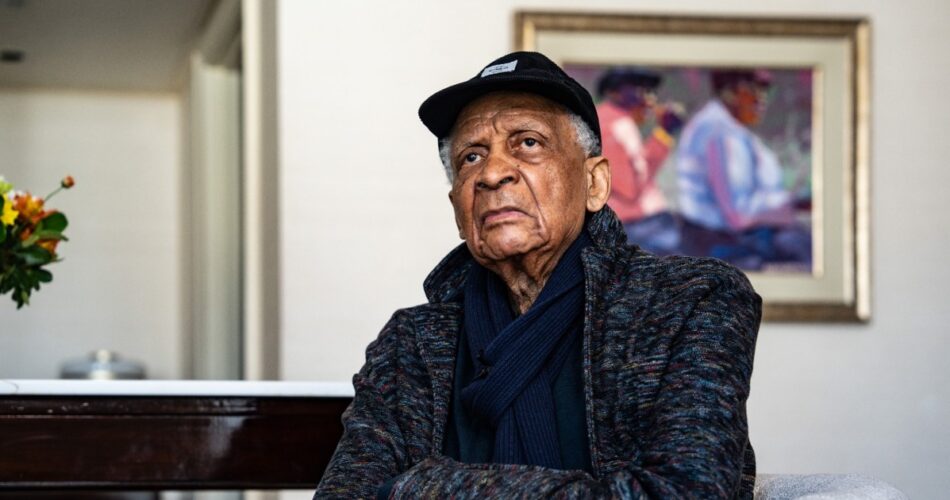
South African jazz pianist and composer Abdullah Ibrahim has died.
After performing for more than seven and a half decades, the master musician passed away on Monday, June 15, 2026.
He was 91 years old.
Born on 9 October 1934 in Kensington, Cape Town, he was baptized Adolf Johannes Brand.
This was the same year that the then Union of South Africa declared itself a sovereign independent state, officially removing any legislative power of the British Parliament over South Africa.
In an exclusive interview with Cape Talk's Lester Kiewit in April 2024, Ibrahim explained why he was given this name.
“My ID card says Adolf Johannes Brand, where did I get this name? Adolf Johannes Brand? It's not me, my name is Senzo, my father is Mosotho. Where did I get this name, Adolf Johannes Brand? It was grandmother who gave me this identity so that I could move easily.”
A master pianist, he began lessons at the age of seven with his grandmother Margaret, who was pianist at the AME Church in Kensington.
His mother, Rachel, led the choir. His father, whom he learned only later, was a Mosotho man who was murdered.
At the age of 15, Ibrahim began performing as a singer before taking up piano with big bands such as the Tuxedo Slickers and the Willie Max Orchestra.
According to his web-based biography, he was exposed to various styles of music during his upbringing, including African Khoi-San songs, gospel, Cape Carnival or Klops music, American jazz, township jive, Cape Malay music, and classical music.
He attended Trafalgar High School, located in the heart of District Six, a mixed-race suburb known for its vibrant community, diverse cultures, and music.
But in 1966, under the Group Areas Act, District Six was declared a “whites only” area and demolition began.
In the exclusive interview, Ibrahim said that her high school English teacher's advice to write compositions based on what she knew best was like a “springboard” for her work.
“So, what I know best is my family, my friends, the people around me, the story of where I grew up, the history of Cape Town.”
When he was refused admission to the College of Music at the University of Cape Town because of his race, he decided to study on his own.
He read everything he could in the local public library and listened to the latest jazz records from American soldiers stationed in Cape Town during World War II.
This is how they got the nickname “Dollar Brand”.
Ibrahim learned to play various styles of music during his youth and became popular in the jazz circles of Cape Town and Johannesburg.
In 1958, he formed the Dollar Brand Trio, which included Johnny Gertz on bass and Makaya Ntshoko on drums.
He played a unique blend of bebop with a distinctive Cape Town flavour.
This was an important part of his early career.
A year later, he played with a group called the Jazz Epistles with saxophonist Kippy Moeketsi, trumpeter Hugh Masekela, trombonist Jonas Gwangwa, bassist Johnny Gertz and drummer Makaya Ntshoko.
He recorded South Africa's first jazz album just before the Sharpeville massacre of 1960.
The same year, he met singer Sathima B Benjamin and performed with her for the first time.
Six years later, they got married.
In 1962, he left the country for Zurich and was later joined by fellow Dollar Brand Trio members Johnny Gertz and Makaya Ntshoko.
It was here in 1963 that his wife persuaded Duke Ellington to hear him play.
This led to a recording session in Paris and invitations to several concerts.
In 1965, he moved to New York, making appearances at the Newport Jazz Festival and Carnegie Hall. A year later, he was called to replace Ellington as leader of the orchestra.
The following year, he received a Rockefeller Foundation grant to attend the Juilliard School of Music.
In 1968, he returned to Cape Town in search of spiritual harmony, converted to Islam and changed his name to Abdullah Ibrahim.
During his 2024 interview, Ibrahim reminisced about Table Mountain as he laid eyes on the iconic natural wonder for the first time in five years.
“As a young man I spent hours and hours, days and nights, on this mountain, I wrote compositions and songs about it.”
In the early 1970s, he met the late Rashid Wally at his record shop in Johannesburg, and Wally produced two of Ibrahim's albums.
After spending some time in Swaziland, where he started a music school, he returned to Cape Town in 1974.
In June that year, they recorded one of their most famous tracks, *Manenberg – Is Where It's Happening*, which became the unofficial national anthem for Black South Africans.
During the 2024 interview, Ibrahim shared a memory of how the track, recorded in a studio on Cape Town's Bloom Street, came together after several days of jamming.
“We say no to the instrument, we're going to play you now, I ask the instrument, what do you have? Give it to me. And he said, *sings the note* That's what the instrument said. So, we called everyone together and we said *mumbles* 'Okay Basil, *sings the note* Okay now what's the bridge? *sings the note* … there we go.'”
The 14-minute composition is one of the most iconic pieces of music in South Africa and is often praised as an anti-apartheid anthem.
Ibrahim was often referred to as the “Liszt” of South African jazz piano due to his prolific musical ability and his 90-minute solo performances without pause.
He is also quoted as saying that some of his works were smuggled to Robben Island by Nelson Mandela's lawyer and that when Mandela heard this composition, he said that liberation was near.
Following the Soweto student uprising in 1976, Ibrahim organized an illegal benefit concert for the African National Congress.
Shortly thereafter, he and his family returned to New York.
There, he performed in a concert in Central Park in celebration of Nelson Mandela's 70th birthday in 1988.
In 1990, after Mandela was released from prison, he invited Ibrahim to return to South Africa.
In 1994, Ibrahim performed at Mandela's inauguration as President.
including some of his works Manenberg, Soweto, The Wedding, The Mountain and African Marketplace, have become classics and their catalog is believed to number over 300 albums.
“It's an ongoing narrative, an exploration of what we have to offer to our communities near and far, so I've been given this task to do it through what we call music.”
He also received several accolades, including a South African Lifetime Achievement Award from the SA Recording Industry and the title of Best Male Artist for his album. senzoHonorary Doctorate of Music from Wits University and the Order of Ikhamanga.
Ibrahim also wrote film scores for several productions including the award-winning Chocolate.
Closing the Cape Town concert in April 2024, he silenced the crowd before leaving the stage to thunderous applause.