
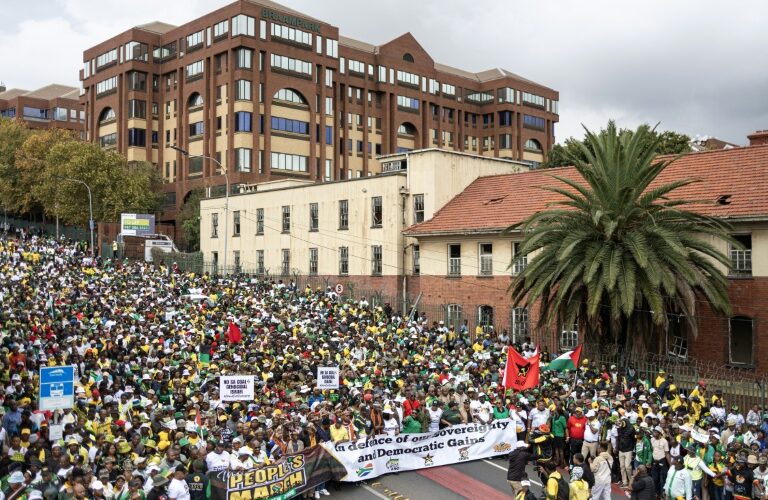
Thousands of South Africans marched on Saturday to demand respect for their country's sovereignty after months of pressure from US President Donald Trump on issues ranging from trade to race relations.
Trump has repeatedly clashed with South Africa's government, imposing high tariffs on the country, denouncing President Cyril Ramaphosa in the Oval Office over discredited claims of “white genocide”, and boycotting last year's G20 summit in Johannesburg.
Marking Human Rights Day in South Africa – the anniversary of the 1960 Sharpeville massacre, when apartheid police opened fire on a crowd of black protesters – Ramaphosa's party called for a march “in defense of our sovereignty and democratic gains”.
“We want to defend our country,” said protester Siyanda Moloi, a 34-year-old construction worker.
“I think they'll get the message. You have to respect our president, our laws, our policies.”
A group of ANC marchers in green and yellow took to the streets in the financial capital Johannesburg, some in T-shirts with messages such as “We will not be intimidated”.
Another march was planned in another city, Cape Town, later in the day.
“The principle of national sovereignty is under attack by foreign and domestic forces,” Ramaphosa's party, the African National Congress (ANC), said in a manifesto organizing the rallies.
The march came 10 days after South Africa summoned US Ambassador Brent Bozell for “undiplomatic comments” just a month after his arrival in the country.
The ambassador said it was hate speech for black South Africans to use the controversial apartheid-era chant, “Kill the Boer” – a term for the country's white African population.
“I don't care what your courts say, this is hate speech,” Bozell said in his first public comments in South Africa.
– 'They hate us' –
The Trump administration has also clashed with Ramaphosa's government over South Africa taking US ally Israel to the International Court of Justice for allegedly committing genocide in its war in Gaza.
Last year, Trump imposed 30 percent tariffs on most South African exports – the highest for sub-Saharan Africa.
The US Supreme Court recently rejected Trump's tariff policy.
But South Africa is among 60 countries facing a US trade investigation that could lead to further tariff increases.
“They hate us,” said protester Noxolo Scomolo, a 53-year-old real-estate agent.
“We are protecting our Constitution. We don't want them to threaten us. This is our land and our country.”
Trump has also criticized South Africa's racial justice policies, designed to address historical inequalities left by the legacy of colonial rule and apartheid – but the US leader has slammed as discriminatory against whites.
The call for the march condemned the “serious attack” on those policies.
Without naming the United States, it said, “Countries are being lied about to justify punitive economic measures and direct foreign interference in domestic politics.”
March 21 marks the anniversary of the massacre in Sharpeville, south of Johannesburg, where at least 69 people were killed by security forces after demanding an end to laws restricting the movement of black people under white-minority rule.
CLV/ZHB/RMB