
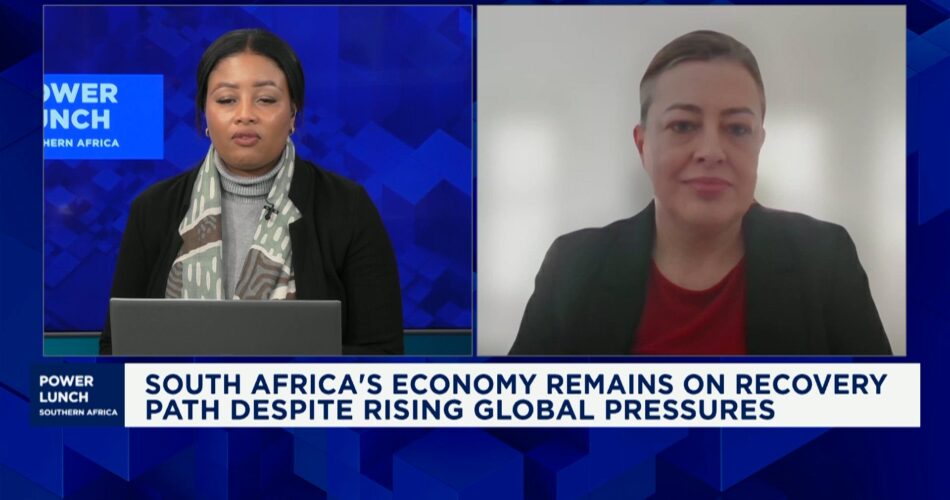
South Africa's economy is expected to remain on a recovery path in the second half of 2026, but the pace of that rebound is slowing due to high inflation, elevated interest rates and rising geopolitical risks, according to Lulu Kruger, chief economist at PwC South Africa.
Speaking in a television interview on the outlook for the economy, Kruger said PwC's base case points to economic growth of about 1.1% this year, with a best-case scenario of about 1.3%. That would leave South Africa well below the strong growth expectations seen at the start of the year, when economists and policymakers were forecasting growth closer to 1.6% or even 2%.
The comments underline how rapidly the macroeconomic picture has changed for Africa's most industrialized economy. By early 2026, the outlook had appeared more constructive, supported by signs of deceleration in inflation, decline in government debt levels and gradual stabilization of domestic conditions. But renewed global uncertainty has complicated that picture.
“Everything was looking much better for the South African economy”, Kruger said, adding that global instability had effectively “put a halt to operations.”
A major concern is the impact of external cost shocks, particularly energy prices, on the country. Although motorists are likely to benefit from lower fuel prices in the near term, Kruger cautioned that the inflation damage from the earlier increase has not disappeared. Fuel costs have begun to decline, but they remain above levels seen at the beginning of the year, and so-called second-round effects are still expected to filter through to the broader economy.
This means transportation costs, input prices and consumer-facing expenses could continue to be under pressure, even if oil prices retreat from recent highs. For businesses and households, this creates a more difficult environment as the economy tries to build on a fragile recovery.
PwC's base case currently sees year-end inflation at around 4.3%, with risks tilted towards a 4.5% outcome if second-round price effects intensify. These estimates are broadly in line with market expectations of rising inflation and reinforce the view that the South African Reserve Bank is unlikely to rush into monetary policy easing.
Kruger said the central bank's next decisions will largely depend on whether the recent recovery in fuel prices proves sustainable and whether the rand remains resilient. If policymakers are confident that oil prices will remain under control and imported inflationary pressures will not worsen, they may opt to keep rates steady rather than resuming rate tightening. But even in that scenario, borrowing costs are likely to remain high over the long term.
“The Reserve Bank is sitting with a very high level of uncertainty,” Kruger said, pointing specifically to unresolved geopolitical tensions and the uncertain sustainability of developments in the Middle East. As long as these risks remain present, the central bank will take a wait-and-see approach, he said.
This suggests that any meaningful discussion of interest rate cuts has been pushed back to 2027 unless there is a sharp and sustained improvement in the inflation outlook. For consumers and companies already struggling with expensive debt, the prospect of higher rates threatens to further limit demand and investment.
Kruger also offered a mixed assessment of the region's performance. He said the first-quarter GDP data should be viewed with caution as it effectively captured conditions “just before the storm”, with many of the recent global and cost-related pressures not yet fully reflected in the numbers.
Looking ahead, construction is one of the sectors where PwC sees relative promise. After years of pressure, the sector could benefit from a recovery in capital spending and government-led investment, both of which are driven by long-term planning and are less likely to reverse suddenly.
In contrast, consumer facing sectors remain vulnerable. Higher fuel costs and lingering inflation are putting pressure on households, potentially eroding recent gains in consumer spending. Transport-related sectors also face stress due to their sensitivity to energy prices. Manufacturing indicators have shown some improvement, but Kruger suggested part of that may reflect businesses building inventory amid uncertainty rather than a clear, sustained demand improvement.
Financial services and the broader services sector remain in relatively good shape, he said, providing an important foundation for the economy. Still, these are not areas where PwC expects tremendous growth in the near term.
Kruger said that on the positive side, South Africa is entering this more difficult period with a somewhat stronger fiscal and financial position than in previous years. Government debt dynamics have improved, rating agencies have become somewhat more constructive, and policymakers have a track record of trying to restore stability in public finances.
However, this progress does not protect the economy from global shocks. The main downside risks remain external: another rise in oil prices, renewed inflation pressures, weak global growth, soft demand from export markets and the possibility of new tariffs or trade disruption.
In Kruger's assessment, South Africa has made progress in “getting our house in order”, but the country's near-term fortunes will depend largely on factors beyond its control.
For now, that leaves the economy in a delicate balancing act. Growth has not stalled, inflation is no longer rising and fiscal credibility has improved. But the recovery remains modest and weak, and the second half of 2026 is shaping up to test whether South Africa can maintain stability in an increasingly hostile global environment.