
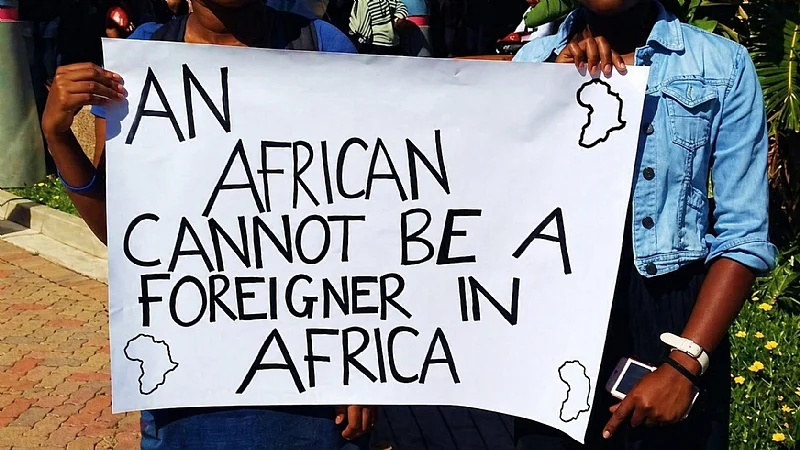
A video is going viral. A Ghanaian man surrounded by fifteen people on a street in KwaZulu-Natal has been asked to prove he is in South Africa. He explains that he left his passport at home because it was raining and he was afraid the document would get wet. They dismissed him. Someone tells him to keep quiet. Another voice tells him to go and fix his country.
That footage circulated on social media this week lit a diplomatic firestorm between Accra and Pretoria. Ghana's Minister of Foreign Affairs, Samuel Okudzeto Ablakwa, summoned the Acting High Commissioner to South Africa. A Ghanaian lawyer was confronted separately and ordered to prove his legal status before being released. In the Eastern Cape, mobs vandalized shops, homes and cars of foreigners, with reports that the attackers also entered hospitals to expel foreign nationals seeking treatment.
These are not scenes of imagination. It is April 2026, on the continent that keeps talking about Pan-Africanism, borderless Africa and shared destiny.
disgrace in history
There is something particularly bitter about Ghana bearing the brunt of this. When apartheid embraced South Africa, Ghana, under Nkrumah's leadership, had already established itself as the heartbeat of African liberation. Accra was a sanctuary. Pan-Africanism was not then the subject of the conference. This was a policy. Ghana bled for the idea that Africa takes care of itself.
Ablakwa reminded Pretoria of exactly that history. He described the attacks as “naked hatred” and “baseless xenophobia” and stressed that attacking law-abiding Africans was a betrayal of everything the continent's founding fathers stood for. South Africa knows this history. Which makes it all the more difficult to explain the silence on its streets, the inaction of its police and the aggression of its mobs.
what's really happening on the ground
Prince Kontonki, a resident of Ghana in South Africa, said the current violence started in the Eastern Cape and has now spread. He said that in previous outbreaks, Ghanaians were largely spared. not this time. He also alleged that the South African police stood by and watched without intervening. If this is true then it is not just a failure of policing. This is collusion.
The complaints local agitators voice are familiar: foreigners stealing jobs, taking their women, selling drugs. Consider what this really means on the ground. Ghanaians in South Africa are largely running barber shops, nail salons, beauty stores and small cosmetics businesses. These are survival businesses in communities that South African formal enterprises do not bother to service. The question of who is stealing whose opportunity is more complex than who is willing to sit with the crowd on the street.
And what about South Africans abroad? Their number is in thousands in other African countries including Ghana. No one is cornering them on the wet roads. No one is raiding their workplace. Ablakwa himself assured that Ghana will not tolerate reprisals against South Africans living here. This paradox reveals something important about how far the continent's hospitality really extends.
Is South Africa inherently xenophobic?
This question makes some people uncomfortable. This still deserves a direct answer.
Research by Dr Christopher Clasen, published by Afrobarometer, paints a dire picture. In the 1995 World Values Survey, South Africa ranked as the most xenophobic nation among the 18 countries surveyed. A 1998 poll found that 72% of South Africans supported requiring foreigners to carry identity cards at all times, and 66% wanted the border fence to be electrified. By 2006, barely anything had changed. The proportion of South Africans holding favorable attitudes towards immigrants did not exceed 26%, regardless of whether the question was about Africans, Europeans or Americans, and whether the respondents themselves were black or white.
The violence in May 2008 killed 62 people and displaced 100,000. Another wave occurred in April 2015, when the Zulu monarch publicly referred to African foreigners as “lice”. Between those two incidents, 350 foreigners were executed for their alleged national origin. Every few years, the pattern repeats.
But Clasen's research also tells us some useful things. The reason for this is not cultural difference. The “symbolic threat” theory, which argues that hostility is fueled by concerns about how different foreigners look or worship, found almost no support in the South African data. In fact, xenophobia was predicted by poverty, relative deprivation, frustration with the government, and social mobilization. In plain words: those who feel poor, who feel cheated compared to their neighbors, and who believe their government has abandoned them are the most likely to point to a Ghanaian barber and call him an enemy. The system is making a scapegoat. The frustration that should be directed at the state gets redirected to the nearest visible and vulnerable group.
Crisis is looking for a villain
South Africa's official unemployment rate in the last quarter of 2025 was 31.4%. Youth unemployment was 43.8%. These numbers help explain why anti-immigrant rhetoric spreads so easily in townships. They don't justify it.
South Africa's labor crisis is rooted in weak economic growth, a broken education-to-work pipeline, decades of apartheid spatial exclusion, and a state that has consistently failed its poorest citizens. Foreign nationals did not make anything out of it. They have simply become a face on which those failures are projected.
South Africa's government has now promised a tough crackdown, with the police ministry saying those found participating in or inciting xenophobic violence will be apprehended and prosecuted. Nice words. South Africans have been hearing versions of this same statement since 2008. This process has not stopped.
The legality argument is not valid
Some South Africans raise the question of documentation and suggest that if a foreigner does not have documentation, complaints are complicated. Even accepting that argument at face value, it collapses under basic scrutiny.
If someone is in a country without the correct papers, the legitimate response is deportation through due process, controlled by the state, not a mob surrounding a person in the rain asking for his passport and telling him to go home. The moment private citizens take immigration enforcement into their own hands, they themselves become criminals, regardless of the status of the person they are confronting. Intimidation on the road does not break the law. The moment South Africa accepted that logic, anarchy got a respectable cover.
The paradox South Africa cannot overcome
South Africa presents itself on the continental stage as a leader, a champion of African integration, a country whose independence was partly paid for by solidarity with the rest of the continent. The President goes to the AU summit with beautiful speeches about One Africa.
Then the same country cannot protect a Ghanaian man walking home from the barber shop.
No nation is born hating its neighbors. But a society that has repeated the same violent patterns every few years since 1994, where surveys consistently show that about a third of the population would actively participate in actions to expel African immigrants, where the police watch and do nothing, and where the government condemns but does not stop, there is a problem in that society for which marginalized elements cannot be blamed.
The research is clear on one last point. The conditions of xenophobia, poverty, despair and perceived government indifference in South Africa have not been addressed. As long as they are there, the videos will keep coming. Another man, another wet road, another directive to fix our country.
Africa cannot defeat itself with one hand and build itself up with the other.
Alpha Osei Amoako is a teacher, school administrator and education columnist based in Accra, Ghana. He writes regularly on education, society and public affairs for ModernGhana.com, one of Ghana's leading online platforms for commentary and analysis. He also connects with a wide Ghanaian audience through social commentary on Facebook, where he addresses issues at the intersection of education, culture and national development.
Email: (email protected)
Mobile: +233208007439